


How Investors Are Reacting To Eisai (TSE:4523) Late Stage Cancer Trial Data
- Eisai recently presented a wide set of oncology data at the ESMO Congress 2026, including new Phase 3 analyses for LENVIMA based combinations in advanced renal cell carcinoma and exploratory biomarker findings in endometrial cancer.
- The breadth of these late stage results, paired with a patient advocacy survey on real world cancer experiences, gives investors a clearer view of how Eisai’s oncology pipeline design connects to actual treatment decisions and unmet needs.
- This section explores how Eisai’s late stage LENVIMA based oncology data at ESMO could shape the broader investment narrative around the business.
Scan how Eisai’s oncology push compares with other late stage healthcare pipelines by running the 10 healthcare AI stocks alongside this ESMO data story.
Eisai Investment Narrative Recap
Eisai asks you to believe that a focused neurology and oncology portfolio can support recurring earnings while it absorbs higher biologics costs and pricing scrutiny. The oncology push around LENVIMA sits alongside LEQEMBI, with both needing consistent real world uptake to justify a P/E that screens above Japanese pharma peers. The latest ESMO data does not radically change that big picture.
Near term attention still leans toward LEQEMBI IQLIK uptake, Alzheimer’s testing volumes and how quickly manufacturing and cost of sales land near guidance. The biggest operational risk remains pressure on drug pricing and margins, especially as dividends are not well covered by current earnings and free cash flow.
The ESMO 2026 presentations around LENVIMA based regimens in advanced renal cell carcinoma and biomarker work in endometrial cancer matter because they tie directly to Eisai’s oncology refocus on biomarker guided care. These readouts feed investor questions on how durable oncology revenue can be as the business targets more recurring income.
For catalysts, the LITESPARK and LEAP data sit next to Alzheimer’s drivers like LEQEMBI IQLIK and blood based diagnostics. Together they shape how diversified Eisai’s future earnings mix could look versus Alzheimer’s alone. Execution risk is practical, not abstract, from running more complex late stage trials to managing production costs on higher value therapies.
How Eisai’s ESMO Story Connects To The Numbers
For anyone tracking Eisai, the oncology data at ESMO only really lands once it is lined up against what analysts already build into their spreadsheets. The current consensus framework assumes revenue growth of 5.1% each year for the next three years, profit margins moving from 4.9% today to 7.1% in three years, and earnings climbing from ¥42.3 billion now to ¥70.2 billion by 2029. Those figures set the backdrop for how much additional weight investors might choose to put on LENVIMA based regimens and biomarker guided cancer care after the latest congress updates.
Fund managers are not staring at the ESMO deck in isolation. They are comparing it to a valuation setup where 2029 revenues are projected at ¥994.8 billion, earnings at ¥70.2 billion, and the shares on a P/E of 21.3x, versus 30.7x today and 13.9x for the broader Japanese pharmaceuticals group. Within that framework, LENVIMA’s renal cell carcinoma combinations and endometrial biomarker work feed directly into questions around whether oncology can support the margin lift analysts are building into their models, especially as biologics like LEQEMBI raise Eisai’s cost of sales ratio over the next few years.
Underlying all of this is a fair amount of disagreement. Consensus centers on ¥70.2 billion of earnings in 2029, yet the most optimistic forecast sits at ¥81.3 billion and the most cautious at ¥45.1 billion. That spread mirrors the uncertainty around how much commercial traction Eisai can ultimately achieve in both neurology and oncology, and how effectively management can manage pricing pressure while absorbing higher manufacturing costs for complex therapies.
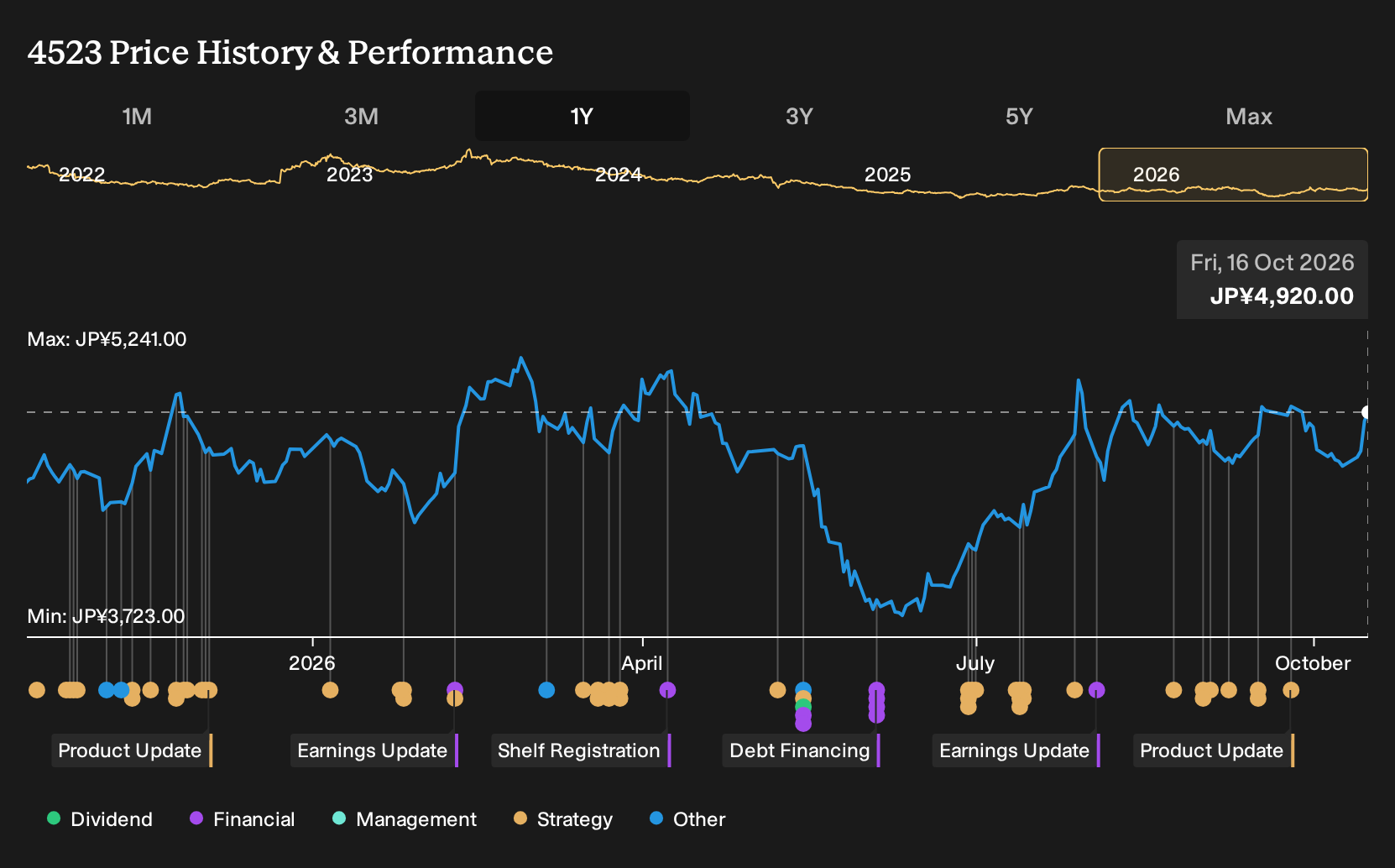
At today’s share price of ¥4,603.0, the analyst consensus target of ¥4,582.14 is only 0.5% lower, which indicates that the market is broadly aligned with the current story. ESMO data on LENVIMA based regimens, and any future readouts in biomarker heavy oncology indications, become the sort of incremental evidence that can shift investors between the bearish and bullish ends of that range, rather than rewrite the whole Eisai thesis overnight.
Eisai's current analyst framework points to revenues of ¥994.8 billion and earnings of ¥70.2 billion by 2029, which aligns with a projected 5.1% annual revenue growth rate and implies an earnings increase of about ¥27.9 billion from ¥42.3 billion today.
Uncover why Eisai's fair value indicates a 7% potential downside to its current price, suggesting that this premium may not hold.
Exploring Other Perspectives
One catalyst that bullish analysts highlight is Eisai’s plan to reach about ¥1,170.9 billion of revenue and ¥81.2 billion of earnings by 2029, compared with the consensus view of ¥994.8 billion and ¥70.2 billion. You see a much more optimistic story there. The fresh ESMO oncology data could shift both narratives once models are updated.
Explore 2 other Eisai fair value estimates, including one that suggests as much as 13% upside from the current price.
The Verdict Is Yours
Don't just follow the ticker; dig into the data and build a conviction that's truly your own.
- A great starting point for your Eisai research is our analysis highlighting 2 key rewards and 1 important warning sign that could impact your investment decision.
- See our latest analysis for Eisai. The report includes a comprehensive fundamental analysis summarized in a single visual, the Snowflake, making it easy to evaluate Eisai's overall financial health at a glance.
Looking For More Eisai Adjacent Investment Ideas?
If this Eisai deep dive has sharpened your view on neurology and oncology, it can help to line that thinking up against other opportunities. The Simply Wall St Screener lets you filter for different qualities so you can build a watchlist that matches your own risk and income preferences.
- If you care most about quality at a reasonable entry point, scan a curated set of companies with strong fundamentals through the 73 high quality undiscovered gems.
- For investors who prioritize resilience and steadier profiles, filter for businesses with lower risk characteristics using the 22 resilient stocks with low risk scores.
- If balance sheet strength is non negotiable for you, sort for companies with robust finances and solid metrics via the list of solid balance sheet and fundamentals (21 results).
This article by Simply Wall St is general in nature. We provide commentary based on historical data and analyst forecasts only using an unbiased methodology and our articles are not intended to be financial advice. It does not constitute a recommendation to buy or sell any stock, and does not take account of your objectives, or your financial situation. We aim to bring you long-term focused analysis driven by fundamental data. Note that our analysis may not factor in the latest price-sensitive company announcements or qualitative material. Simply Wall St has no position in any stocks mentioned.
Have feedback on this article? Concerned about the content? Get in touch with us directly. Alternatively, email editorial-team@simplywallst.com