


Here’s Why Cathie Wood Just Bet $12.1M on Archer Aviation Stock
Putting millions of dollars behind a company that hasn’t been commercially successful yet will seem like a risky move to many. But contrarian investor Cathie Wood has built her strategy around identifying growth opportunities before they reach maturity, often buying when volatility and negative sentiment weigh on share prices.
ARK Invest’s recent purchase of $12 million worth of Archer Aviation (ACHR) stock reflects this strategy. Currently valued at a market cap of $3.6 billion, the opportunity is enormous if the company can make electric air taxis commercially successful. The risks, however, are just as real.
Is Archer Aviation stock worth buying after Cathie Wood's move?
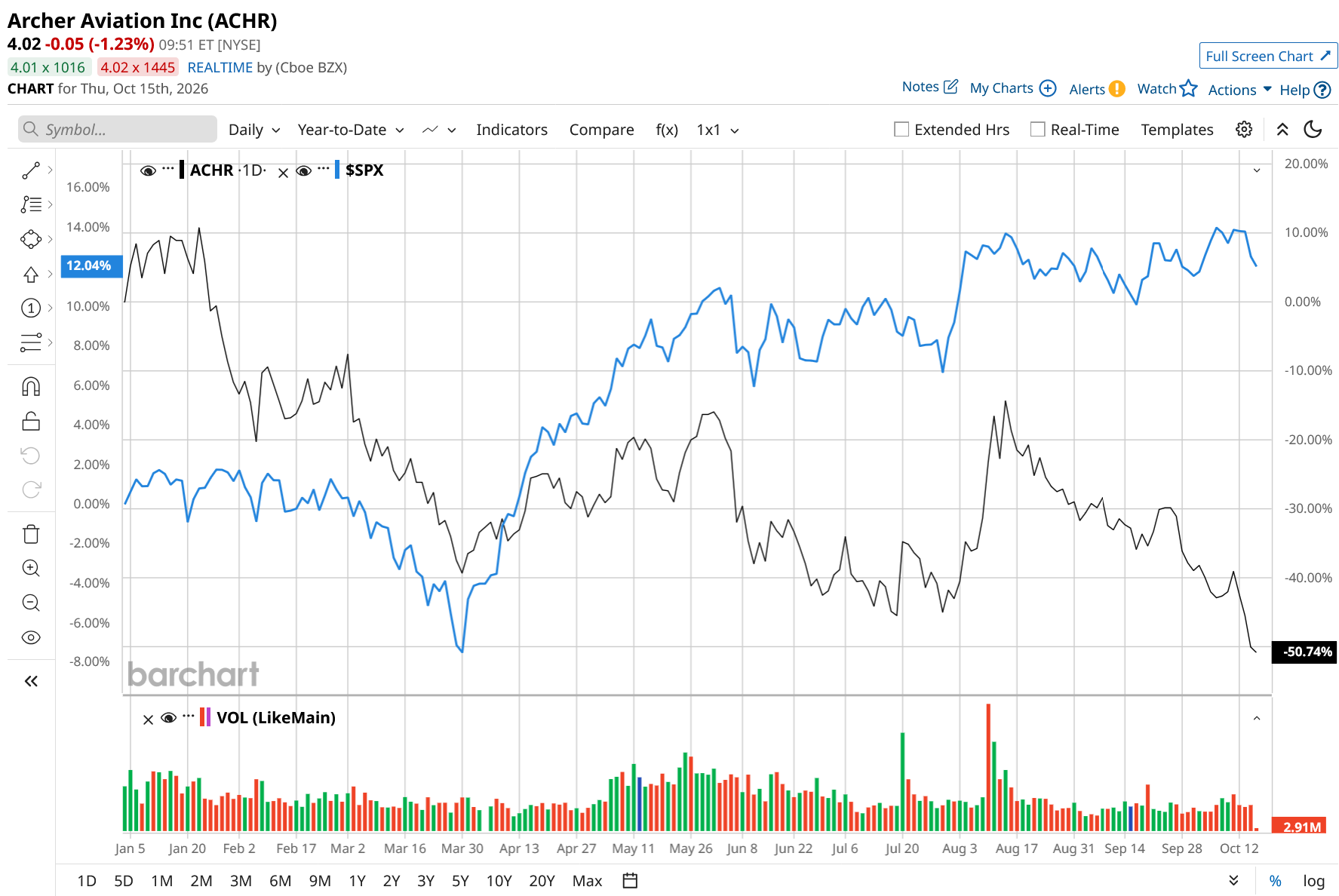
Cathie Wood Pours $12.1 Million into Archer Aviation
On Oct. 4, Wood’s Ark Innovation, Autonomous Technology & Robotics ETF (ARKQ) and Ark Space Exploration & Innovation ETF (ARKX) purchased 2,566,731 Archer Aviation shares worth roughly $12.1 million based on that day's closing price. It carries a total weightage of 2.88% in the overall ARK portfolio.
The timing isn’t surprising. This year has been hard for electric vertical takeoff and landing (eVTOL) stocks, as investors have started weighing the distance between promising aircraft technology and a profitable transportation business. Archer Aviation stock has plunged 26% in the past month alone and is down 46% year-to-date (YTD). For Cathie Wood, however, pullbacks, as these in high-growth stocks, represent attractive entry points. But buying into a company whose commercial success remains uncertain is also a risk. However, a $12 million commitment signals that ARK is willing to accept that risk and increase exposure to the emerging electric aviation industry despite mounting market skepticism.
Archer Is Trying to Build an Entirely New Aviation Business
Archer's commercial ambition centers on Midnight, an electric aircraft designed for short trips with vertical takeoff and landing capability. The business model involves moving passengers between locations that might otherwise require a lengthy road journey. If this service can operate safely, reliably, and at an attractive cost, it could open a new category of urban and regional transportation.
While the business model sounds simple, Archer must complete the necessary regulatory work, establish production capacity, develop operational infrastructure, and persuade customers to pay for flights. Only then can this business scale. The company is making meaningful progress. In the second quarter, the company said Midnight completed a piloted round-trip journey between Salinas Municipal Airport and Monterey Regional Airport, which took approximately nine minutes one way, compared with more than 35 minutes by car. The company is also preparing for operations under the White House's eVTOL Integration Pilot Program.
Furthermore, Midnight isn’t the only piece of its growth story. The company announced a planned deal involving Boeing's (BA) Wisk Aero, Insitu, and SkyGrid businesses, with the goal of building a broader aerospace and defense platform. The deal, when completed and integrated, could give Archer more ways to generate revenue than passenger air taxis alone. It has introduced Thunder for defense applications and Halo for commercial use.
A company that can develop technology for commercial aviation, defense, and autonomous flight may have more opportunities to monetize. However, diversification at this early stage creates a much more complicated business, especially for a company that hasn’t seen commercial success yet. In the second quarter, revenue reached $5.0 million, up from $1.6 million in the first quarter. However, net loss stood at $263.2 million. While revenue is growing from a tiny base, the cost of developing, testing, and preparing aircraft for commercial service remains substantial. It ended the quarter with $1.56 billion in cash, cash equivalents, and short-term investments, plus $7.3 million in restricted cash.
Aircraft development, certification, manufacturing, and infrastructure require significant investment before revenue can scale. If commercialization takes longer than expected, the company could face additional funding needs, which could weigh on the balance sheet.
Is ACHR Stock Worth Buying After Cathie Wood's Move?
Now coming back to this question, while Wood's $12.1 million purchase puts Archer back on investors' radar, this alone is not a reason to buy the stock. ARK is betting on a potential transformation in aviation, with opportunities spanning electric passenger flights, autonomous technology, and defense applications.
The road to commercial success, however, remains uncertain. Certification delays, elevated operating expenses, weaker-than-expected demand, and additional financing needs could all weigh on Archer’s progress. Archer's Q2 results indicate that the company is still far from generating the revenue needed to cover its expenses.
Therefore, the risks are equally high, which ARK is willing to accept. For investors, Archer remains a high-risk, long-term growth opportunity rather than a proven aviation business.
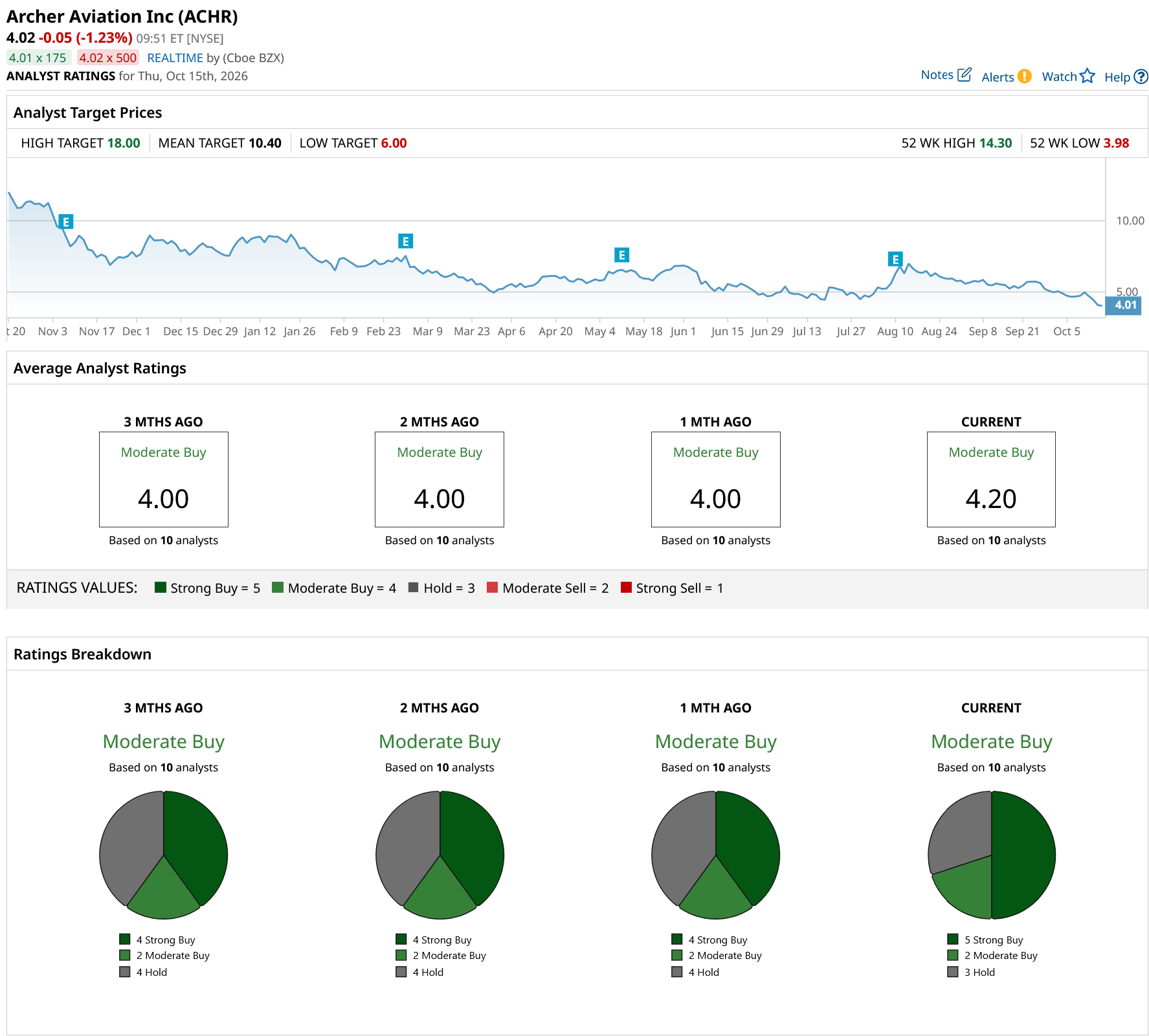
Overall, Wall Street believes Archer Aviation stock is a “Moderate Buy.” Among the 10 analysts covering the stock, five rate it a “Strong Buy,” two say it is a “Moderate Buy,” and three rate it a “Hold.” The average target price of $10.40 is 159% above current levels. Plus, its Street-high estimate of $18 suggests the stock can rally around 348% over the next 12 months.
On the date of publication, Sushree Mohanty did not have (either directly or indirectly) positions in any of the securities mentioned in this article. All information and data in this article is solely for informational purposes. For more information please view the Barchart Disclosure Policy here.