


AI Platform Upgrade Might Change The Case For GitLab Stock
- GitLab Inc. recently rolled out new governed software factory features, including Artifact Central, Dependency Firewall, Secrets Manager, and expanded AI-driven Duo Agent Platform capabilities across security, automation, and policy control.
- The combination of a single control plane for code, artifacts, dependencies, and secrets, together with Anthropic Claude integration, tightens GitLab’s pitch as an all-in-one DevSecOps and AI automation hub for large enterprises seeking stricter governance and cost visibility.
- The next step is to see how GitLab’s Artifact Central and broader governed software factory push feed into the existing investment narrative.
GitLab Investment Narrative Recap
To own GitLab, you need to believe a single, tightly governed DevSecOps and AI platform can win budget against bundled rivals like GitHub and a flood of point tools, even while GitLab remains loss making and is not forecast to reach profitability over the next three years. The near term swing factor is whether AI agents and high tier plans can keep annual recurring revenue growing without relying only on existing customers.
Execution around go to market changes and hybrid seat plus usage pricing still looks like the biggest risk. The new governed software factory features help the product story and may support higher value tiers, but they do not by themselves resolve concerns around slower new logo adds, SMB softness, or the proof that AI usage will translate into durable monetization.
Among the announcements, Artifact Central looks most directly tied to GitLab’s broader investment case. It brings containers and packages into the same control plane as source code and CI pipelines, with organization wide policy set once and applied everywhere. That matters for large enterprises that want one governed system rather than stitching together registries, scanners, and policy engines from multiple providers.
For catalysts, Artifact Central and the governed software factory features are operational tools that could help GitLab argue for tool consolidation, higher tier adoption, and stickier enterprise relationships. The risk is that rivals already pitch integrated flows, and any friction in rollout, pricing, or integrations could limit how much these capabilities offset competitive pressure, slower customer additions, and the ongoing transition to a mixed seat plus usage model.
GitLab's narrative projects US$1.6b revenue and US$188.0 million earnings by 2029. That profile assumes 15.4% yearly revenue growth and an earnings swing of roughly US$241 million from a loss of US$52.7 million today to the forecast level.
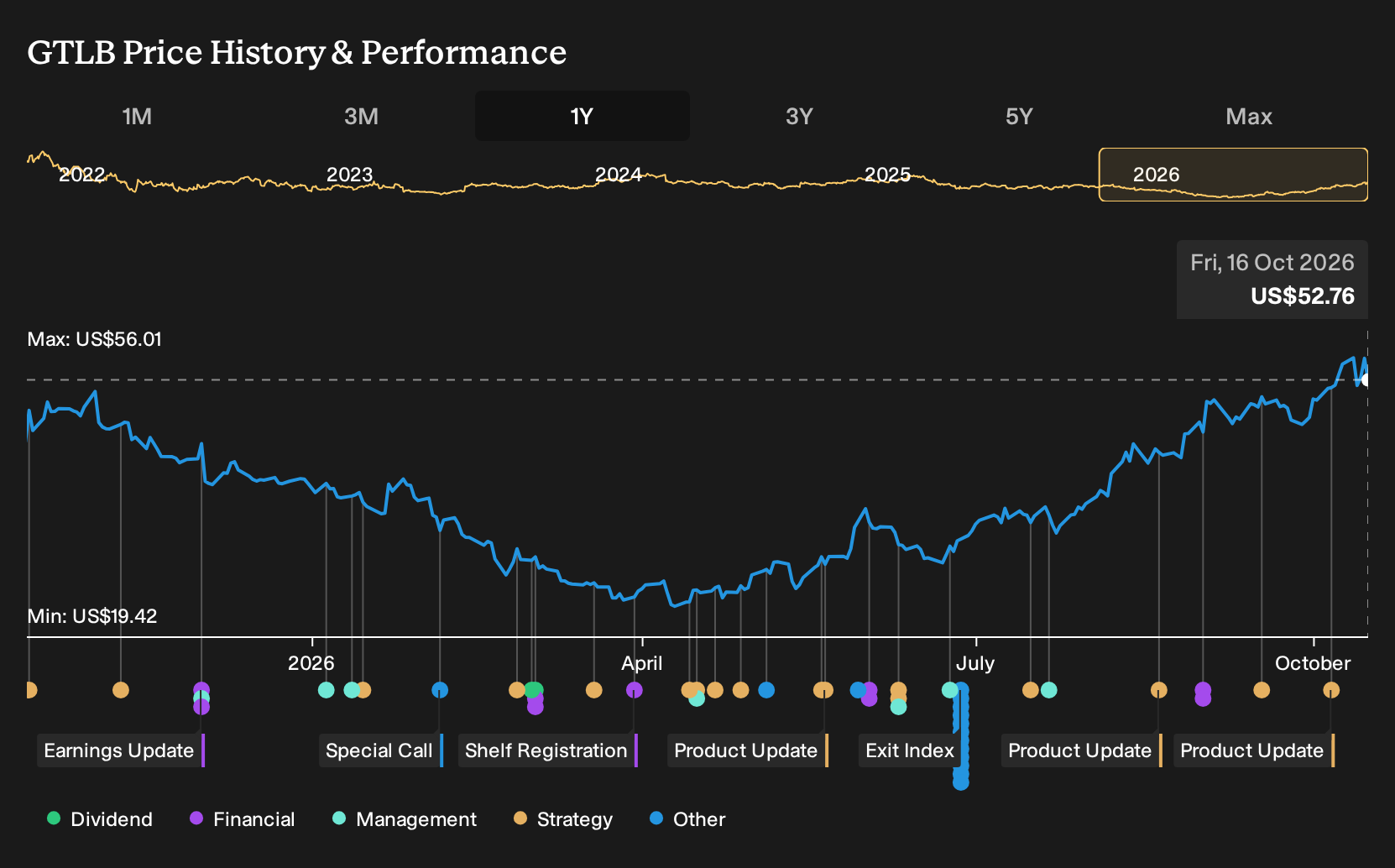
Discover how GitLab's fair value indicates a 6% potential upside to its current price, which could narrow quickly if GitLab executes on its AI and governance story.
Exploring Other Perspectives
One alternate view sees GitLab’s AI push as a double edged sword. The most bearish analysts worry that a flood of third party AI tools could weaken platform stickiness, so their earlier forecasts only assumed 14.6% annual revenue growth and about US$184.1 million earnings by 2029. Use this new governed software factory news to reassess which story you find more convincing.
Explore 3 other GitLab fair value estimates, including one that indicates as much as 15% downside from the current price.
Reach Your Own Conclusion
Disagree with existing narratives? Extraordinary investment returns rarely come from following the herd, so go with your instincts.
- A great starting point for your GitLab research is our analysis highlighting 1 key reward and 1 important warning sign that could impact your investment decision.
- See our latest analysis for GitLab. The report includes a comprehensive fundamental analysis summarized in a single visual, the Snowflake, making it easy to evaluate GitLab's overall financial health at a glance.
Looking For More Ideas Beyond GitLab?
If you want to pressure test your GitLab view against other opportunities, casting a wider net with the Simply Wall St Screener can help you see how it stacks up against different types of businesses with solid fundamentals.
- If capital preservation is high on your list, consider reviewing 32 resilient stocks with low risk scores that score well on resilience and risk controls.
- For investors focused on value and quality together, a helpful next step is to check companies in the 33 high quality undervalued stocks that pair healthy balance sheets with discounted valuations.
- If you prefer to hunt for underfollowed opportunities, you could scan the 20 high quality undiscovered gems that combine strong fundamentals with relatively low market attention.
This article by Simply Wall St is general in nature. We provide commentary based on historical data and analyst forecasts only using an unbiased methodology and our articles are not intended to be financial advice. It does not constitute a recommendation to buy or sell any stock, and does not take account of your objectives, or your financial situation. We aim to bring you long-term focused analysis driven by fundamental data. Note that our analysis may not factor in the latest price-sensitive company announcements or qualitative material. Simply Wall St has no position in any stocks mentioned.
Have feedback on this article? Concerned about the content? Get in touch with us directly. Alternatively, email editorial-team@simplywallst.com