


What DocuSign (DOCU)'s Salesforce Expansion Means For Shareholders
- In October 2026, Docusign announced an expanded partnership that brings its Intelligent Agreement Management platform directly into Salesforce, Agentforce, Slack, and related AI driven workflows.
- This deeper Salesforce integration ties Docusign into day to day sales and legal activity, which can influence agreement volume, workflow dependence, and long term platform usage.
- Attention now turns to how this deeper Salesforce integration might reshape Docusign's investment narrative around Intelligent Agreement Management execution.
DocuSign Investment Narrative Recap
To stay comfortable as a DocuSign shareholder, you need to believe the Intelligent Agreement Management pivot keeps deepening usage across larger customers while revenue growth in the high single digits remains acceptable. The Salesforce, Agentforce, and Slack integration speaks directly to that belief because it embeds DocuSign into tools where contracts already live, which can support IAM usage and stickiness.
The near term catalyst is clear execution on IAM adoption while keeping non GAAP operating margins supported, even as management has flagged some cloud migration pressure on gross margins. The biggest risk is that large enterprise and international momentum underwhelms, leaving revenue growth and agreement volumes below what current expectations imply.
The Salesforce partnership expansion is the announcement that ties closest to those catalysts. By putting DocuSign workflows directly into Salesforce, Agentforce, and Slack, the firm is aiming to make agreement creation, review, and renewals part of routine CRM and collaboration activity instead of a separate step that can fall through the cracks.
That is where the risk shows up as well. If AI agents inside Agentforce and Slack threads do not drive meaningful IAM usage, investors may keep viewing DocuSign as a slower growing e signature provider with a premium P/E and the weakest guidance profile among productivity peers. Execution around these embedded AI workflows is what will be watched most closely from here.
What The Current DocuSign Forecasts Assume
DocuSign's current analyst playbook leans heavily on Intelligent Agreement Management doing real work inside Salesforce, Agentforce, and Slack rather than sitting at the edge of the sales stack. The assumptions around that story are already baked into the consensus numbers, which gives you a concrete way to judge whether this deeper CRM integration feels ambitious or conservative.
Revenue expectations sit at a 7.9% annual growth rate over the next three years, which is the hurdle IAM needs to help clear as workflows push further into large enterprises. Profitability today is pegged at a 9.8% margin and analysts are pencilling in 14.8% in three years, so the bet is that richer agreement management use cases and AI driven workflows offset cloud migration pressure on gross margins.
Earnings are forecast to move from US$329.9 million today to US$624.4 million by about 2029, with some analysts modelling as high as US$700.9 million. That shift hinges on IAM adoption and on management keeping non GAAP operating margins supported while hosting and migration costs work through the system.
Part of the thesis around DocuSign is also about capital allocation. Consensus assumes the share count shrinks by roughly 6.68% each year for the next three years, which amplifies per share earnings if the business hits those profit targets. Analyst models use an 8.61% discount rate to pull those future cash flows back to today. This shapes how sensitive fair value is to any change in revenue growth or IAM traction.
On valuation, the numbers line up around a future P/E of 21.8x on those 2029 earnings, compared with 42.6x today and a current US Software industry P/E of 30.7x. For investors, that means the story only really holds together if DocuSign can grow into that lower multiple through higher earnings instead of relying on sentiment to keep a premium valuation in place.
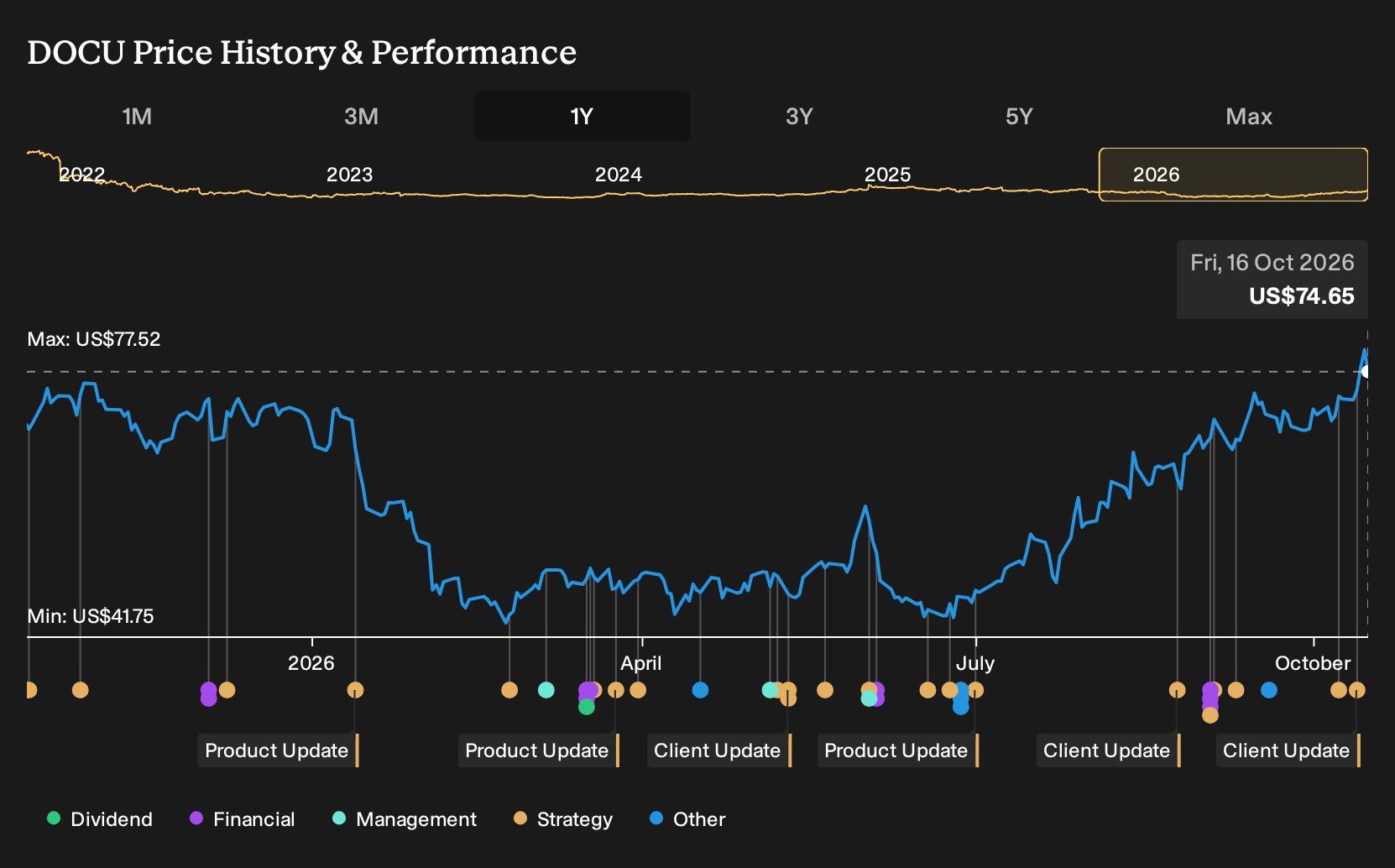
Analysts currently anchor on a US$69.99 price target, with a spread that runs from US$46.89 on the cautious end to US$86.00 on the optimistic side. With the stock at US$75.23 as of mid October 2026, the consensus target sits about 7.5% below the market price. This signals that, on average, the Street sees DocuSign as roughly fairly valued on these IAM driven forecasts.
DocuSign's narrative projects US$4.2b revenue and US$624.4 million earnings by 2029. This setup assumes 7.9% yearly revenue growth and roughly US$294.5 million earnings increase from US$329.9 million today.
Uncover why DocuSign's fair value indicates a 6% potential downside to its current price, leaving little room for error.
Exploring Other Perspectives
Some of the most optimistic DocuSign analysts lean hard into IAM acting as the agreement layer for AI agents. They were already modelling about US$4.4b in revenue and US$695.3 million in earnings by 2029 before this Salesforce news. You can read that as a far more upbeat storyline that may shift again as opinions update.
Explore 6 other DocuSign fair value estimates, including one that suggests as much as 113% upside from the current price!
Reach Your Own Conclusion
Disagree with existing narratives? Extraordinary investment returns rarely come from following the herd, so go with your instincts.
- A great starting point for your DocuSign research is our analysis highlighting 3 key rewards and 1 important warning sign that could impact your investment decision.
- See our latest analysis for DocuSign. The report includes a comprehensive fundamental analysis summarized in a single visual, the Snowflake, making it easy to evaluate DocuSign's overall financial health at a glance.
Looking For More Investment Ideas Beyond DocuSign?
If DocuSign has sharpened your interest in AI driven workflows, it can help to widen the field and compare it with other companies that fit different risk and quality profiles. The Simply Wall St Screener lets you scan the market quickly so you can see how DocuSign stacks up against a broader watchlist built around your own criteria.
- If capital preservation matters most, focus on resilience and review 32 resilient stocks with low risk scores that may help smooth out portfolio swings.
- For investors hunting for quality at a reasonable price, check out companies in the 33 high quality undervalued stocks that combine fundamentals with more modest valuation multiples.
- If you want to get ahead of the crowd, keep an eye on potential future leaders using the 20 high quality undiscovered gems that have strong underlying metrics but limited current attention.
This article by Simply Wall St is general in nature. We provide commentary based on historical data and analyst forecasts only using an unbiased methodology and our articles are not intended to be financial advice. It does not constitute a recommendation to buy or sell any stock, and does not take account of your objectives, or your financial situation. We aim to bring you long-term focused analysis driven by fundamental data. Note that our analysis may not factor in the latest price-sensitive company announcements or qualitative material. Simply Wall St has no position in any stocks mentioned.
Have feedback on this article? Concerned about the content? Get in touch with us directly. Alternatively, email editorial-team@simplywallst.com