


How New CRENESSITY Data At Neurocrine Biosciences Stock Has Changed Its Investment Story
- Neurocrine Biosciences reported new real world findings from its CAHtalyst program, showing how classic congenital adrenal hyperplasia affects patients differently over time and how CRENESSITY use relates to androgen control and glucocorticoid dosing in both children and adults.
- The fresh data set, built from the large CAHtalyst Phase 3 program and the CAHtalog registry, gives Neurocrine Biosciences more evidence to help shape CRENESSITY positioning, dosing decisions and education for endocrine teams managing this rare disease every day.
- We will now look at how Neurocrine Biosciences' broader investment narrative could be influenced by CRENESSITY's longer term CAHtalyst evidence.
Neurocrine Biosciences Investment Narrative Recap
To own Neurocrine Biosciences, you need to believe this is a durable multiproduct story, not just an INGREZZA cash cow. The thesis leans on steady INGREZZA volume, expanding CRENESSITY use in classic CAH and eventual contribution from late stage CNS assets. Fresh CAHtalyst real world data supports CRENESSITY’s clinical role, but does not materially change the near term setup.
The key near term swing factor remains how pricing and reimbursement for INGREZZA evolve as Medicare headwinds build into 2026 and 2027. The biggest risk is that required discounts prove steeper than expected, which could pressure margins just as Neurocrine Biosciences is investing heavily in VYKAT XR, CRENESSITY and psychiatry programs.
The most relevant disclosure tied to this news is the broader CAHtalyst Phase 3 package that underpinned U.S. approval of CRENESSITY in December 2024. Those adult and pediatric trials, together with the CAHtalog registry, created the clinical backbone that today’s two year data and patient journey work build on.
For investors watching catalysts, this matters because CRENESSITY is already contributing about US$184 million in quarterly revenue with an estimated 15% of the diagnosed classic CAH population treated. The richer longitudinal evidence set presented in Phoenix may support prescriber confidence and GC dose optimization, while execution risk still sits in sustaining uptake without safety, pricing or reimbursement surprises.
What The Current Neurocrine Biosciences Forecasts Assume
Analysts sketch a future where Neurocrine Biosciences scales its rare disease and CNS portfolio into a larger, higher margin operation, and the numbers behind that story are explicit. Forecasts point to revenue growth of 14.6% each year over the next three years and to profit margins moving from 20.9% today to 25.7% by 2029. Consensus earnings are pegged at US$1.3b by 2029, compared with US$705.5m in earnings today, which implies nearly a doubling of the profit pool. That jump in earnings would come with share count creeping higher at 1.95% a year, so the underlying profit expansion would need to outpace modest dilution.
On those projections, the analyst view assumes investors will accept a richer multiple for Neurocrine Biosciences. The stock would need to trade on a P/E of 21.2x 2029 earnings, up from 19.6x today and above the 17.6x P/E currently attached to the broader US biotech group. That higher valuation multiple is doing part of the lifting in the US$206.81 consensus price target, alongside the absolute earnings step up. A wide spread between the most bullish and most cautious earnings forecasts, from US$1.1b to US$2.0b, highlights how much room there is for sentiment to swing if execution on INGREZZA, CRENESSITY, VYKAT XR and the psychiatry pipeline veers away from this central case.
To align with the prevailing price targets, you would need to accept that Neurocrine Biosciences can reach US$5.1b of revenue and US$1.3b of earnings in 2029 while sustaining broader access and managing policy and safety questions. That set of assumptions underpins the current analyst narrative around the stock and frames how much of the CRENESSITY CAHtalyst upside may already be reflected in expectations.
Neurocrine Biosciences' narrative projects US$5.1b revenue and US$1.3b earnings by 2029. This rests on 14.6% yearly revenue growth and an earnings increase of about US$594.5m from US$705.5m today.
Uncover how Neurocrine Biosciences' fair value indicates a 52% potential upside to its current price before the market closes that gap.
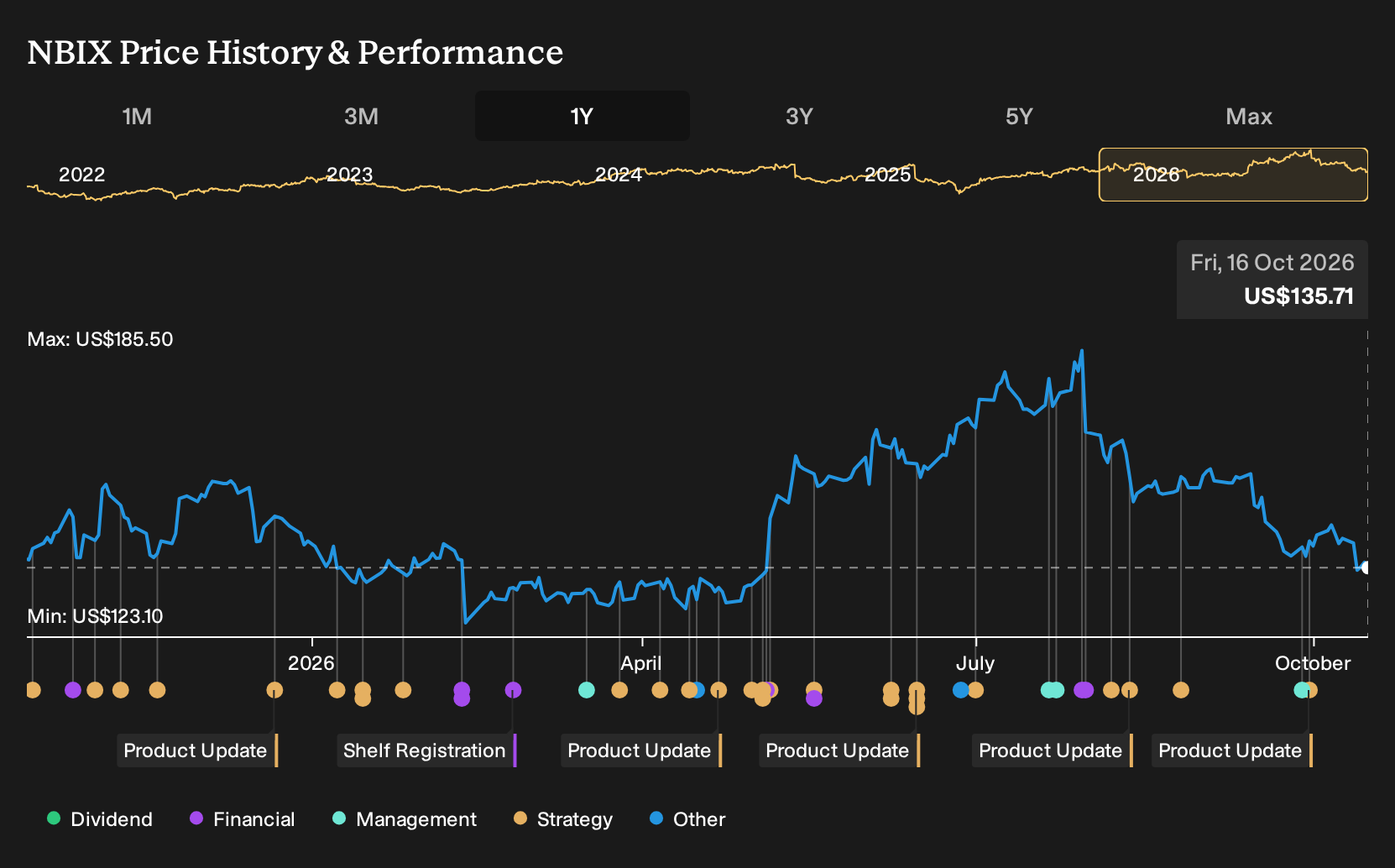
Exploring Other Perspectives
You might see the new CRENESSITY CAHtalyst data and immediately think about upside. The most cautious Neurocrine Biosciences analysts instead fixate on pricing risk. Their pre news models only pencilled in US$5.1b revenue and US$1.1b earnings by 2029, so they painted a tighter story. Use that contrast to test your own view.
Explore 2 other Neurocrine Biosciences fair value estimates, including one that suggests it could be worth just $206.81!
The Verdict Is Yours
Disagree with existing narratives? Extraordinary investment returns rarely come from following the herd, so trust your own analysis.
- A great starting point for your Neurocrine Biosciences research is our analysis highlighting 4 key rewards that could impact your investment decision.
- See our latest analysis for Neurocrine Biosciences. The report includes a comprehensive fundamental analysis summarized in a single visual, the Snowflake, making it easy to evaluate Neurocrine Biosciences' overall financial health at a glance.
Looking For More Investment Ideas Beyond Neurocrine Biosciences?
If the Neurocrine Biosciences story has sharpened your thinking about risk, reward and position sizing, use that same lens across a wider watchlist with the Simply Wall St Screener.
- For investors who want to keep downside in check, start with a set of 32 resilient stocks with low risk scores that may help you balance bolder bets like specialized biotech.
- If resilient balance sheets matter most to you, filter for companies backed by a list of solid balance sheet and fundamentals (25 results) so you can focus on businesses with financial cushions that support long term plans.
- When you are hunting for mispriced opportunities, scan a curated pool of 33 high quality undervalued stocks that combine fundamental strength with valuations the market has yet to fully reflect.
This article by Simply Wall St is general in nature. We provide commentary based on historical data and analyst forecasts only using an unbiased methodology and our articles are not intended to be financial advice. It does not constitute a recommendation to buy or sell any stock, and does not take account of your objectives, or your financial situation. We aim to bring you long-term focused analysis driven by fundamental data. Note that our analysis may not factor in the latest price-sensitive company announcements or qualitative material. Simply Wall St has no position in any stocks mentioned.
Have feedback on this article? Concerned about the content? Get in touch with us directly. Alternatively, email editorial-team@simplywallst.com