


Is FTAI Aviation (FTAI) Undervalued As Its United Airlines Engine Exchange Deal Expands?
FTAI Aviation (FTAI) hit the spotlight after announcing a multi-year Maintenance, Repair and Exchange agreement with United Airlines that replaces traditional shop visits with engine exchanges on select fleets.
For context, FTAI Aviation’s share price has retreated recently, with the 1 month share price return down 13.36% and the 3 month share price return down 20.73%. However, the 3 year total shareholder return is above 4x, which points to strong longer term momentum even as short term sentiment cools around the latest developments.
Scan other aviation and industrials plays with strong capital efficiency and asset depth using our hand picked screener: list of solid balance sheet and fundamentals (25 results)
FTAI Aviation now carries a sharp pullback after a long run of strong multi year returns. Does that reset create a reasonable entry today, or argue for patience while the valuation case firms up?
Most Popular Narrative: 26.9% Undervalued
On the most widely followed view, FTAI Aviation screens as undervalued, with a narrative fair value of $225.05 against a last close of $164.46. That gap anchors a thesis that leans heavily on engines, maintenance economics, and contract visibility rather than headline share price swings.
FTAI Aviation Ltd. is a specialized aviation platform focused on commercial jet engine ownership, maintenance, and leasing, with a growing emphasis on aftermarket aerospace products (MRE – Maintenance, Repair & Exchange). The company is undergoing a strategic pivot from capital-intensive leasing toward higher-margin, asset light aftermarket services, leveraging its expertise in mid-life narrowbody engines (CFM56, V2500).
See why 5 investors see FTAI Aviation as 27% undervalued.
According to kapirey, the narrative leans on a few concrete pillars. FTAI Aviation generated $3,112.874m of revenue and $477.636m of net income, with reported annual revenue growth of 27.87% and net income growth of 37.91%. Those figures sit alongside a value score of 3 out of 6, which tells you the valuation case is not one sided.
The same memo highlights the shift toward services and Maintenance, Repair and Exchange contracts as a core driver behind that Fair Value estimate. That shows up in the segment mix. Aerospace Products contribute $2,699.753m of revenue compared with $413.121m from Aviation Leasing, pointing to a business that now leans far more on engine work and aftermarket activity than on owning whole aircraft.
Forward looking assumptions also matter for that narrative valuation. Forecasts in the data show revenue growth of 27.9% per year and earnings growth of 37.91% per year, which both sit well above the referenced US market benchmarks of 13.5% and 17.1%. The memo treats that gap as evidence that a higher implied value can be supported by future profit expansion, even though analysts' price targets are flagged as not tightly aligned with each other.
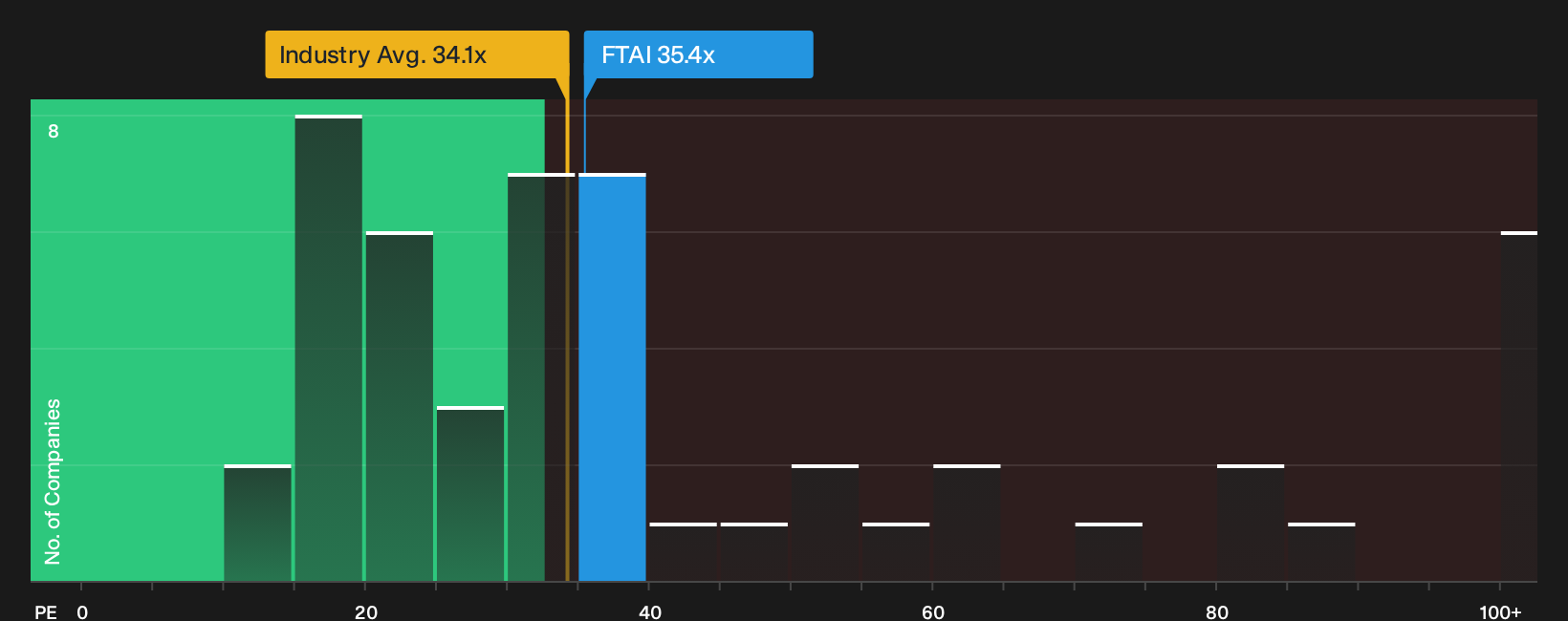
At the same time, the story is not a simple growth-at-any-price pitch. The statements data describe FTAI Aviation as expensive on a P/E of 35.4x versus peers at 21.1x and the US Aerospace & Defense industry at 34.1x. Debt is also a central part of the picture, with commentary that liabilities are fully made up of higher risk funding and that debt is not well covered by operating cash flow. The very high 122.84% Return on Equity is explicitly called out as being skewed by that leverage.
Ownership, governance and incentives are another layer of the narrative. Board independence runs at 86%, the directors' average tenure sits at 11.4 years, and management pay of $5.99m is described as below the typical level for US companies of similar size. Those points are balanced by a relatively new executive team with an average tenure of 0.7 years, which introduces execution risk around the engine focused strategy that supports the fair value work.
One final tension within the narrative is time horizon. The 1 year total shareholder return is roughly flat and characterized as lagging the broader US market, even though the 3 year and 5 year total returns are above 4x and 7x respectively. That disconnect underpins the memo's framing that recent weakness, including the pullback to $164.46, can sit alongside an internally consistent case for a Fair Value of $225.05 based on cash flows, margins, and the evolving mix toward Aerospace Products.
Result: Fair Value of $225.05 (UNDERVALUED)
Still, the whole FTAI Aviation narrative leans heavily on aging CFM56 and V2500 fleets, as well as on managing a sizeable debt load without a stumble.
Find out about the key risks to this FTAI Aviation narrative.
Another View: FTAI Aviation Through The Earnings Lens
There is a very different picture when FTAI Aviation is viewed through its P/E ratio rather than the narrative fair value. The stock trades on 35.4x earnings, compared with 21.1x for peers and 34.1x for the wider US Aerospace & Defense group, while the fair ratio sits higher at 55.2x. That spread points to investors already paying a clear premium to similar companies, even though the model suggests the market could move toward a richer multiple over time. For anyone weighing fresh capital, the question is whether that premium feels like headroom or hazard.
See what the numbers say about this price, find out in our valuation breakdown See what the numbers say about this price — find out in our valuation breakdown.
Next Steps
Sentiment around FTAI Aviation is mixed, and the window for a clear view may not stay open for long. Pressure test the upside, the downside and the balance in between by checking the 3 key rewards and 2 important warning signs.
Looking for more FTAI Aviation style investment ideas?
If you want to keep your edge, do not stop with FTAI Aviation. Use the Simply Wall Street screener to uncover fresh opportunities before the crowd catches on.
- Target stability first by scanning a 32 resilient stocks with low risk scores that prioritizes resilient balance sheets and lower volatility profiles.
- Hunt for value by comparing businesses that screen as 33 high quality undervalued stocks on both earnings power and financial strength.
- Spot early potential by reviewing a 14 elite penny stocks with strong financials that focuses on smaller companies with stronger fundamentals than their share prices might suggest.
This article by Simply Wall St is general in nature. We provide commentary based on historical data and analyst forecasts only using an unbiased methodology and our articles are not intended to be financial advice. It does not constitute a recommendation to buy or sell any stock, and does not take account of your objectives, or your financial situation. We aim to bring you long-term focused analysis driven by fundamental data. Note that our analysis may not factor in the latest price-sensitive company announcements or qualitative material. Simply Wall St has no position in any stocks mentioned.
Have feedback on this article? Concerned about the content? Get in touch with us directly. Alternatively, email editorial-team@simplywallst.com