


How Investors Are Reacting To Merck (MRK) Phase 3 Skin Cancer Data
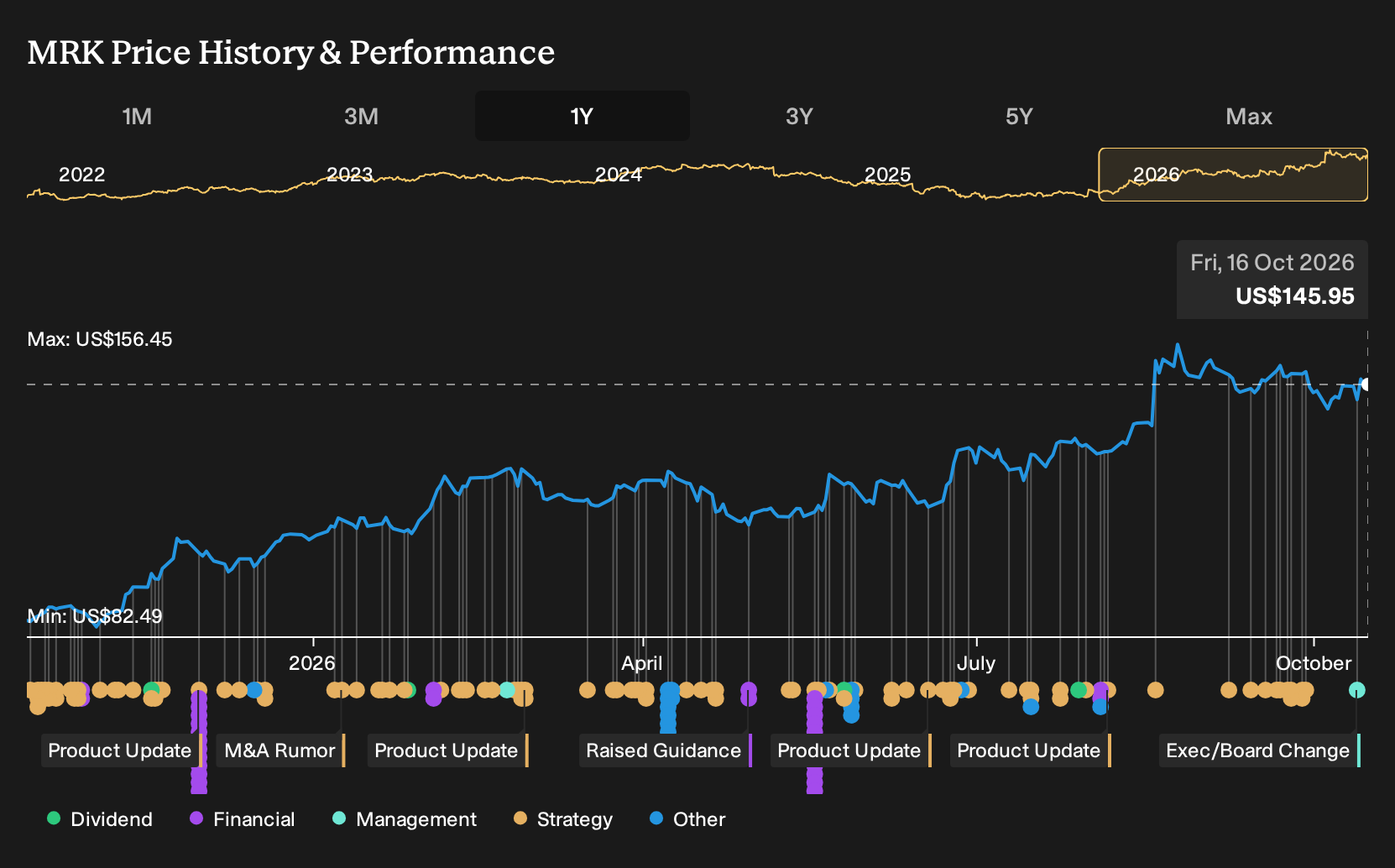
- Merck announced that Paul J. Diaz, a healthcare investor and former CEO of Myriad Genetics and Kindred Healthcare, joined its board in November 2026. At the same time, the drugmaker reported promising phase 3 data for Keytruda paired with a personalized mRNA vaccine in skin cancer and continued to highlight new product launches such as LIPFENDRA and WINREVAIR.
- The mix of oncology pipeline progress, a broader set of new therapies beyond Keytruda, and Merck’s push into areas such as single use bioprocessing systems underscores how management is working to diversify future revenue streams as loss of exclusivity and shifting product contributions reshape the business.
- We will now look at how Merck's phase 3 Keytruda plus mRNA vaccine results might influence the broader investment narrative around the stock.
Compare how Merck’s oncology pipeline and board refresh stack up against other large-cap health stocks by scanning our hand-picked 32 resilient stocks with low risk scores featuring resilient profiles and measured risk scores.
Merck Investment Narrative Recap
To own Merck, you need to be comfortable with a story that is still heavily tied to Keytruda while the company works to build out more than 20 planned growth drivers across oncology, cardiometabolic disease, HIV and other areas. The short term swing factor remains execution in late stage cancer programs and newer launches like LIPFENDRA and WINREVAIR.
The biggest risk is that Keytruda’s loss of exclusivity around 2028 to 2029 hits harder than the pipeline can absorb, especially if safety or regulatory issues limit newer products. The recent phase 3 mRNA combination data and the stock’s move as a defensive healthcare option do not fundamentally change that near term risk reward balance.
The most relevant recent development for this news is Merck’s phase 3 data showing improved survival for Keytruda combined with a personalized mRNA vaccine in skin cancer. For a shareholder, this sits right at the intersection of the Keytruda dependence problem and the oncology pipeline that needs to shoulder more of the load over time.
If that mRNA collaboration expands beyond melanoma, it could become one of the “next wave” oncology assets that help offset future Keytruda pressure alongside programs like sac TMT and intismeran. Execution risk is still real, including possible safety, reimbursement or competition issues, but the trial result gives Merck another concrete late stage asset for investors to track as a potential catalyst.
Merck's current analyst narrative points to US$75.3b in revenue and US$22.5b in earnings by 2029, based on forecast top line expansion of 4.2% a year and an earnings increase of about US$19.3b from US$3.2b today.
Uncover why Merck's fair value indicates a 7% potential upside to its current price, which could narrow quickly.
Exploring Other Perspectives
Some of the most optimistic analysts focus on a very different catalyst for Merck. They lean into the idea that pipeline execution turns Keytruda’s patent risk into a softer landing, with projected 2029 revenue around US$82.1b and earnings near US$30.2b. Those estimates and Paul Diaz joining the board were all set before this mRNA and governance news, so you may want to see how views shift as fresh data and board input filter into new forecasts.
Explore 5 other Merck fair value estimates, including one that suggests as much as 61% upside from the current price!
The Verdict Is Yours
Disagree with existing narratives? Extraordinary investment returns rarely come from following the herd, so consider conducting your own research and analysis.
- A great starting point for your Merck research is our analysis highlighting 2 key rewards and 5 important warning signs that could impact your investment decision.
- See our latest analysis for Merck. The report includes a comprehensive fundamental analysis summarized in a single visual, the Snowflake, making it easier to evaluate Merck's overall financial health at a glance.
Looking For More Ideas Beyond Merck?
Once you have formed a view on Merck, it can help to compare that thesis with other opportunities that fit different income, quality and risk preferences using the Simply Wall St Screener.
- If you want income to do more of the heavy lifting in your portfolio, scan a curated set of dependable payers through 8 dividend fortresses.
- For investors hunting for quality at a measured entry price, review a targeted universe of potential bargains in the 33 high quality undervalued stocks.
- When capital preservation is front of mind, focus your research on companies with steadier profiles using the list of solid balance sheet and fundamentals (25 results).
This article by Simply Wall St is general in nature. We provide commentary based on historical data and analyst forecasts only using an unbiased methodology and our articles are not intended to be financial advice. It does not constitute a recommendation to buy or sell any stock, and does not take account of your objectives, or your financial situation. We aim to bring you long-term focused analysis driven by fundamental data. Note that our analysis may not factor in the latest price-sensitive company announcements or qualitative material. Simply Wall St has no position in any stocks mentioned.
Have feedback on this article? Concerned about the content? Get in touch with us directly. Alternatively, email editorial-team@simplywallst.com