


Earnings Outlook Could Be A Key Test For Capital One Stock (COF)
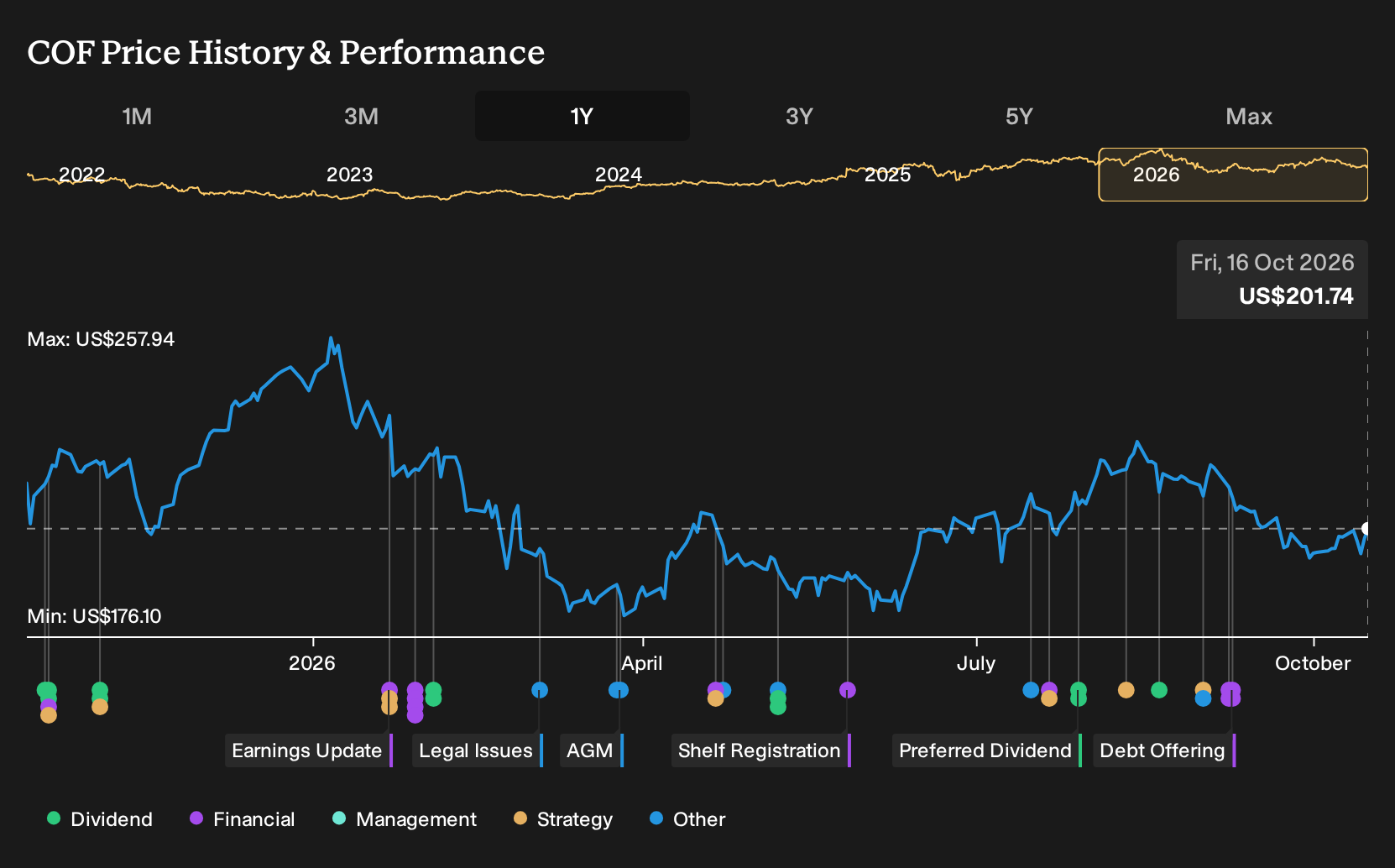
- Capital One Financial and its foundation recently named 10 finalists for a US$25m Scaling Pathways to Homeownership program, while the bank prepares to report third quarter 2026 results under fresh OCC scrutiny of its customer risk policies.
- The housing initiative and higher expected credit loss provisions both highlight how Capital One Financial is balancing community commitments with rising compliance and operating cost pressures.
- Next is an examination of how Capital One Financial's earnings outlook could be influenced by OCC scrutiny of its customer risk policies.
Capital One Financial Investment Narrative Recap
To own Capital One Financial, you need to be comfortable with a bank that leans heavily on credit cards, technology spend and the Discover deal to drive its future. The key short term swing factor is how Q3 2026 earnings and credit quality land against higher expected provisions and weaker loan demand.
The biggest current risk is a squeeze from rising operating expenses, including technology and marketing, without matching revenue progress, especially while OCC scrutiny of customer risk policies adds compliance costs. The homeownership initiative and OCC review look important for reputation and governance but do not fundamentally change the near term earnings catalyst.
The Scaling Pathways to Homeownership initiative is the clearest recent announcement linked to this story. Capital One Financial and its foundation are putting US$25m behind housing affordability, and the funding sits inside a much larger US$265b Community Benefits Plan. That is a sizable community program alongside a complex banking platform build out.
For you as a shareholder, the relevance is less about philanthropy and more about execution and scrutiny. The OCC’s focus on debanking policies sharpens attention on how Capital One applies reputation and customer risk rules. Any added compliance workload or changes to client onboarding could influence expense trends, risk appetite and, by extension, how the Discover integration and payments ecosystem plans play out.
Capital One Financial’s analyst narrative points to revenues of US$72.9b and earnings of US$14.5b by 2029. These figures are based on an assumed 14.8% yearly revenue growth rate and an earnings increase of about US$4.7b from current earnings of US$9.8b.
Uncover why Capital One Financial's fair value indicates a 25% potential upside to its current price, a gap that could narrow more quickly than many investors expect.
Exploring Other Perspectives
Some of the most optimistic analysts focus less on OCC scrutiny and more on how Capital One Financial might scale its payments ecosystem once the current investment cycle eases. Before this news, the bullish camp was modeling about US$77.9b of revenue and US$15.6b of earnings by 2029. You can use those higher expectations as a reference point and then ask how fresh regulatory and housing headlines might reshape them.
Explore 4 other Capital One Financial fair value estimates, including one that suggests as much as 59% upside from the current price!
The Verdict Is Yours
Disagree with existing narratives? Extraordinary investment returns rarely come from following the herd, so go with your instincts.
- A great starting point for your Capital One Financial research is our analysis highlighting 4 key rewards and 2 important warning signs that could impact your investment decision.
- See our latest analysis for Capital One Financial. The report includes a comprehensive fundamental analysis summarized in a single visual, the Snowflake, making it easy to evaluate Capital One Financial's overall financial health at a glance.
Looking For More Investment Ideas Beyond Capital One Financial?
If the Capital One Financial story has sharpened your sense of risk, reward and regulation, it can help to compare it against other businesses with different balance sheet strength, payout profiles and growth setups. The Simply Wall St Screener lets you quickly filter for companies that match the mix of quality, value and resilience you want, then build a watchlist that suits your own risk profile.
- Prioritise resilience and capital protection by scanning a curated set of 32 resilient stocks with low risk scores that keep overall risk scores in tighter bounds.
- If income is a focus, zero in on companies offering 8 dividend fortresses where yield and balance sheet strength work together rather than pulling in opposite directions.
- For investors hunting for tomorrow's leaders before the crowd pays attention, start with a focused pool of 20 high quality undiscovered gems that pair solid fundamentals with lower market attention.
This article by Simply Wall St is general in nature. We provide commentary based on historical data and analyst forecasts only using an unbiased methodology and our articles are not intended to be financial advice. It does not constitute a recommendation to buy or sell any stock, and does not take account of your objectives, or your financial situation. We aim to bring you long-term focused analysis driven by fundamental data. Note that our analysis may not factor in the latest price-sensitive company announcements or qualitative material. Simply Wall St has no position in any stocks mentioned.
Have feedback on this article? Concerned about the content? Get in touch with us directly. Alternatively, email editorial-team@simplywallst.com