


How Lowered Earnings Guidance Will Impact Delta Stock Investors
- Delta Air Lines reported third quarter 2026 revenue of US$20.2b with net income of US$756m, and lowered full year earnings guidance as rising fuel and operating costs pressured profitability despite solid travel demand.
- The airline is leaning into higher margin premium products such as Delta One upgrades and diversified revenue streams to offset cost headwinds, while earnings per share guidance for 2026 now sits at US$5.10 to US$5.60.
- Next, the focus shifts to how Delta Air Lines' cost pressure and trimmed earnings outlook could reshape the existing investment narrative.
Compare Delta Air Lines' earnings reset with peers by scanning a curated group of 33 high quality undervalued stocks that pair stronger balance sheets with disciplined cost control.
Delta Air Lines Investment Narrative Recap
For Delta Air Lines, the core belief is that premium, loyalty and international revenue can carry more of the profit load while fuel and other costs stay under tighter control. The latest quarter tests that view. Revenue reached US$20.2b but net income fell to US$756m, so the most important near term catalyst now is evidence that cost pressure can stabilise.
The biggest risk is that very high fuel and operating expenses persist while domestic Main Cabin demand softens or discount carriers get more aggressive on price. The earnings guidance cut makes that risk more visible but does not fundamentally change the idea that Delta needs premium and diversified revenue to do more work.
The clearest announcement tied to this story is Delta Air Lines' updated outlook for the fourth quarter and full year 2026. Management now expects US$5.10 to US$5.60 in EPS for the year, with Q4 revenue growth of about 20% and a 7% to 9% operating margin. This helps frame how much cost inflation the operation is absorbing.
For you as an investor, that guidance is a practical reference point for near term catalysts and risks. Delivery against the 7% to 9% margin range would indicate that premium cabins, loyalty and the refinery benefit are offsetting fuel and non fuel expense pressure. Falling short would highlight how sensitive the business remains to fuel spikes and any wobble in Main Cabin or corporate demand.
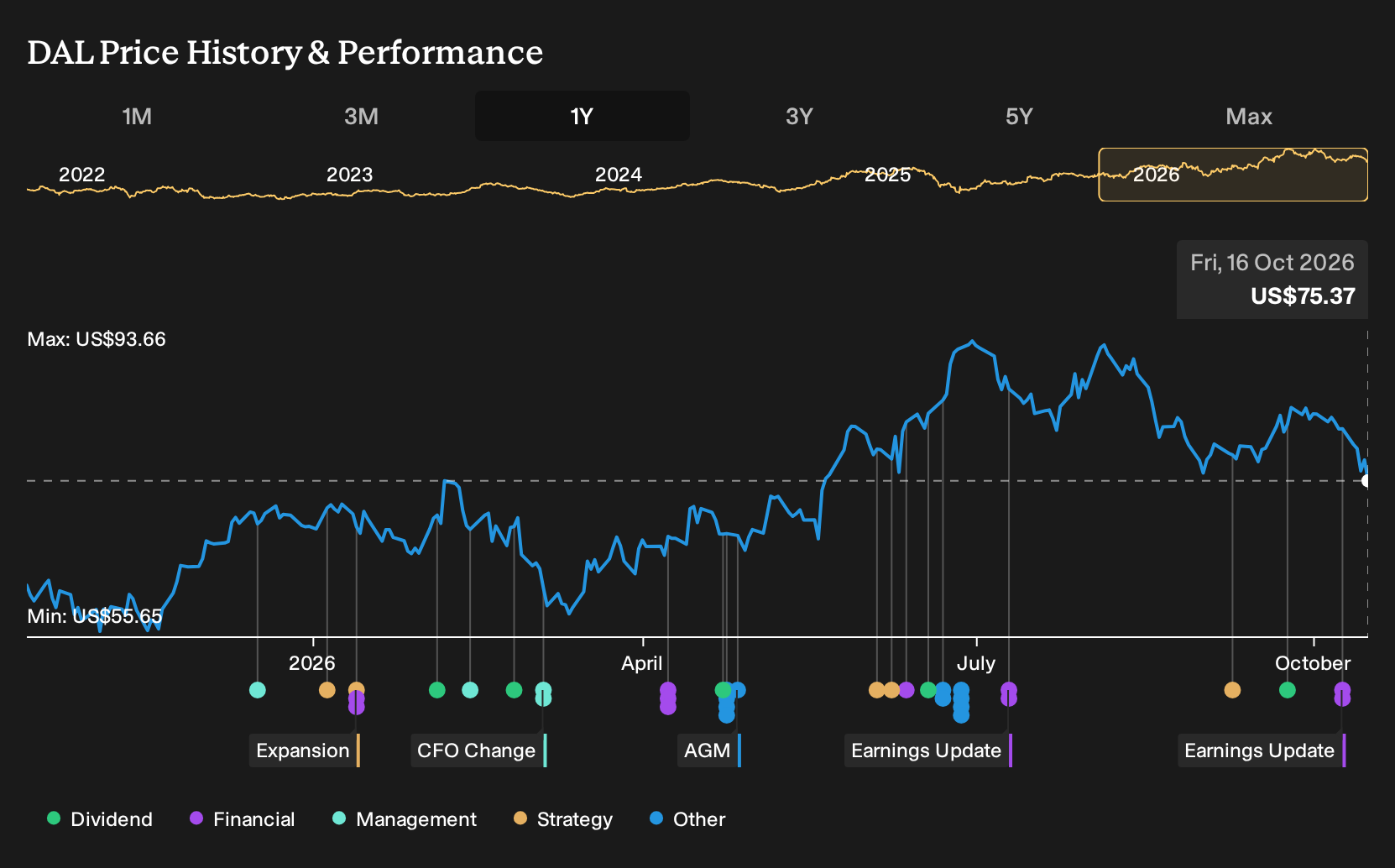
Delta Air Lines' current analyst narrative points to revenue of US$80.8b and earnings of US$3.4b by 2029, based on 4.0% yearly revenue growth and an increase in earnings of about US$0.1b from US$3.3b today.
Uncover why Delta Air Lines' fair value indicates a 34% potential upside to its current price, a discount that could narrow quickly if sentiment improves.
Exploring Other Perspectives
One alternative view for Delta Air Lines emphasizes the risk that higher fuel and nonfuel costs could pressure earnings for a longer period. The most bearish analysts were already estimating revenue of about US$69.1b and earnings of roughly US$3.1b by 2029. That is a much more cautious story. These forecasts were set before this latest guidance reset, so treat them as moving parts and use them to compare how differently informed people can interpret the same business.
Explore 7 other Delta Air Lines fair value estimates, including one that suggests as much as 16% downside from the current price.
The Verdict Is Yours
Disagree with existing narratives? Extraordinary investment returns rarely come from following the herd, so you may wish to consider your own instincts.
- A great starting point for your Delta Air Lines research is our analysis highlighting 3 key rewards and 3 important warning signs that could impact your investment decision.
- See our latest analysis for Delta Air Lines. The report includes a comprehensive fundamental analysis summarized in a single visual, the Snowflake, which makes it easy to evaluate Delta Air Lines' overall financial health at a glance.
Looking For More Investment Ideas Beyond Delta Air Lines?
Once you have formed a view on Delta Air Lines, it often helps to widen the lens and compare it with other opportunities that fit different risk and income profiles. The Simply Wall St Screener can help you quickly filter for businesses that better match your preferences on quality, balance sheet strength and volatility.
- If capital preservation and steady compounding matter most to you, filter for companies with stronger financial resilience by reviewing a 32 resilient stocks with low risk scores that keeps balance sheet risks in check.
- If you want potential upside backed by fundamentals rather than hype, scan a 20 high quality undiscovered gems that pairs solid earnings quality with relatively low market attention.
- If cash returns are a priority, focus on income ideas through a 8 dividend fortresses to find businesses combining higher yields with more stable payout profiles.
This article by Simply Wall St is general in nature. We provide commentary based on historical data and analyst forecasts only using an unbiased methodology and our articles are not intended to be financial advice. It does not constitute a recommendation to buy or sell any stock, and does not take account of your objectives, or your financial situation. We aim to bring you long-term focused analysis driven by fundamental data. Note that our analysis may not factor in the latest price-sensitive company announcements or qualitative material. Simply Wall St has no position in any stocks mentioned.
Have feedback on this article? Concerned about the content? Get in touch with us directly. Alternatively, email editorial-team@simplywallst.com