


What QXO (QXO)'s TopBuild Integration Means For Shareholders
- QXO has pursued an acquisition heavy expansion, including buying TopBuild and building an estimated $18b building products revenue base. The company is carrying higher debt, integration costs and working capital needs that are pressuring profitability and cash generation in a weaker housing market.
- The business is relying heavily on extracting at least $300 million of expected annual synergies from TopBuild by 2030. This makes integration execution and cost control a central operational risk as residential construction demand remains subdued.
- We will now look at how QXO's integration risks and housing exposed earnings profile shape the company's broader investment narrative.
Stress test QXO's acquisition-heavy model against peers by scanning for construction-exposed businesses with stronger balance sheets and cash profiles using the curated list of solid balance sheet and fundamentals (25 results).
What Is QXO's Investment Narrative?
To own QXO here, you need to buy into a pretty specific story. Management is trying to stitch together a large scale building products distributor, with TopBuild as a centerpiece and a plan to reach at least $300 million of annual synergies by 2030. The housing slowdown cuts right into that plan because softer residential construction makes it harder to grow volumes while carrying more inventory, higher working capital and increased interest costs on the debt stack.
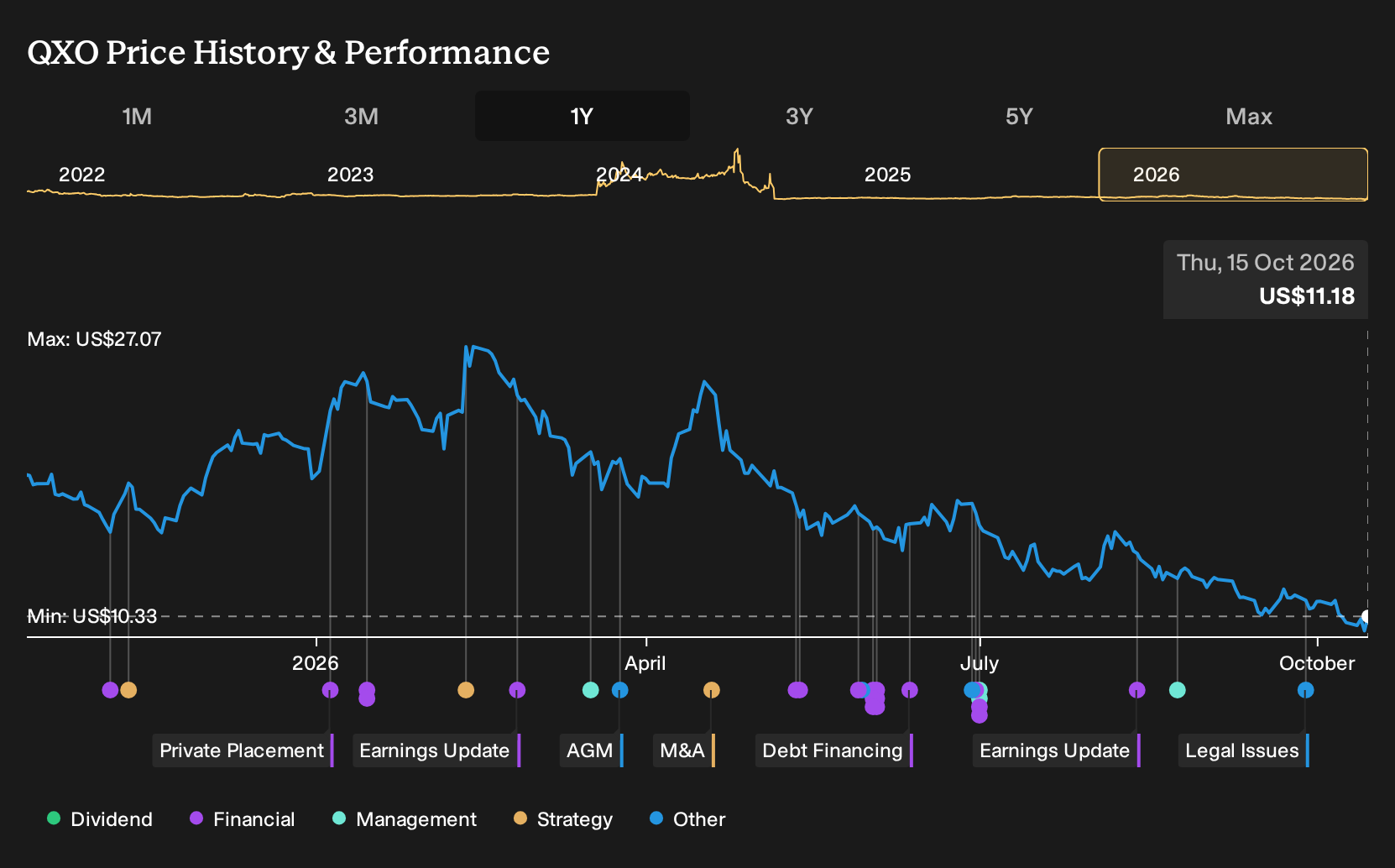
The recent share price slide of about 43% year to date underlines how sensitive this model is to execution and cash generation. In the short term, the big swing factors are integration speed, realized cost savings and the ability to turn that $18b revenue base into positive free cash flow while QXO is still loss making. Downward earnings estimate revisions and weaker housing demand make those catalysts harder, not impossible. As a result, balance sheet risk and further dilution fears are now front of mind.
That said, there is one aspect of QXO's funding story that tends to get overlooked until you realize it means...
There's only one way to know the right time to buy, sell or hold QXO. Head to Simply Wall St's company report for the latest analysis of QXO's Fair Value.
Exploring Other Perspectives
The Simply Wall St Community has only three fair value estimates for QXO, ranging from US$26 to about US$43.39 per share, so opinions already span a wide gap. Those views also predate the roughly 42.8% year-to-date share price decline. Treat this as a starting point and explore multiple viewpoints before forming your own stance.
Explore 2 other QXO fair value estimates, including one that suggests it could be worth just $26.00.
The Verdict Is Yours
Disagree with this assessment? Extraordinary investment returns rarely come from following the herd, so go with your instincts.
- A great starting point for your QXO research is our analysis highlighting 2 key rewards and 1 important warning sign that could impact your investment decision.
- See our latest analysis for QXO. The report includes a comprehensive fundamental analysis summarized in a single visual, the Snowflake, making it easy to evaluate QXO's overall financial health at a glance.
Looking For More Investment Ideas Beyond QXO?
If QXO's situation has you rethinking concentration risk, it can help to compare it with companies that score well on balance sheet strength, income resilience, and valuation quality. The Simply Wall St Screener lets you filter for these traits directly so you can build a watchlist that matches your own risk and return preferences.
- For investors who care most about financial resilience, start with a curated list of solid balance sheet and fundamentals (25 results) that prioritize stronger balance sheets and healthier fundamentals.
- If income reliability is a priority, focus on potential income anchors by scanning companies described as 7 dividend fortresses that might warrant a closer look.
- To seek out potential mispriced opportunities, cast a wider net across 20 high quality undiscovered gems that pair solid fundamentals with relatively low market attention.
This article by Simply Wall St is general in nature. We provide commentary based on historical data and analyst forecasts only using an unbiased methodology and our articles are not intended to be financial advice. It does not constitute a recommendation to buy or sell any stock, and does not take account of your objectives, or your financial situation. We aim to bring you long-term focused analysis driven by fundamental data. Note that our analysis may not factor in the latest price-sensitive company announcements or qualitative material. Simply Wall St has no position in any stocks mentioned.
Have feedback on this article? Concerned about the content? Get in touch with us directly. Alternatively, email editorial-team@simplywallst.com