


Phase III Trial Launch Might Change The Case For Nektar Therapeutics Stock (NKTR)
- Nektar Therapeutics has advanced its wholly owned immune-modulating drug rezpegaldesleukin into the ZENITH AD phase III program for atopic dermatitis, with broader autoimmune studies planned.
- Because Nektar owes no royalties on rezpegaldesleukin, any successful late-stage outcome could feed directly into future revenue potential and funding flexibility.
- The next section examines how Nektar Therapeutics' investment narrative could evolve as rezpegaldesleukin moves into the costly phase III stage.
Scan beyond Nektar Therapeutics and rezpegaldesleukin by reviewing a curated group of potential breakout stories in our 20 high quality undiscovered gems featuring strong underlying fundamentals and room to prove themselves.
Nektar Therapeutics Investment Narrative Recap
For Nektar Therapeutics, the core belief is that a focused immune modulation platform can eventually support a commercial business despite current losses. Rezpegaldesleukin now moving into phase III for atopic dermatitis keeps that thesis intact and makes clinical execution the main near term catalyst. The key watchpoint is whether management can run these trials efficiently while keeping the runway to 2027 intact.
The flip side is concentrated risk. A pre commercial setup, a Q2 2025 net loss of US$41.6 million, and prior pipeline setbacks mean rezpeg must clear high efficacy and safety expectations to justify ongoing spend. The new phase III commitment does not remove funding or dilution risk; it simply raises the stakes on trial results and potential partnering.
The most relevant recent development is the ZENITH AD phase III program initiation for rezpegaldesleukin in atopic dermatitis, with additional autoimmune readouts guided for 2027. This step locks in a long and costly development arc but also gives investors a clearer timetable for the next clinical data waves that could reshape Nektar Therapeutics' profile.
This progression matters because the firm is still pre commercial, unprofitable, and highly dependent on rezpeg while competitor therapies in immunology and dermatology keep advancing. With Fast Track designations, a runway targeted into 2027 after the last equity raise, and no royalties owed on rezpeg, execution on trial design, enrollment, and safety monitoring now sits at the center of both upside potential and downside risk.
How The ZENITH AD Spend Lines Up With Street Assumptions
Nektar Therapeutics' late stage push for rezpegaldesleukin lands in a very specific analyst framework that is already penciled in. Consensus models point to revenue declining by 10.9% a year over the next three years, even as the research budget and headcount needed to run ZENITH AD rise. That mix of shrinking top line and higher development commitments is what keeps the story firmly in high risk territory for now.
On earnings, the gap between today and the long term scenario is wide. Analysts reference a current annual loss of US$157.1 million and then map to a profit of US$6.7 million by 2029 if margins eventually resemble the broader US biotech peer group. That implies an earnings swing of roughly US$163.8 million from loss to profit. Any future cash flows from rezpeg need to be weighed against the very real funding strain that could build in the years between.
Valuation work in the latest stock research leans heavily on that 2029 snapshot. To line up with a consensus target price of US$133.08, the model used in the report assumes Nektar Therapeutics generates US$38.7 million in revenue and US$6.7 million in earnings in 2029. The same framework applies a future P/E of 1,043.1x to those projected profits and discounts the result at roughly 7.6%. Readers should treat that P/E multiple as an abstract bridge between current uncertainty and a distant profit number rather than as a benchmark for typical biotech pricing.
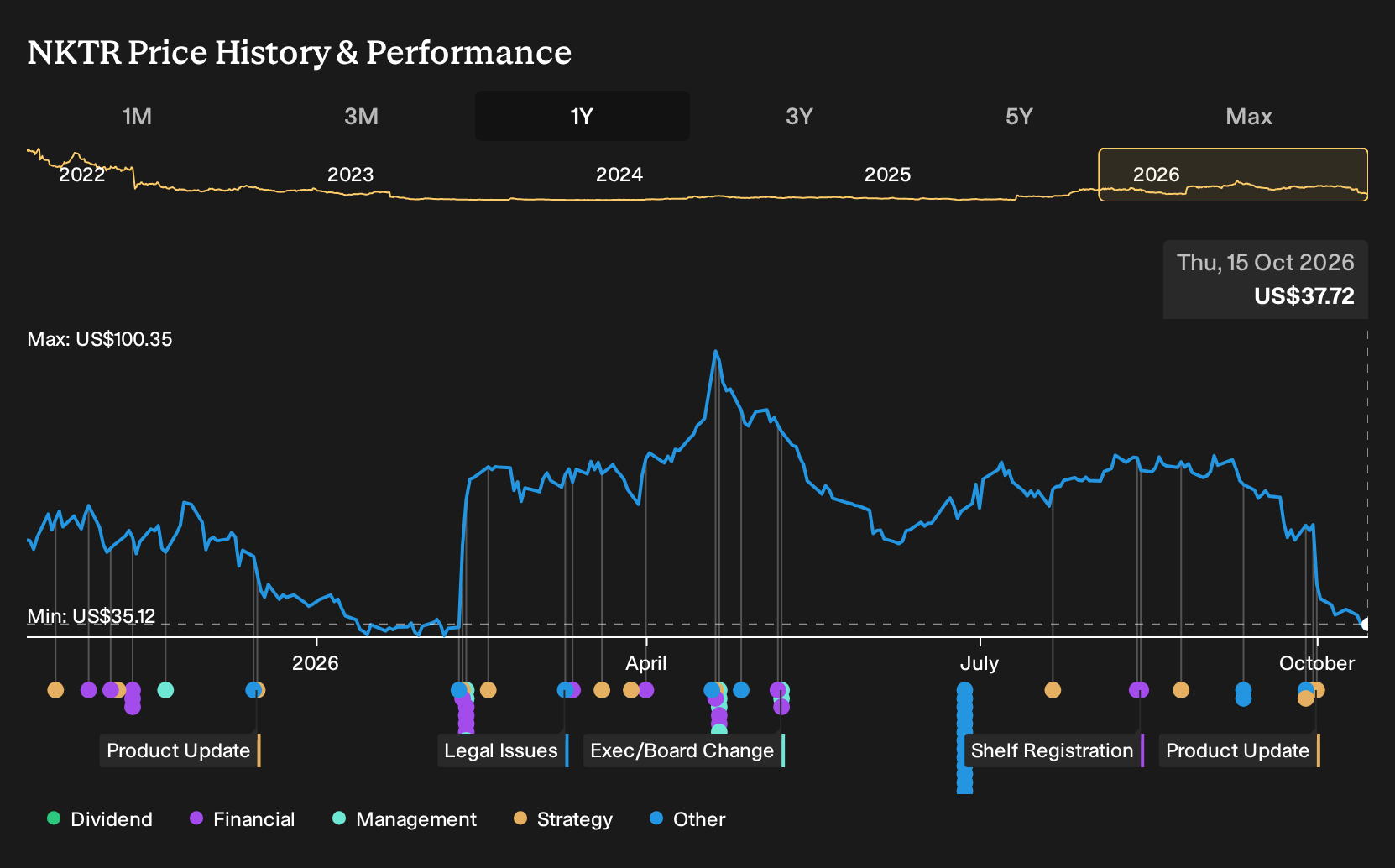
Current share price context matters too. With the stock recently around US$39.84 and analysts publishing a collective target that is 70.1% higher, the implied upside in those models rests on a belief that rezpeg and the wider immune modulation platform will eventually justify a richer valuation. At the same time, the report acknowledges that sell side views are far from uniform, with price targets ranging from US$50.00 on the low end to US$192.00 at the top.
For anyone tracking Nektar Therapeutics through the phase III spend cycle, the message is clear. Street expectations build in declining revenue near term, a long road to possible profitability, and a valuation construct that depends on both improved margins and higher share count over time. The ZENITH AD readouts and any future business development moves could change how realistic those numbers feel, but they do not remove the execution and financing questions that sit behind them.
Nektar Therapeutics' narrative projects US$38.7 million revenue and US$6.7 million earnings by 2029. This uses a forecast yearly revenue decline of 10.9% and implies an earnings improvement of about US$163.8 million from a current loss of US$157.1 million.
Uncover why Nektar Therapeutics' fair value indicates a 253% potential upside to its current price that could narrow quickly.
Exploring Other Perspectives
One big swing factor the most optimistic analysts highlight is potential revenue acceleration if rezpegaldesleukin reaches multiple dermatology indications. Before this phase III news, the bullish cohort was already penciling in US$95.2 million of revenue and US$16.4 million of earnings by 2029. That is a far more upbeat Nektar Therapeutics story than consensus, so use it as a prompt to compare very different scenarios for yourself.
Explore 2 other Nektar Therapeutics fair value estimates, including one that suggests up to 409% upside from the current price.
Decide For Yourself
Don't just follow the ticker. Dig into the data and build a conviction that's truly your own.
- A great starting point for your Nektar Therapeutics research is our analysis highlighting 1 key reward and 3 important warning signs that could impact your investment decision.
- See our latest analysis for Nektar Therapeutics. The report includes a comprehensive fundamental analysis summarized in a single visual, the Snowflake, making it easy to evaluate Nektar Therapeutics' overall financial health at a glance.
Looking For More Investment Ideas Beyond Nektar Therapeutics?
If the Nektar Therapeutics story has sharpened your thinking, you could broaden the opportunity set by scanning other potential candidates that fit different risk and income profiles using the Simply Wall St Screener.
- For investors who want income to do more of the heavy lifting, consider a curated set of steady high yield opportunities through the 7 dividend fortresses.
- If capital preservation and steadier financial footing matter most to you, filter for companies with robust balance sheets using the list of solid balance sheet and fundamentals (25 results).
- For those hunting for mispriced quality, cast a wider net across potential value opportunities with the 33 high quality undervalued stocks.
This article by Simply Wall St is general in nature. We provide commentary based on historical data and analyst forecasts only using an unbiased methodology and our articles are not intended to be financial advice. It does not constitute a recommendation to buy or sell any stock, and does not take account of your objectives, or your financial situation. We aim to bring you long-term focused analysis driven by fundamental data. Note that our analysis may not factor in the latest price-sensitive company announcements or qualitative material. Simply Wall St has no position in any stocks mentioned.
Have feedback on this article? Concerned about the content? Get in touch with us directly. Alternatively, email editorial-team@simplywallst.com