


SK hynix Sinks as AI Stocks Pullback Amid Rising Interest Rates. How to Play SKHY Here.
In late July, SK hynix (SKHY) reported Q2 revenue of $51.3 billion with an operating margin of 76%. Sales more than tripled in the June quarter, driven by strong memory demand from major customers.
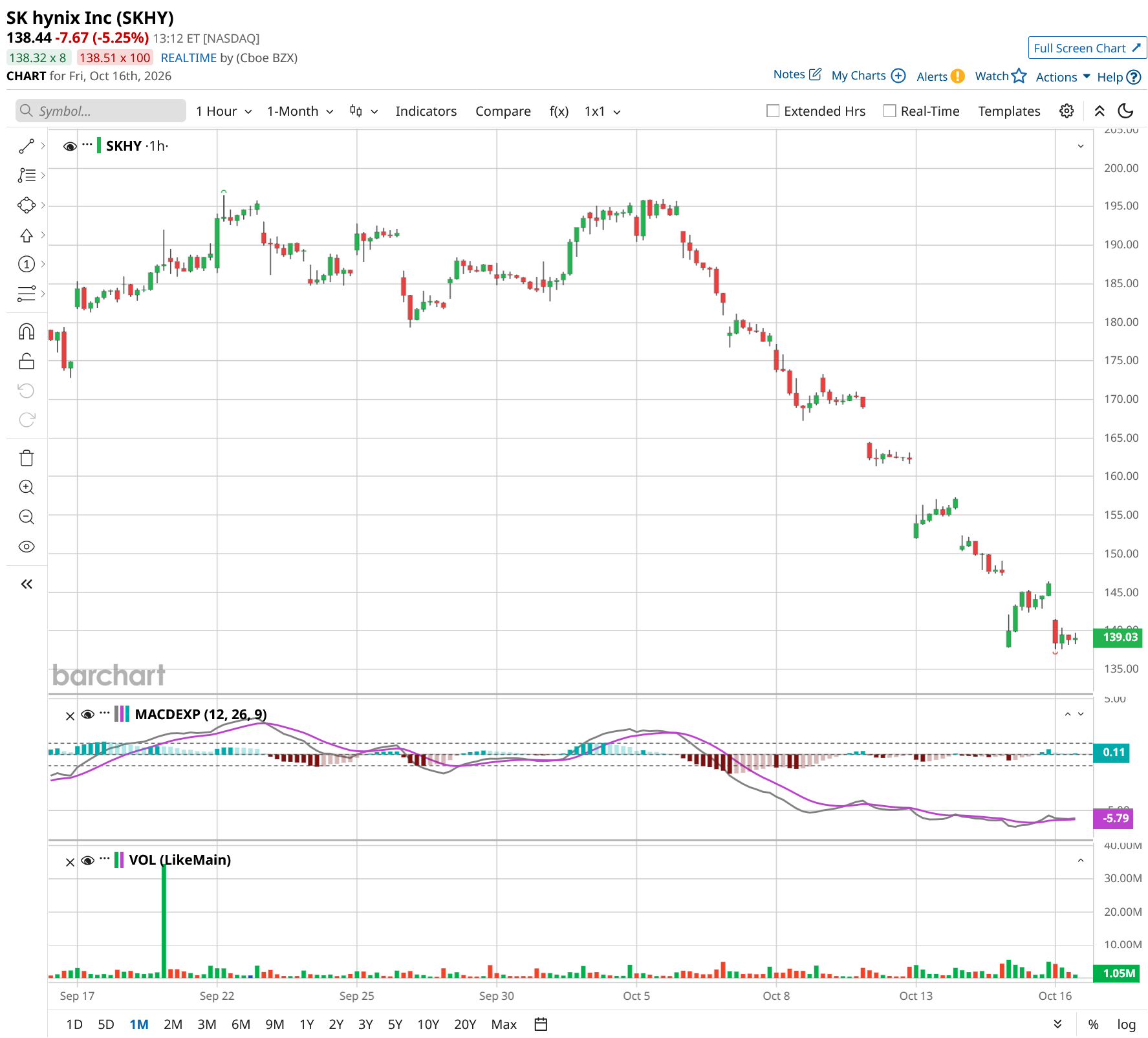
After a strong rally, the Korea-based tech stock trades 31% below its all-time highs in October 2026. However, in Korea it is down almost over 50% from record levels, losing $660 billion in market cap.
It is a brutal fall for what Bloomberg called Asia’s poster child for the AI trade. A few weeks back, SK hynix was a great business priced for perfection, before sentiment turned bearish.
A Blowout Quarter Set the Bar
Let’s start with what SK hynix told investors on its July 29 earnings call.
- Revenue rose 51% from the first quarter and 257% from a year ago, while operating income grew to $39 billion.
- Net income totaled $60.7 billion in Q2, including $47.5 billion in gains from selling and revaluing investments.
- An analyst on the call linked part of that to the sale of its Kioxia (KXIAY) stake.
Management also dismissed fears of a slowdown in AI spending. Song Hyeon-jong, president of the company's “Corporate Center,” said efficient AI models would widen adoption while projecting AI investment to remain robust beyond 2027.
SK hynix also said it had signed long-term supply agreements with about ten customers. These deals run about five years and include deposits, meaning customers lock in supply years in advance.
Why Are AI Stocks Down In October 2026?
Bloomberg reported that U.S. consumer prices rose in September at the fastest pace in five months, which could translate to interest rate hikes.
Higher interest rates will raise borrowing costs and squeeze profit margins across sectors. Several AI companies have raised billions in debt to fund expansion plans, spooking investors.
CoreWeave (CRWV) bonds due in 2032 fell to 78 cents on the dollar, dragging the stock down 15% in a single trading session. Over the last five trading sessions, SKHY stock is down 18%, while Samsung also posted a double-digit decline.
The Kospi ($KSIC), South Korea's benchmark index, is down 15% over the last week and 41% from its all-time high. Trading on the Korean exchange was halted for 20 minutes after it posted seven consecutive days of losses.
Bloomberg said foreign investors dumped $2.7 billion of Kospi shares on Thursday and more than $10 billion in October. Analyst Hebe Chen of Vantage Global Prime said Korea is “the shock absorber for the global AI selloff.”
Bloomberg also emphasized that a closely watched US chip index has erased $1.6 trillion in value over six straight days of losses. CNBC reported that memory stocks also faced fears about Chinese competition and a future glut.
The spark came from ChangXin Memory Technologies, or CXMT. The Chinese chipmaker announced a server memory product with a design that allows denser storage. Investors feared it could siphon market share from Samsung, SK hynix, and Micron (MU).
Then a Maeil Business Newspaper column added a darker forecast. Two experts, it said, expect a flood of new supply by 2029. Elon Musk replied that China will make “a LOT of RAM in 2028.” CNBC noted that other analysts have not echoed the 2029 call.
Is SKHY Stock a Good Buy Right Now?
Even the bearish scenarios look milder than past downturns. Counterpoint Research sees DRAM prices falling about 23% in 2028 from 2027. Even then, prices would stay about 230% above 2025 prices. Counterpoint analyst Jeongku Choi pointed to long-term agreements with upfront payments and price limits, which should soften any downturn.
Investors worry about debt-heavy AI infrastructure companies and neoclouds such as CoreWeave and Nebius (NBIS). However, profitable companies like SK hynix have much stronger balance sheets.
It ended Q2 with net cash of roughly $52 billion and a debt-to-equity ratio of 7%. Notably, the company has expanded operating margins to 76% in Q2, up from 41.4% last year.
Analysts forecast adjusted earnings to increase to $44.63 in 2028. If the tech stock trades at 5x earnings, it could surge 90% in the next 15 months.
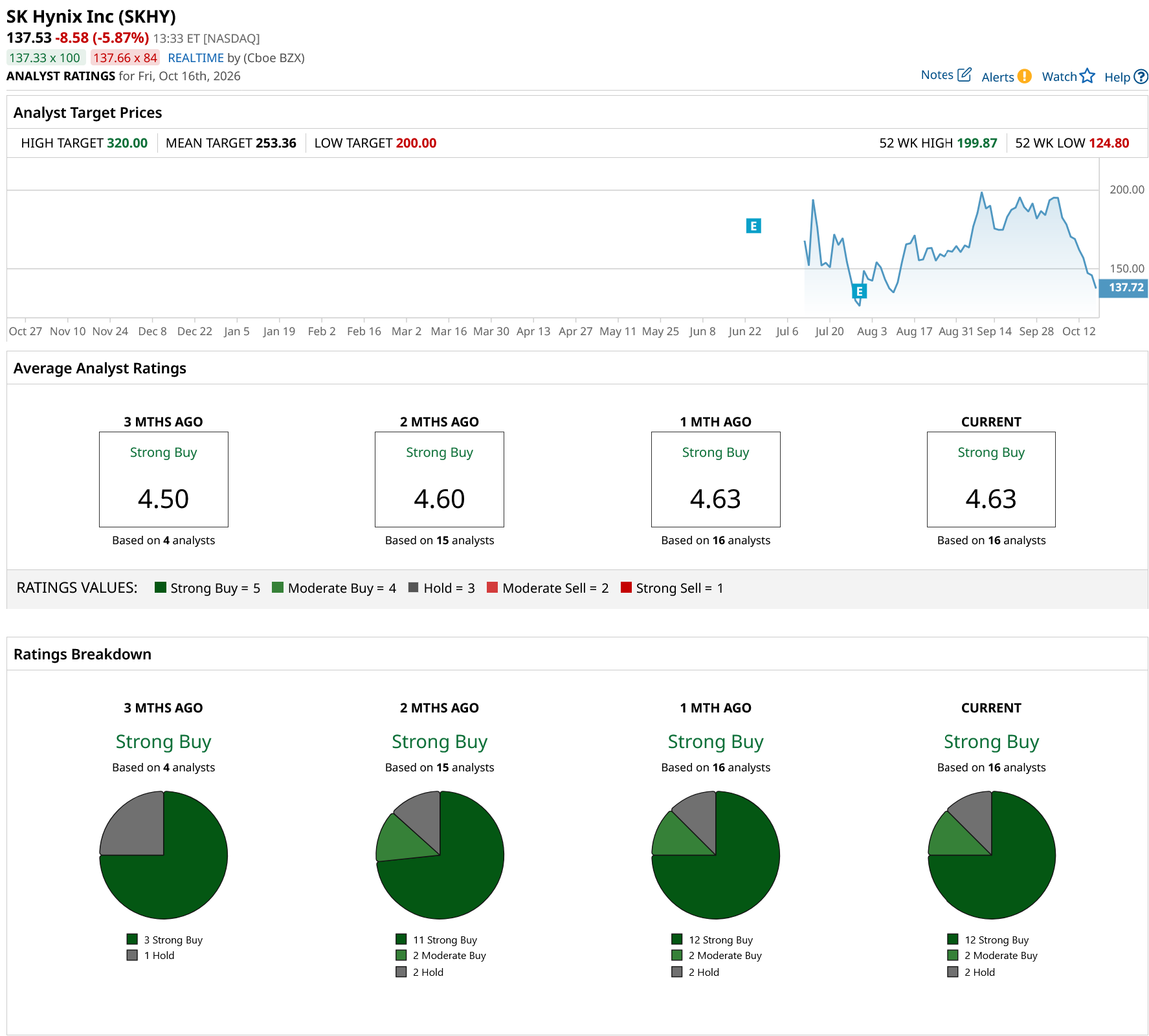
Out of the 16 analysts covering SKHY stock, 12 recommend “Strong Buy,” two recommend “Moderate Buy,” and two recommend “Hold.” The average SK hynix stock price target is $253.36, above the current price of about $138.
On the date of publication, Aditya Raghunath did not have (either directly or indirectly) positions in any of the securities mentioned in this article. All information and data in this article is solely for informational purposes. For more information please view the Barchart Disclosure Policy here.