


Australian United Investment (ASX:AUI) Moves To Quarterly Dividends, Is The Stock Still Cheap?
Australian United Investment (ASX:AUI) has moved to quarterly dividends, with guidance of 9 cents per share for payments beginning in December 2026 and 10 cents flagged for the June 2027 quarter.
Those dividend changes arrive while Australian United Investment’s share price has edged up to A$11.98, with a 90 day share price return of 8.03% and a 1 year total shareholder return of 7.88%. This points to steady momentum backed by stronger multi year total shareholder returns of 43.45% over three years and 46.08% over five years.
Spot opportunities with similar income-focused potential by scanning our curated 4 dividend fortresses, which pairs higher yields with robust fundamentals.Australian United Investment has provided clearer income guidance and the share price has already moved. Should you treat this as an entry point now, or wait for a potentially lower price after you run the numbers?
Price-to-Earnings of 11.8x: Is it justified?
On simple earnings terms, Australian United Investment trades on a P/E of 11.8x, which sits below both the broader Australian market and the capital markets peer group. With the last close at A$11.98, that gap raises a clear question for income investors who are weighing up whether the current valuation fairly reflects the underlying portfolio and earnings profile.
The P/E multiple compares today’s share price to the most recent earnings per share. For an investment company like Australian United Investment, it gives you a quick sense of how much investors are willing to pay for each dollar of look through profit generated from its portfolio of Australian equities across banks, financials, healthcare, consumer names, infrastructure, transport, mining and energy.
At 11.8x, the stock trades at a marked discount to the Australian Capital Markets industry average of 18.7x and also below a 21.4x peer group average. That gap suggests the market is assigning a lower earnings multiple to AUI than to comparable capital markets businesses. This could reflect its lower 8.5% return on equity, the use of higher risk external borrowing as its sole funding source, and the impact of a large one off gain of A$159.7m on the latest 12 month earnings quality.
Even with those caveats, the comparison is stark. Investors are paying a materially lower P/E for Australian United Investment than for both the wider Australian market on 16.1x and the sector on 18.7x. This points to a conservative earnings multiple relative to peers rather than a stretched one.
See what the numbers say about this price — find out in our valuation breakdown.
Result: Price-to-Earnings of 11.8x (UNDERVALUED).
Still, the A$2.59b market cap and relatively low 8.5% return on equity could limit how quickly sentiment shifts if earnings quality comes under pressure.
Find out about the key risks to this Australian United Investment narrative.
Another View: DCF Says Australian United Investment Is Expensive
The P/E picture for Australian United Investment looks forgiving, yet the SWS DCF model tells a very different story. On this measure, AUI at A$11.98 trades well above an estimated future cash flow value of A$0.60, which frames the shares as overvalued rather than cheap.
That gap between earnings based value and cash flow based value leaves you with a simple question: Which signal do you trust more when your own horizon is long and income is a priority, the low P/E or the DCF warning light?
Look into how the SWS DCF model arrives at its fair value.
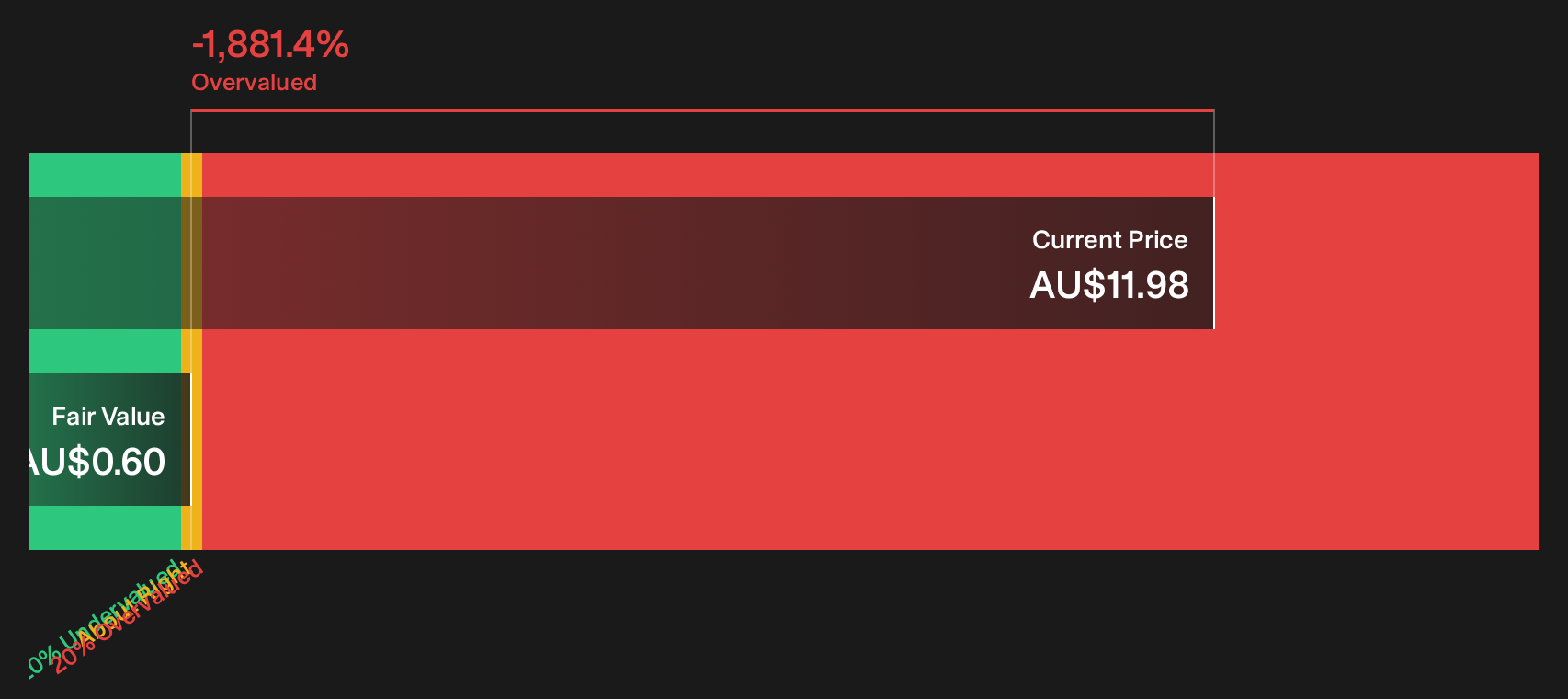
Simply Wall St performs a discounted cash flow (DCF) on every stock in the world every day (check out Australian United Investment for example). We show the entire calculation in full. You can track the result in your watchlist or portfolio and be alerted when this changes, or use our stock screener to discover 4 high quality undervalued stocks. If you save a screener we even alert you when new companies match - so you never miss a potential opportunity.
Next Steps
Conflicted by Australian United Investment’s mixed P/E and DCF signals, along with the blend of risks and rewards highlighted here? Act quickly, review the underlying data for yourself, and pressure test your view against the 2 key rewards and 3 important warning signs.
Looking for more investment ideas beyond Australian United Investment?
If Australian United Investment has sharpened your focus on income and valuation, do not stop here. You will miss useful opportunities if you only watch one stock.
- Target resilient balance sheets and steady fundamentals by scanning the list of solid balance sheet and fundamentals (12 results) for companies that aim to keep financial risk in check.
- Hunt for quality at a discount by reviewing the 4 high quality undervalued stocks that highlights businesses combining stronger fundamentals with pricing that may look appealing.
- Prioritise reliable cash payouts and robust coverage by tracking the 4 dividend fortresses to see which dividend payers align with your income goals.
This article by Simply Wall St is general in nature. We provide commentary based on historical data and analyst forecasts only using an unbiased methodology and our articles are not intended to be financial advice. It does not constitute a recommendation to buy or sell any stock, and does not take account of your objectives, or your financial situation. We aim to bring you long-term focused analysis driven by fundamental data. Note that our analysis may not factor in the latest price-sensitive company announcements or qualitative material. Simply Wall St has no position in any stocks mentioned.
Have feedback on this article? Concerned about the content? Get in touch with us directly. Alternatively, email editorial-team@simplywallst.com