


Did T-Mobile US Fall Catch You Out? What Investors Missed
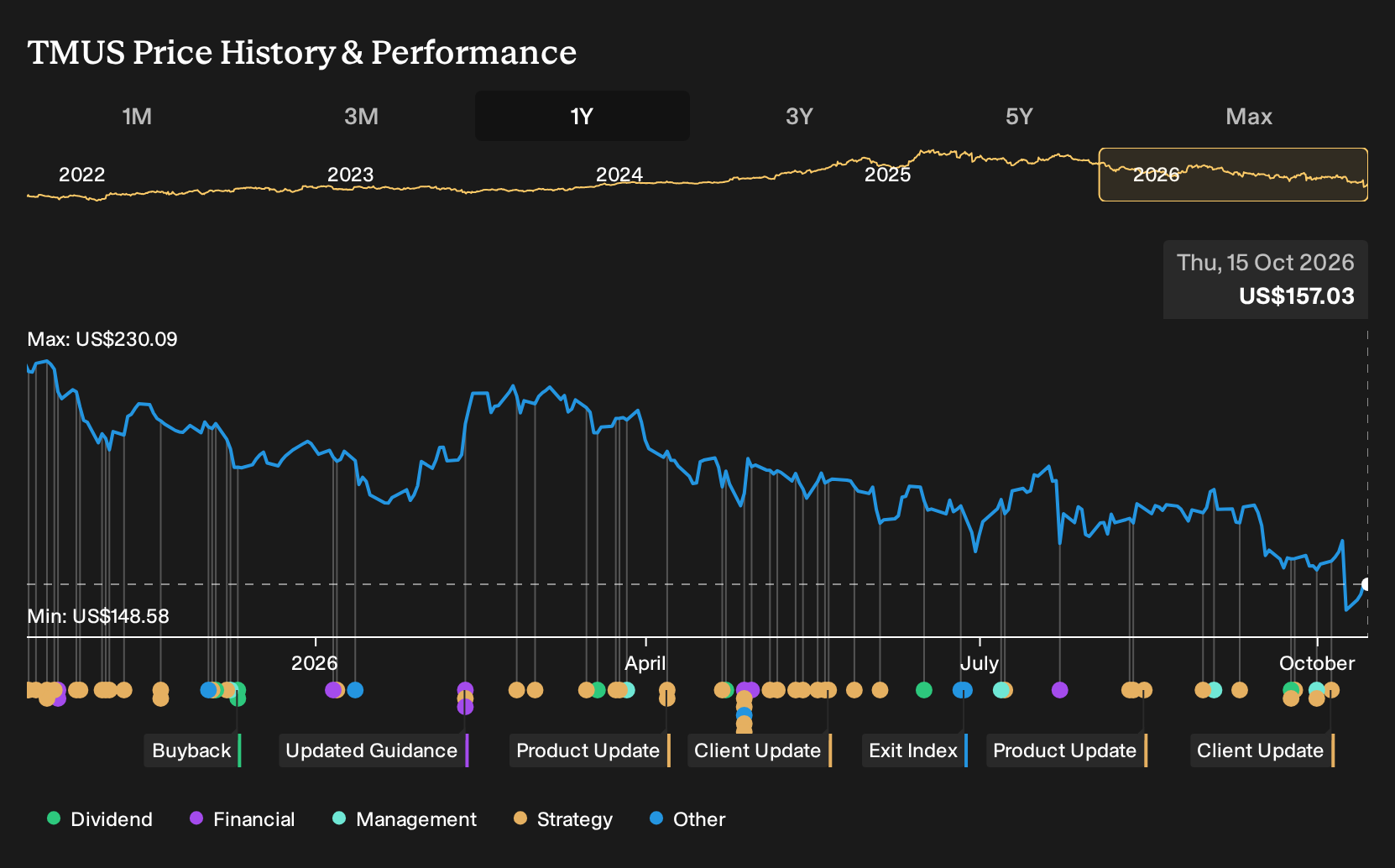
Investors who held T-Mobile US over the past year are down 29.2%, including dividends. If you had bought after bullish reports talked up 5G leadership, T-Fiber expansion and rising postpaid ARPA, that result probably feels jarring. Fresh headlines about Starlink’s spectrum deals and talk of mergers with Deutsche Telekom or even SpaceX add more noise. What exactly did those original growth and margin assumptions miss about future competition and capital needs?
On Simply Wall St, a Narrative is an investor's thesis written down: the reasoning, plus the numbers it rests on. Run those numbers and you get an estimated Fair Value.
If the move has made T-Mobile US harder to judge, start where the gap is still open and scan 33 high quality undervalued stocks.
The Two T-Mobile US Stories Investors Had To Weigh
The shares cost US$227 at the start of the period, and T-Mobile US sat between two very different but reasonable stories about where the business could go next.
The bullish narrative put fair value at US$272 and focused on 5G and T-Fiber expansion driving higher postpaid ARPA and margin improvement, even if near-term fiber buildout could weigh on service profit.
The more cautious view set fair value at US$202 and assumed revenue growth of 4.3% with a future P/E of 25.0x, while noting that intense competition and possible customer churn could pressure earnings.
What The Facts Did To The T-Mobile US Thesis
T-Mobile US posted Q2 2026 revenue of US$22.79b and net income of US$3.24b, both above Q2 2025, which leaned toward the bullish growth story. Net margin slipped from 15.2% to 14.2%, and rising satellite competition from Starlink plus merger speculation with Deutsche Telekom and SpaceX challenged the clean-margin and capital-light assumptions. The evidence cut both ways.
The episode turned on how much profit quality mattered versus simple top-line progress. For another telecom, test any growth pitch against whether revenue, absolute earnings and net margin are all moving in the same direction in the quarterly filings, rather than focusing on only the one metric the story highlights.
What You Would Be Paying For In T-Mobile US Today
T-Mobile US now trades at US$157 after falling 29.2% over the past year, while the selected Narrative’s Fair Value sits above the current price based on its own assumptions rather than a proven truth.
The Narrative leans on continued 5G and broadband execution, AI driven efficiency gains and steady capital returns. For the fall to look like an opportunity rather than a warning, a buyer today would need to believe those execution and margin goals can hold despite satellite and carrier competition.
"The main thing that has to go right is that T-Mobile US continues to convert network and AI investments into higher value postpaid, broadband and adjacency revenue, while keeping churn and competitive pressures in check."
One Narrative has put a figure on that disagreement. → See the Narrative with its higher Fair Value, assumptions and all
Looking Beyond T-Mobile US
If T-Mobile US has you focused on wireless, one step away sits broadband and enterprise connectivity. That nearby space is drawing its own kind of attention.
Homes and offices still need reliable internet, even as mobile improves. Fixed wireless and fiber lines approach that demand from a different angle.
Another large telecom leans into that need through wider fiber coverage and bundled broadband. It also promotes private networks that support AI heavy corporate workloads.
Where T-Mobile US leans on wireless and satellite pressure, this peer wrestles with fiber build targets, enterprise contracts and big cost programs. The tension between heavy buildout and uncertain efficiency is the story to watch next.
That argument has a Narrative and a number behind it. → See the company one Narrative values 16% above its price
This article by Simply Wall St is general in nature. We provide commentary based on historical data and analyst forecasts only using an unbiased methodology and our articles are not intended to be financial advice. It does not constitute a recommendation to buy or sell any stock, and does not take account of your objectives, or your financial situation. We aim to bring you long-term focused analysis driven by fundamental data. Note that our analysis may not factor in the latest price-sensitive company announcements or qualitative material. Simply Wall St has no position in any stocks mentioned.
Have feedback on this article? Concerned about the content? Get in touch with us directly. Alternatively, email editorial-team@simplywallst.com