


Is Earnings Miss Altering The Investment Case For Progressive Stock (PGR)?
- Progressive reported nine month 2026 revenue of US$68.989b and net income of US$8.671b, with basic EPS from continuing operations at US$14.87.
- Third quarter results combined an improved combined ratio and higher premiums with earnings and revenue that sat below several analyst expectations, highlighting a trade off between underwriting progress and near term headline performance.
- The focus now turns to how Progressive's mixed quarter, particularly the earnings miss versus forecasts, could reshape the existing investment narrative.
Compare Progressive's mixed quarter with other insurers that combine underwriting discipline and earnings power by scanning our hand picked list of 32 resilient stocks with low risk scores today.
Progressive Investment Narrative Recap
To own Progressive, you need to believe its underwriting engine and pricing tools can keep claim costs and combined ratios in check even when auto pricing is more competitive. The latest quarter supports that idea on operations, with an 88.7% combined ratio and higher net premiums earned. The more immediate swing factor is whether this underwriting discipline can keep offsetting severity and inflation in claims.
The biggest near term risk is that a more deflationary auto market and any renewed spike in claims costs squeeze margins just as investors are watching forecast earnings declines. The mixed quarter, with revenue and net premiums written below some expectations, looks important for sentiment but not thesis breaking on its own.
The most relevant data point for this story is Progressive's nine month 2026 update. Revenue of US$68.989b and net income of US$8.671b, with basic EPS from continuing operations at US$14.87, provide a cleaner, year to date view than a single quarter. These figures sit alongside prior commentary about forecast earnings pressure.
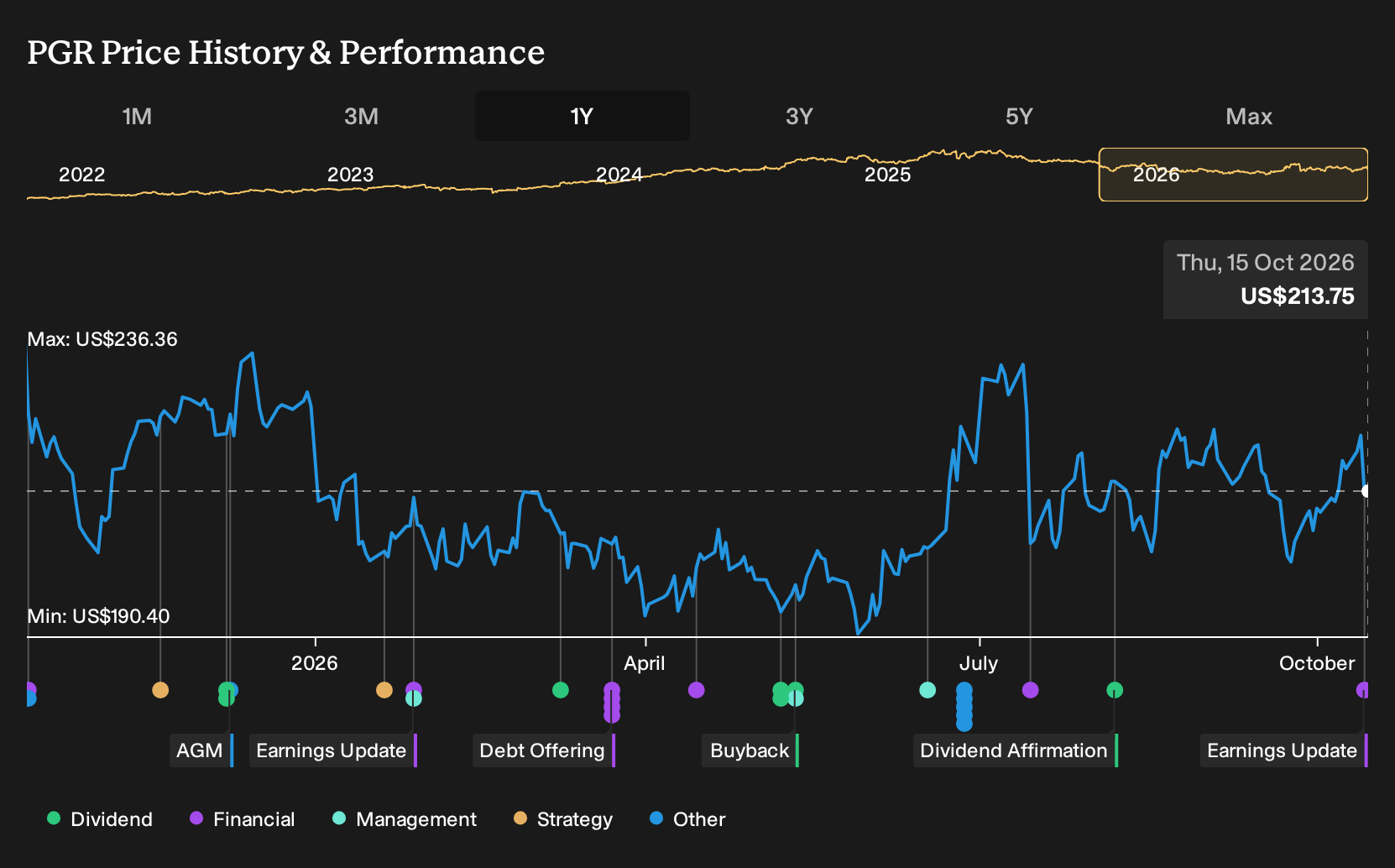
In that context, the quarterly revenue miss and the share price drop of about 9% after the report highlight how sensitive the stock can be to short term expectations. For a catalyst driven view, the focus stays on whether Progressive can keep combined ratios below 100% while still writing enough new business to support premium growth in a tougher auto and property market.
Progressive's current analyst narrative points to revenue of US$99.0b and earnings of US$9.5b by 2029. This is based on assumed yearly revenue growth of 2.9%, alongside an earnings decline of US$2.2b from US$11.7b today to the 2029 consensus level.
Uncover why Progressive's fair value indicates an 8% potential upside to its current price that could narrow quickly.
Exploring Other Perspectives
One alternative view puts Progressive’s cross sell efforts at the center of the story. The most bearish analysts assumed only 1.1% yearly revenue growth to about US$94.0b and earnings of roughly US$8.2b by 2029, which is a much harsher read on margin pressure. This quarter’s results may push those forecasts to shift. Readers should compare both paths before deciding which version feels more realistic.
Explore 3 other Progressive fair value estimates, including one that suggests it could be worth just $230.38.
Reach Your Own Conclusion
Don't just follow the ticker; dig into the data and build a conviction that's truly your own.
- A great starting point for your Progressive research is our analysis highlighting 2 key rewards and 3 important warning signs that could impact your investment decision.
- See our latest analysis for Progressive. The report includes a comprehensive fundamental analysis summarized in a single visual, the Snowflake, making it easy to evaluate Progressive's overall financial health at a glance.
Looking for more investment ideas beyond Progressive?
Progressive may be central to your watchlist right now, but a broader set of opportunities can help you stress test your thesis and balance your portfolio across different types of businesses.
- If capital protection is high on your list, scan companies that score well on resilience and stability with the 32 resilient stocks with low risk scores.
- For investors seeking strong balance sheets and healthier fundamentals, run through the list of solid balance sheet and fundamentals (25 results) to see which stocks meet those criteria.
- Readers hunting for mispriced quality can review potential opportunities using the 20 high quality undiscovered gems.
This article by Simply Wall St is general in nature. We provide commentary based on historical data and analyst forecasts only using an unbiased methodology and our articles are not intended to be financial advice. It does not constitute a recommendation to buy or sell any stock, and does not take account of your objectives, or your financial situation. We aim to bring you long-term focused analysis driven by fundamental data. Note that our analysis may not factor in the latest price-sensitive company announcements or qualitative material. Simply Wall St has no position in any stocks mentioned.
Have feedback on this article? Concerned about the content? Get in touch with us directly. Alternatively, email editorial-team@simplywallst.com