


Should Water System Upgrades Require Action From American Water Investors?
- American Water Works Company subsidiaries announced new infrastructure projects, including a US$470,000 pipe replacement in Charleston and a wildfire resilience upgrade in Monterey funded through a U.S. EPA award.
- These projects are part of a roughly US$48b long term capital plan and highlight how American Water Works Company continues prioritizing system reliability and regulatory backed investment.
- We will explore how American Water Works Company's long term capital plan is reframed by the wildfire resilience funding and West Virginia upgrades.
American Water Works Company Investment Narrative Recap
The core belief for owning American Water Works Company is that regulated water and wastewater spending can keep compounding through a long term, roughly US$48b capital plan without eroding returns. The near term swing factor is execution. Management needs projects like the Charleston pipe replacement and Monterey wildfire hardening to stay on time, on budget, and aligned with regulators.
The biggest risk is that heavy capex, acquisitions and the Essential Utilities merger strain balance sheet flexibility or outpace allowed rate base growth. Recent announcements mainly reinforce the existing story rather than change it. They look incremental, not thesis breaking, for either upcoming regulatory decisions or merger progress.
The Monterey Wildfire Infrastructure Improvement Project, backed by U.S. EPA funding, feels most relevant to today’s focus on essential services and resilience. It ties directly into American Water Works Company’s push to modernize assets while managing bill pressure, since external funding can offset some local cost recovery needs and support infrastructure reliability.
For catalysts, this type of federally supported work speaks to operational execution on risk mitigation, especially as wildfires and other physical threats are front of mind for regulators. It also interacts with the broader US$48b capital pipeline, because projects that attract grants help protect returns, which matters if sentiment on AWK’s relatively high P/E or leverage becomes more cautious.
American Water Works Company Consensus Setup Through 2029
Analysts frame American Water Works Company as a regulated utility where growth hinges on steady capital deployment, regulatory alignment, and disciplined cost control. The long term capital plan, wildfire hardening in Monterey, and pipe work in West Virginia all sit inside that framework rather than outside it. That context matters when you look at the numbers backing the current analyst view.
On the revenue side, the current consensus assumes American Water Works Company can compound its top line at 6.8% a year over the next three years. That is tied to rate base expansion, acquisitions such as Nexus Water Group, and the planned Essential Utilities merger. None of those are guaranteed outcomes for investors, but they are the core building blocks used in the external models.
Earnings expectations carry even more detail. Analysts are working off earnings today of about US$1.1b and a forecast that profit reaches US$1.5b by 2029, with margin estimates moving from 21.3% to 23.6% over roughly the same horizon. That setup implies an earnings increase of about US$400m, which is a sizable jump for a regulated utility that still needs commission approval for most of its project spend and rate changes.
Valuation work in the consensus ties those operating forecasts back to a P/E multiple. To line up with a price target of US$141.45, the projections assume American Water Works Company trades on 24.1x its 2029 earnings. That compares with a current multiple of 23.9x for the stock and 22.3x for the broader US water utilities group, so the view is that investors keep paying a modest premium for perceived stability and capital plan visibility.
American Water Works Company's narrative projects US$6.4b revenue and US$1.5b earnings by 2029. This setup assumes 6.8% yearly revenue growth and an earnings increase of about US$400m from US$1.1b today.
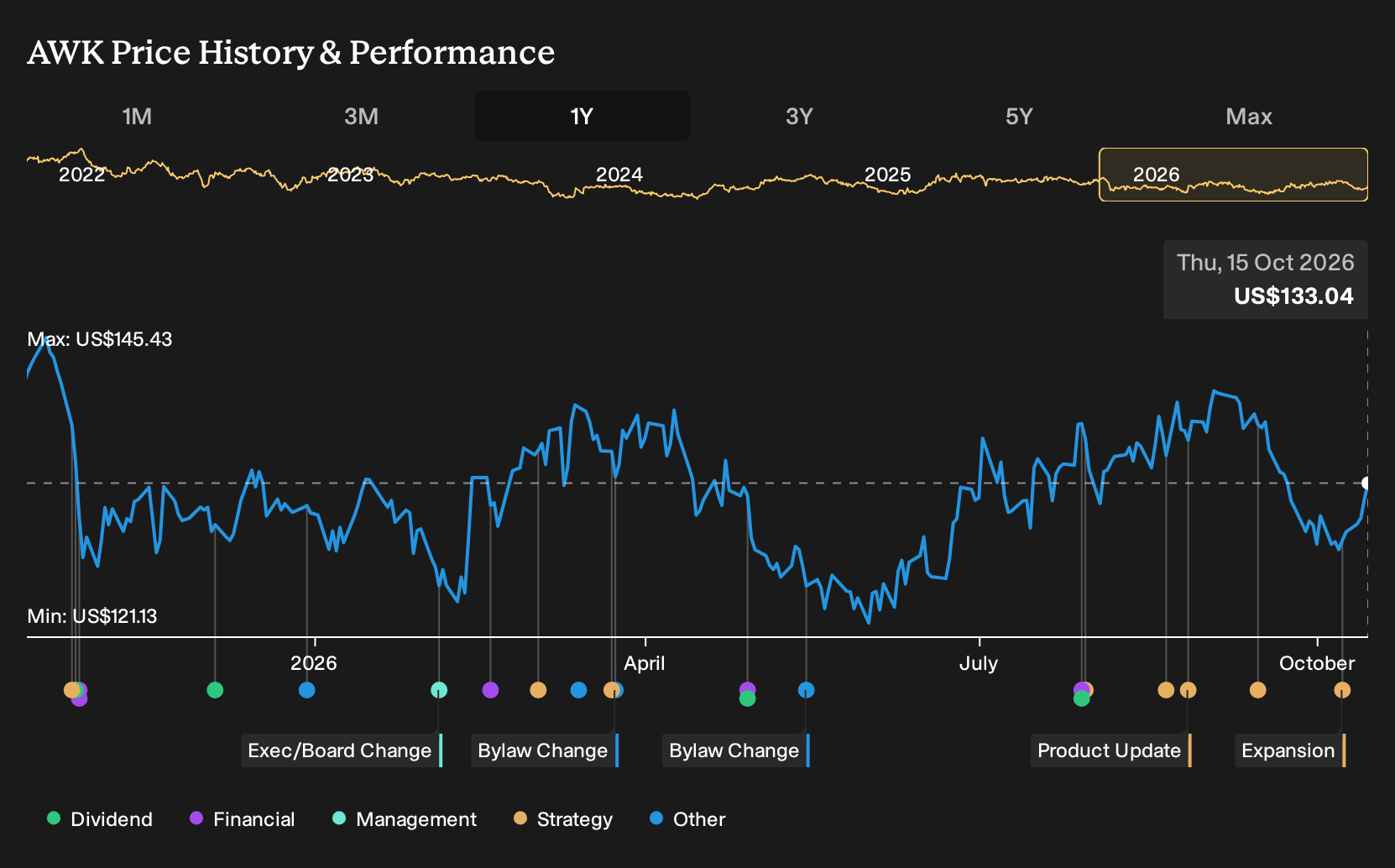
Uncover why American Water Works Company's fair value indicates a 6% potential upside to its current price before that discount feels less comfortable.
Exploring Other Perspectives
Three fair value estimates from the Simply Wall St Community cluster between about US$113 and US$141 per share, with the top end brushing the US$141.45 analyst target. You are weighing those retail views against fresh variables such as wildfire funding, leadership changes, and ongoing capex, which can all influence how American Water Works Company performs over time. Use these contrasts as a prompt to explore several alternative viewpoints before deciding how comfortable you feel with the current pricing and expectations.
Explore 2 other American Water Works Company fair value estimates, including one that suggests as much as 15% downside from the current price.
Form Your Own Verdict
Disagree with existing narratives? Extraordinary investment returns rarely come from following the herd, so consider developing your own perspective.
- A great starting point for your American Water Works Company research is our analysis highlighting 2 key rewards and 2 important warning signs that could impact your investment decision.
- See our latest analysis for American Water Works Company. The report includes a comprehensive fundamental analysis summarized in a single visual, the Snowflake, making it easy to evaluate American Water Works Company's overall financial health at a glance.
Looking for more investment ideas beyond American Water Works Company?
If the American Water Works Company story has sharpened your focus on resilience, cash flow quality, and balance sheet strength, broaden that lens using the Simply Wall St Screener to spot other opportunities that fit your style.
- For investors who care most about capital preservation and steadier risk profiles, start with a 32 resilient stocks with low risk scores that aim to hold up when conditions get choppy.
- If you want potential mispricing paired with robust fundamentals, filter the market through a 33 high quality undervalued stocks that combine strong cash generation with disciplined financials.
- Income focused readers can scan for payouts backed by solid coverage and balance sheets by reviewing a 8 dividend fortresses that target yields from established businesses.
This article by Simply Wall St is general in nature. We provide commentary based on historical data and analyst forecasts only using an unbiased methodology and our articles are not intended to be financial advice. It does not constitute a recommendation to buy or sell any stock, and does not take account of your objectives, or your financial situation. We aim to bring you long-term focused analysis driven by fundamental data. Note that our analysis may not factor in the latest price-sensitive company announcements or qualitative material. Simply Wall St has no position in any stocks mentioned.
Have feedback on this article? Concerned about the content? Get in touch with us directly. Alternatively, email editorial-team@simplywallst.com