


Did Sulfur Supply Disruptions Just Shift Mosaic's (MOS) Investment Narrative?
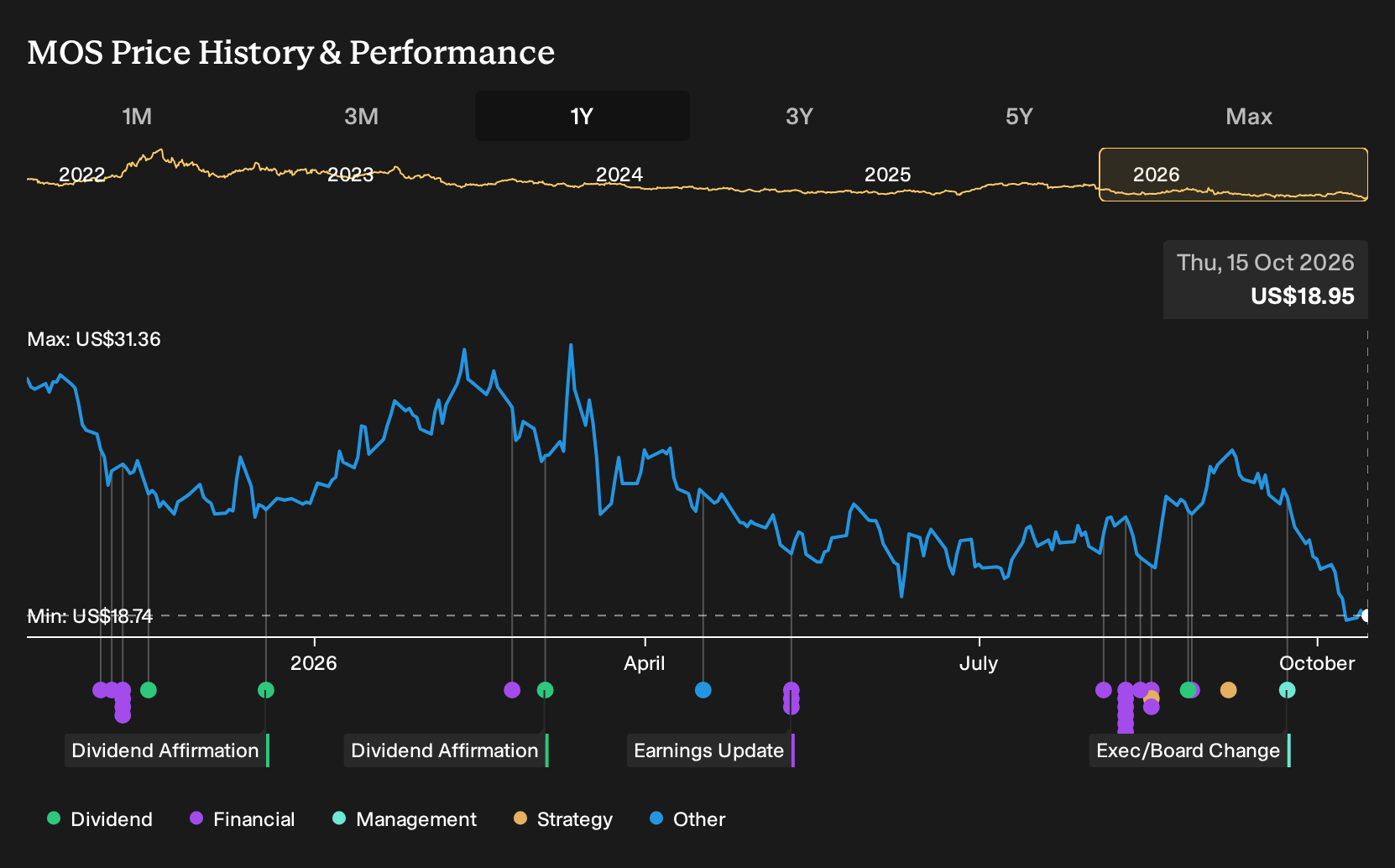
- Mosaic recently highlighted pressure from disrupted sulfur supplies and raw material closures, which are increasing production costs and contributing to phosphate output cuts as the firm heads into its upcoming third quarter 2026 earnings release and conference call.
- The combination of higher input costs and a spending plan that is expected to exceed 2026 cash generation raises fresh questions about Mosaic's cost structure resilience and balance sheet flexibility at a time when its phosphate operations face operational constraints.
- We now examine how Mosaic's investment narrative is being tested by sulfur-driven production costs and the upcoming third quarter earnings discussion.
Mosaic Investment Narrative Recap
To own Mosaic here, you need confidence that sulfur driven phosphate cuts are temporary and that the core fertilizer portfolio can still support the shift toward higher margin areas such as Mosaic Biosciences and rare earth projects. The recent sulfur squeeze raises near term concern around phosphate utilization and idle costs, but does not by itself rewrite that longer term thesis.
The short term catalyst is the upcoming Q3 2026 update on sulfur costs, curtailments at Bartow and Louisiana, and how these flow through to margins and cash generation. The main risk is that higher input prices and a spending plan above 2026 cash inflows keep the business cash flow negative and limit balance sheet flexibility.
The most relevant announcement is Mosaic's plan to release Q3 2026 results on November 3 and hold a conference call on November 4. That event gives you a clear checkpoint on how sulfur contracts, phosphate production levels, and SG&A cuts are interacting with the current cost squeeze.
This call also matters for the capital allocation story. Investors will be listening for detail on how Mosaic intends to fund about US$1.5b of capital expenditure and dividends against year to date operating cash flow of roughly US$270m, while still progressing portfolio reshaping and keeping leverage and interest coverage under control.
Mosaic's current analyst narrative points to revenues of US$13.2b and earnings of US$674.0m by 2029, based on an assumed 2.5% yearly revenue growth rate and an earnings swing of about US$1.31b from a loss of US$638.5m today to the 2029 consensus forecast.
Uncover why Mosaic's fair value indicates a 41% potential upside to its current price that could narrow quickly.
Exploring Other Perspectives
You can see a very different angle when you focus on the bullish catalyst around Mosaic’s working capital release. The most optimistic analysts were pencilling in revenue of about US$16.0b and earnings near US$1.6b by 2029, far above the consensus, and none of those projections yet reflect the latest sulfur driven production cuts or the upcoming Q3 call.
Explore 5 other Mosaic fair value estimates, including one that suggests potential upside of as much as 143% from the current price.
Decide For Yourself
Don't just follow the ticker. Dig into the data and build a conviction that's truly your own.
- A great starting point for your Mosaic research is our analysis highlighting 3 key rewards and 3 important warning signs that could impact your investment decision.
- See our latest analysis for Mosaic. The report includes a comprehensive fundamental analysis summarized in a single visual, the Snowflake, making it easy to evaluate Mosaic's overall financial health at a glance.
Looking for more investment ideas beyond Mosaic?
Once you have a handle on Mosaic's sulfur squeeze and cash flow trade offs, it can help to widen the lens and compare it with other businesses that offer different risk, income and balance sheet profiles. The Simply Wall St Screener lets you shift from a single stock story to a shortlist of companies that better fit your own tolerance for volatility, income needs and balance sheet strength.
- If you want potential upside without ignoring financial quality, consider a curated set of 20 high quality undiscovered gems that pair healthier fundamentals with underfollowed stories.
- If resilience matters more to you than excitement, scan a list of solid balance sheet and fundamentals (25 results) to find businesses that keep leverage and liquidity in tighter check.
- If steady income is near the top of your list, review a focused group of 8 dividend fortresses that balance higher yields with more robust underlying fundamentals.
This article by Simply Wall St is general in nature. We provide commentary based on historical data and analyst forecasts only using an unbiased methodology and our articles are not intended to be financial advice. It does not constitute a recommendation to buy or sell any stock, and does not take account of your objectives, or your financial situation. We aim to bring you long-term focused analysis driven by fundamental data. Note that our analysis may not factor in the latest price-sensitive company announcements or qualitative material. Simply Wall St has no position in any stocks mentioned.
Have feedback on this article? Concerned about the content? Get in touch with us directly. Alternatively, email editorial-team@simplywallst.com