


Does VeriSign Stock Face A Trust Test After Ending Third Level Name Domains
- VeriSign and ICANN previously decided to phase out third-level .name domain registrations, citing limited registrar backing and waning usage among customers.
- The move raises trust and continuity questions for long-time .name users who rely on these domains for essential services, and it may put pressure on VeriSign's approach to legacy products.
- We will now see how VeriSign's investment narrative could be affected by phasing out third-level .name domains and user concerns.
Stress test your trust thesis on VeriSign by comparing it with curated businesses that combine strong fundamentals and balance sheet resilience using the list of solid balance sheet and fundamentals (25 results)
VeriSign Investment Narrative Recap
Owning VeriSign long term means believing its .com and .net registries keep compounding steadily while contracts, pricing and regulation stay manageable. The immediate swing factor is still operational execution in those core zones and upcoming price changes, not the .name portfolio. The .name decision touches reputation, yet on its own it does not materially alter the near term growth or margin drivers.
The bigger risk remains anything that weakens the renewal outlook for .com and .net, from softer domain demand to pressure on contract terms as 2029 and 2030 approach. Insider selling and the balance sheet structure add a layer of perception risk that the .name noise may amplify for some shareholders.
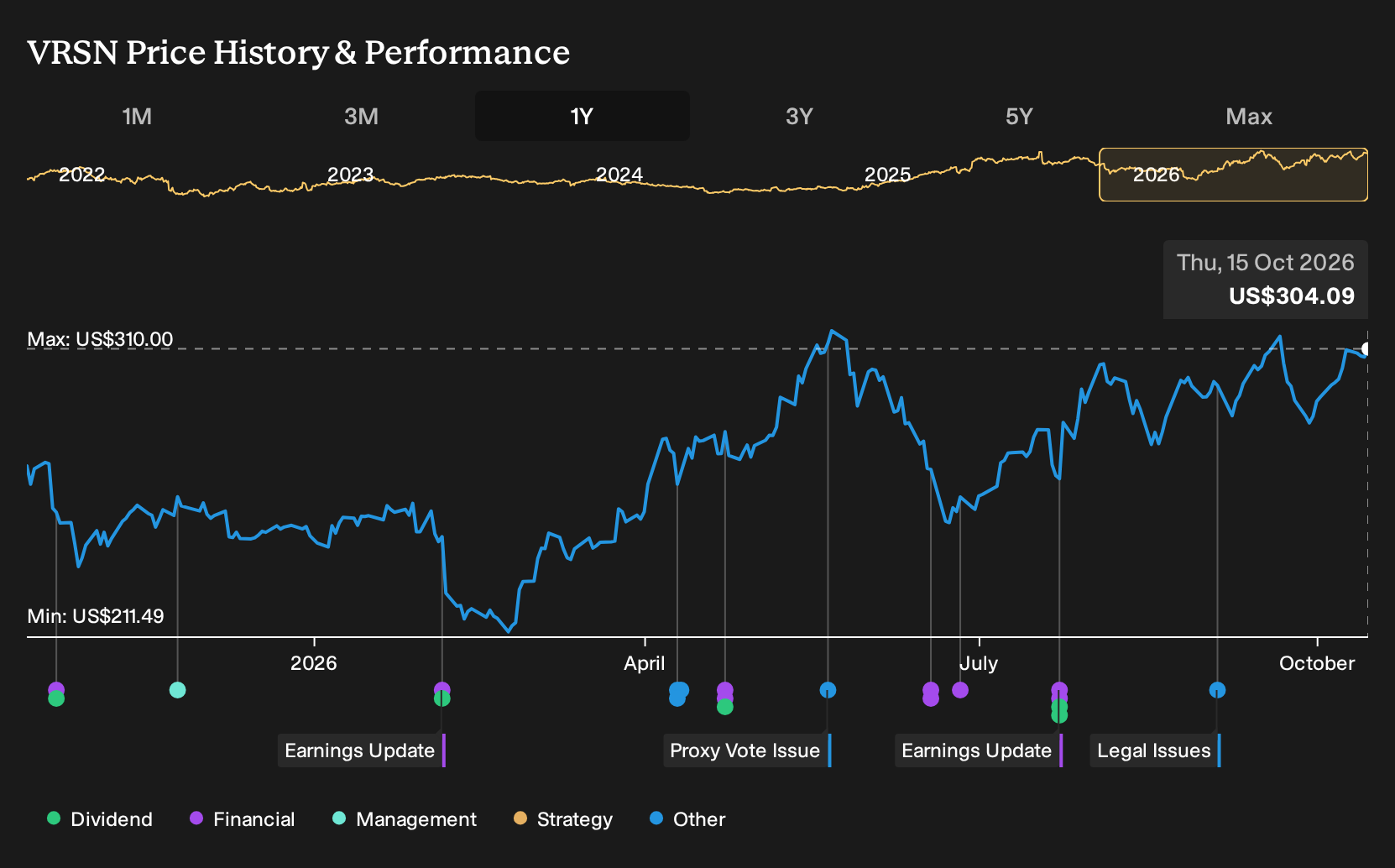
There has been no fresh headline specifically tied to this .name move, so the most relevant reference point is still VeriSign’s previously flagged pricing actions on .com and .net. Those scheduled wholesale increases from November 2026 and March 2027 underpin a key near term earnings catalyst, given the capital light model.
For you as an investor, the tension sits between that pricing power and the trust questions raised by decisions like ending third level .name registrations. Contract renewals, regulatory scrutiny and customer sentiment around legacy products all feed into how durable those price rises and high renewal expectations prove to be.
VeriSign's analyst scenario is based on projected revenues of US$2.2b and earnings of US$1.1b by 2029, assuming 8.8% yearly revenue growth and an earnings increase of about US$250m from current earnings of US$850.0m.
Discover why VeriSign's fair value indicates a 7% potential upside to its current price that could close sooner than many expect.
Exploring Other Perspectives
Some of the most optimistic VeriSign analysts lean hard into new security products and .web, and before this .name decision they were sketching out revenue of about US$2.3b and earnings near US$1.1b by 2029. You might see the .name move as a trust risk that could push those upbeat assumptions to change. Use it as a prompt to compare several viewpoints rather than rely on a single story.
Explore 5 other VeriSign fair value estimates, including one that suggests as much as 17% upside from the current price.
Reach Your Own Conclusion
Don't just follow the ticker. Dig into the data and build a conviction that's truly your own.
- A great starting point for your VeriSign research is our analysis highlighting 2 key rewards and 3 important warning signs that could impact your investment decision.
- See our latest analysis for VeriSign. The report includes a comprehensive fundamental analysis summarized in a single visual, the Snowflake, making it easy to evaluate VeriSign's overall financial health at a glance.
Looking For More Investment Ideas Beyond VeriSign?
If the VeriSign story has sharpened your thinking on quality, pricing power and risk, use that same lens across a wider watchlist. The Simply Wall St Screener lets you quickly filter for businesses that better match your own risk profile and return goals, instead of leaning on a single ticker.
- For investors who care most about financial resilience and cleaner balance sheets, start with this curated list of solid balance sheet and fundamentals (25 results) that already filters for stronger fundamentals.
- If value is your priority and you are hunting for quality at a reasonable price, sort through a focused set of 32 high quality undervalued stocks that may fit a more price conscious checklist.
- Anyone who prefers to let income work quietly in the background can review a targeted group of 8 dividend fortresses that combine higher yields with a focus on consistency.
This article by Simply Wall St is general in nature. We provide commentary based on historical data and analyst forecasts only using an unbiased methodology and our articles are not intended to be financial advice. It does not constitute a recommendation to buy or sell any stock, and does not take account of your objectives, or your financial situation. We aim to bring you long-term focused analysis driven by fundamental data. Note that our analysis may not factor in the latest price-sensitive company announcements or qualitative material. Simply Wall St has no position in any stocks mentioned.
Have feedback on this article? Concerned about the content? Get in touch with us directly. Alternatively, email editorial-team@simplywallst.com