


Unusual Options Activity in These 4 Stocks Shows Bull and Bear Vertical-Spread Setups
Consumer inflation hit 3.7% on Wednesday, up 0.6% from August. Tariffs, the Iran war, and AI have tightened their grip on higher prices as the November 3 mid-term elections approach.
After the Bureau of Labor Statistics' latest inflation report, markets fell yesterday, with the Nasdaq 100 leading the correction, down 2.02% on the day, while the S&P 500 lost 1.11% and the Dow was off only 0.09%.
With more interest rate cuts on the horizon, stocks are likely to get more volatile in the next few weeks. The CBOE Volatility Index, or VIX, is above 17 for the first time since early October.
Not to jinx anything, but we’re only four days away from the 39th anniversary of Black Monday, the day the Dow and S&P 500 lost nearly 23% and 30%, respectively, wiping out more than a trillion dollars of market cap.
I'm reading a book about options right now. The author is a fan of vertical spreads, so I'll focus on that in today’s commentary on unusual options activity.
If you invest in alternative asset managers, you've likely noticed their stocks aren’t having a good year. The VanEck Alternative Asset Manager ETF (GPZ) is down nearly 24% in 2026, suggesting higher interest rates may be weighing on their share prices.
Long term, I believe many of the ETF’s top holdings are worth owning. Coincidentally, the top 4, Brookfield (BN), Blackstone (BX), KKR & Co. (KKR), and Apollo Global Management (APO), all had unusually active options activity yesterday.
Here are some spreads to consider whether you’re bullish or bearish.
The Unusually Active Options in Question
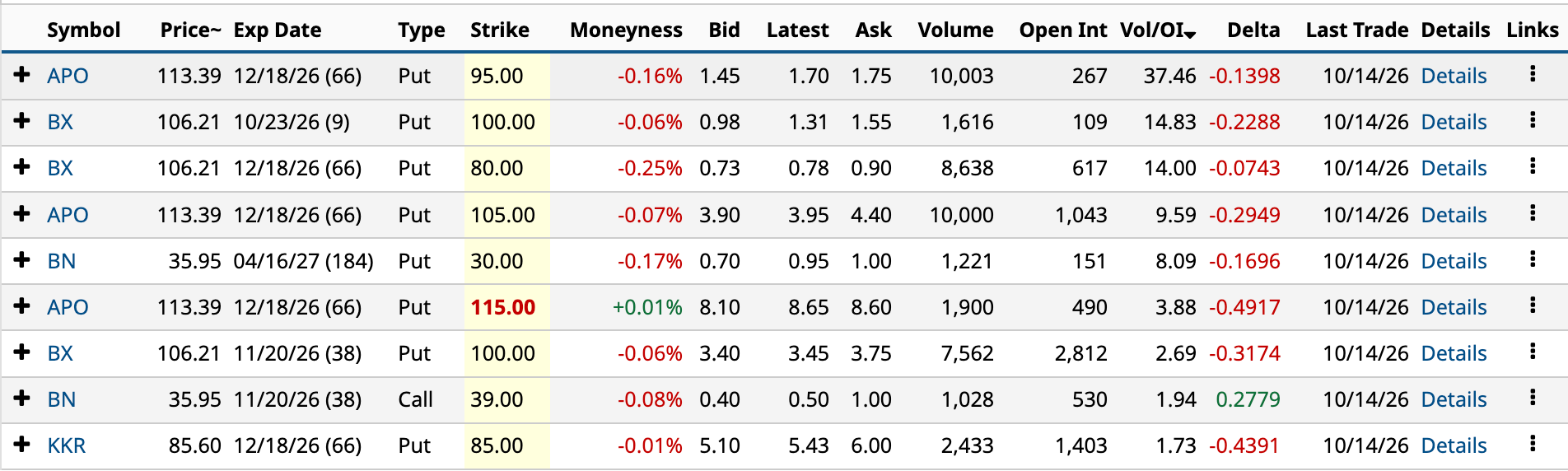
As you can see from above, the four alternative asset managers had nine unusually active options yesterday; all but one were puts. I define these as Vol/OI (volume-to-open-interest) ratios of 1.24 or higher, with volume and open interest of at least 500 and 100, respectively, and an expiration date of six days or more.
Apollo and Blackstone each had three, Brookfield had two, and KKR had one. I’ll discuss them in this order.
Apollo Global Management (APO)
All three unusually active Apollo options were puts expiring in 66 days on Dec. 18. Interestingly, the strike-price spread is $10 between the $95 and $105 puts and $10 between the $105 and $115 puts.
So, if you’re bullish and expect the share price to rise, which not many are right now, you’d go with a Bull Put Spread. This involves selling a put option and buying another put at a lower strike price. Below are five potential bets.



These defined-risk bets have a maximum profit and loss. From a probability-of-profit standpoint, the $105 put short and $95 put long have the best chance of making money at 71.4% (the opposite of the 28.6% loss probability). Don’t be put off by the 3.65-to-1 risk/reward ratio. The goal is to make money. However, all five have a better-than-50/50 chance of making money. That’s good.
The maximum loss of $7.85 [$105 strike price - $95 strike price - $2.15 net credit] occurs if the share price at expiration is at or below $102.85 [$105 strike price - $2.15 net credit]. The expected move by Dec. 18, up or down, is 11.30%, so hitting the maximum loss is not likely. The maximum profit of $2.15 (net credit) is achieved if the share price is above $105 at expiration.
Seasoned options traders would likely choose an expiration date shorter than 65 days. That said, Apollo reports earnings on Nov. 3, so the bull put spread has more than a month to recover from any post-earnings impact.
Now, if you’re bearish and expect the share price to fall, which many are, the Barchart Technical Opinion is a 40% Sell, you’d go with the inverse: a Bear Put Spread. This involves buying a put option and selling another put at a lower strike price. The three potential bets are shown below.



As you can see, the bear put spread has a much lower profit probability than the bull put spread, but a much higher reward.
The best bet of the three is a combination of the long $115 put and short $105 put. It would cost you a net debit of $4.70, which is also your maximum loss. The maximum profit is $5.30 [$115 strike price - $105 strike price - $4.70 net debit].
You’ll notice your maximum profit percentage is much higher than the bull put spread, but the risk/reward ratio is much lower. That doesn’t make it the better bet. To maximize profit, the share price must be below $105 at expiration, a 7.4% drop.
Looking at yesterday's options flow, you’ll see two trades for 10,000 contracts each at the same time.

While both trades are at the midpoint, I would lean toward this being an institution that already owns 1 million shares of APO, wants income, and wouldn’t mind buying 1 million more at $105.
Blackstone (BX)
Blackstone had three unusually active options yesterday, all with different expiration dates: Oct. 23 $100 put, Nov. 20 $100 put, and Dec. 18 $80 put.
Looking at the options flow, I don’t see any multi-leg, matched trades of 10 or more contracts for any of the three expiration dates, so I’ll go with the Nov. 20 $100 put because it’s right in the sweet spot for DTEs (days to expiration) between 30 and 45 days and match it with the $80 put expiring on Nov. 20.
The bull put spread shown below is followed by the bear put spread in Thursday morning trading.


The former has a 74.9% probability of profit, more than three times that of the latter. We’ll go with the bull put spread.
Your net credit from selling the $100 put short and buying the $80 put long is $2.31, a maximum profit percentage of just 13.06%. This is the equivalent of betting $10 to show (to finish 3rd place or better) on Secretariat at the 1973 Belmont Stakes--he won by 31 lengths, setting a world record for a 1.5-mile dirt track, running it in 2 minutes and 24 seconds, and winning the Triple Crown in the process.
Some bets are a proverbial lock. You make money if the share price is higher than $97.69 at expiration.
Brookfield (BN)
Brookfield had two unusually active options yesterday: April 16/2027 $30 put and Nov. 20 $39 call. Because it’s the only call, I’ll focus on the Nov. 30 $39 strike.
Across the various share-price combinations, the best bet for profit probability is a Bear Call Spread, a bearish bet that the share price will fall. It involves selling a call option for premium and buying another call at a higher strike price for a net credit.

In this situation, the long calls would be either the $40 or $41 strike price to go along with the short $39 call. I like Brookfield a lot, but this is about probabilities and making bank. With the same maximum profit percentage and risk/reward ratio, I’d choose the $40 call and a net credit of $0.10 because the maximum loss is half that of the $41 call, with a profit probability of 77.2%, just seven basis points lower.
KKR & Co. (KKR)
The final vertical spread is focused on KKR’s Dec. 18 $85 put. It saw one large trade of 2,300 contracts at 12:51:08 p.m. ET yesterday, accounting for nearly 95% of the put’s total volume, and 32% of KKR’s 30-day average.

Given the “sell to open” designation and the $5.70 trade price at the bid, it appears this single-leg trade was an institution selling 2,300 put contracts for $1.31 million in premium. If it expires worthless in December, that’s an annualized return of 40.4%. The institution most likely wouldn’t have a problem owning KKR at $79.30 a share, the cost after subtracting the $5.70 premium per share.
However, because we’re focused on vertical spreads, I’ll look for a bull put or bear spread that includes the $85 strike.
For the bull put spread, the best combination with the Dec. 18 $85 long put is the $87.50 put short, with a 46.2% profit probability (shown below). The best combination with the $85 short strike is the $60 long strike, with a 64.1% profit probability (shown below).


For the bear put spread, the best combination with the Dec. 18 $85 long put is the $82.50 put short, with a 44.1% profit probability (shown below). The best combination with the $85 short strike is the $105 long strike, with a 58.5% profit probability (shown below).


In this instance, two things matter: 1) Are you bullish or bearish about KKR stock? and 2) Are you comfortable with the $20 difference in strike prices with the short $85 put?
If you’re bullish and believe that the share price at expiration will be higher than the $86.60 breakeven, then the short $87.50 put with the long $85 put is the way to go because the maximum loss is only $1.60, nearly 13-fold less than the short $85 put combined with the long $60 put. However, the latter has a much higher success rate.
If you’re bearish and believe the share price will be lower at expiration, like the bullish example, you’ll have a better chance of making money by going with the short $85 put and the higher-priced long $105 put, at a 58.5% probability of profit.
It’s a lot to think about.
On the date of publication, Will Ashworth did not have (either directly or indirectly) positions in any of the securities mentioned in this article. All information and data in this article is solely for informational purposes. For more information please view the Barchart Disclosure Policy here.