


SpaceX Has Created New Subscription Bundles That Combine Grok, Cursor, and More. What This Means for SPCX.
SpaceX (SPCX) is quickly building a bigger AI business. In Q2 2026, its AI segment brought in $2.56 billion, about one-third of the company’s $7.8 billion in total revenue, as overall revenue rose 92% from a year earlier. Grok Bot, which entered beta on August 11, had 418,000 users by Sept. 14 after growing 24% in one week. SpaceX's $60 billion purchase of Cursor also added a software business reportedly generating $4 billion in annual recurring revenue.
Now, SpaceXAI is putting those services under one roof. Its new X Subscription combines Grok, X features, and Cursor coding tools across five plans, from a free option to a $200-per-month Ultra tier.
SpaceX already has meaningful AI revenue, but it is also spending heavily to grow. Can these bundles bring in enough steady subscription revenue to make a real difference for SPCX? Let’s take a closer look.
Inside SpaceX's New Subscription Strategy
SpaceX has launched X Subscription, which puts Grok, Cursor, Grok Bot, and X Premium features into one plan. The rollout started on Oct. 13. Existing subscribers can keep their plans or switch after linking their accounts. There are five tiers, starting with a free plan and ending with Ultra. SpaceX says the new plans offer more use of its in-house models for the money than the old standalone options.
Before this change, users could pay separately for Grok, Cursor, Grok Bot, and X’s premium features. Grok Bot access was already included in Cursor’s $20-a-month individual plan and $40-per-user Teams plan, as well as SuperGrok at $30 a month and SuperGrok Plus at $100 a month. Usage limits reset weekly, and users may face extra charges if they go beyond those limits.
The bundle also gives SpaceX a simpler way to sell the products it has brought together. The company bought xAI in February and later acquired Cursor for $60 billion. Cursor had more than 2 million developers, over 1 million daily active users, 1 million paying customers, and a reported $4 billion annual recurring revenue run rate. Putting everything under one account could make it easier for X users to try paid Grok or Cursor plans. For SPCX investors, the real test is whether more users upgrade and stay subscribed without AI costs rising faster than subscription sales.
Is SPCX's Foundation Solid Enough?
SpaceX showed strong growth in its first earnings report as a public company, but that growth came with high costs. In Q2 2026, revenue rose 92% from a year earlier to $7.81 billion, while its net loss narrowed to $541 million.
Adjusted EBITDA increased 191% to $3.5 billion. Starlink remained the main source of earnings, generating $4.29 billion in revenue and $1.56 billion in operating income. The AI business grew faster, with revenue up 247% to $2.56 billion, but it also posted a $1.25 billion operating loss. SpaceX finished the quarter with $100 billion in cash and marketable securities, along with a $47.5 billion backlog.
The stock reflects that mix of promise and risk. SPCX is up 12.51% over its roughly three months of trading and 3.52% in the past month, though it recently traded about 2% below its June IPO price.
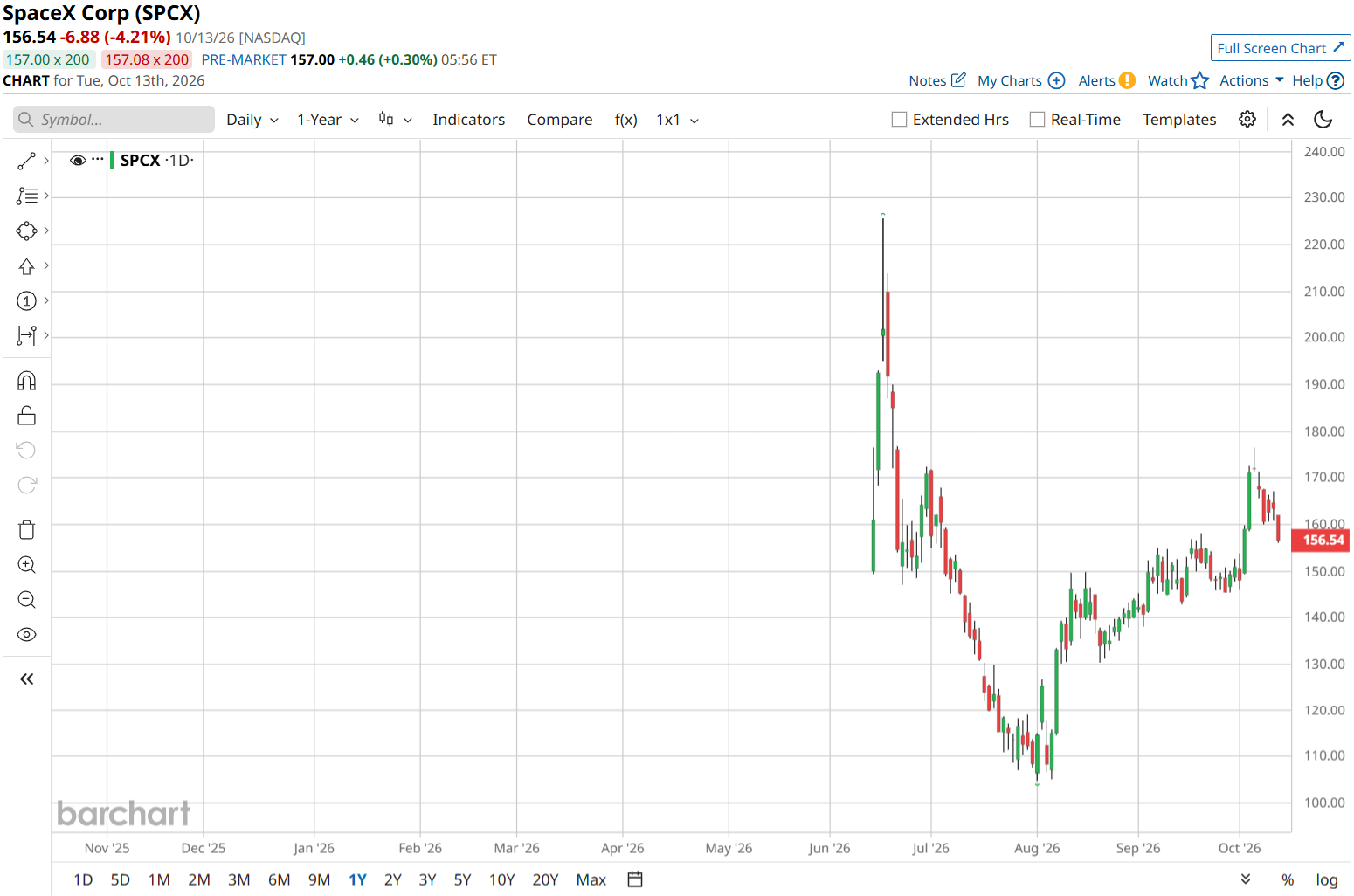
On Oct. 9, SpaceX agreed to buy up to 14 MHz of paired 800 MHz spectrum from Grain Management for about $8 billion. It also plans to use 65 MHz of EchoStar (ECHO) spectrum in its next-generation mobile service. The deal expands Starlink’s mobile plans, while the Grok-Cursor bundle gives SpaceX another way to grow subscription sales.
Where Do Analysts See SPCX Heading?
SPCX’s next earnings report is due Nov. 3. Wall Street expects quarterly earnings of $0.11 per share for the September 2026 quarter and full-year earnings of $0.07 per share for fiscal 2026.
That long-term framing is central to Morgan Stanley analyst Adam Jonas’ bullish case. Jonas recently reiterated a Buy rating and a $300 price target, arguing that SPCX offers relatively inexpensive exposure to AI infrastructure. His thesis rests on SpaceX’s ability to turn its spending across compute capacity, connectivity, and software into recurring revenue streams. That opportunity is substantial: CFO Bret Johnsen expects the company to reach $100 billion in annualized recurring revenue by year-end.
JPMorgan’s Doug Anmuth has also maintained an Overweight rating and a $240 price target. His view reflects the completed Cursor acquisition, Cursor’s reported $4 billion annual recurring revenue run rate, and rising confidence in Grok’s product trajectory.
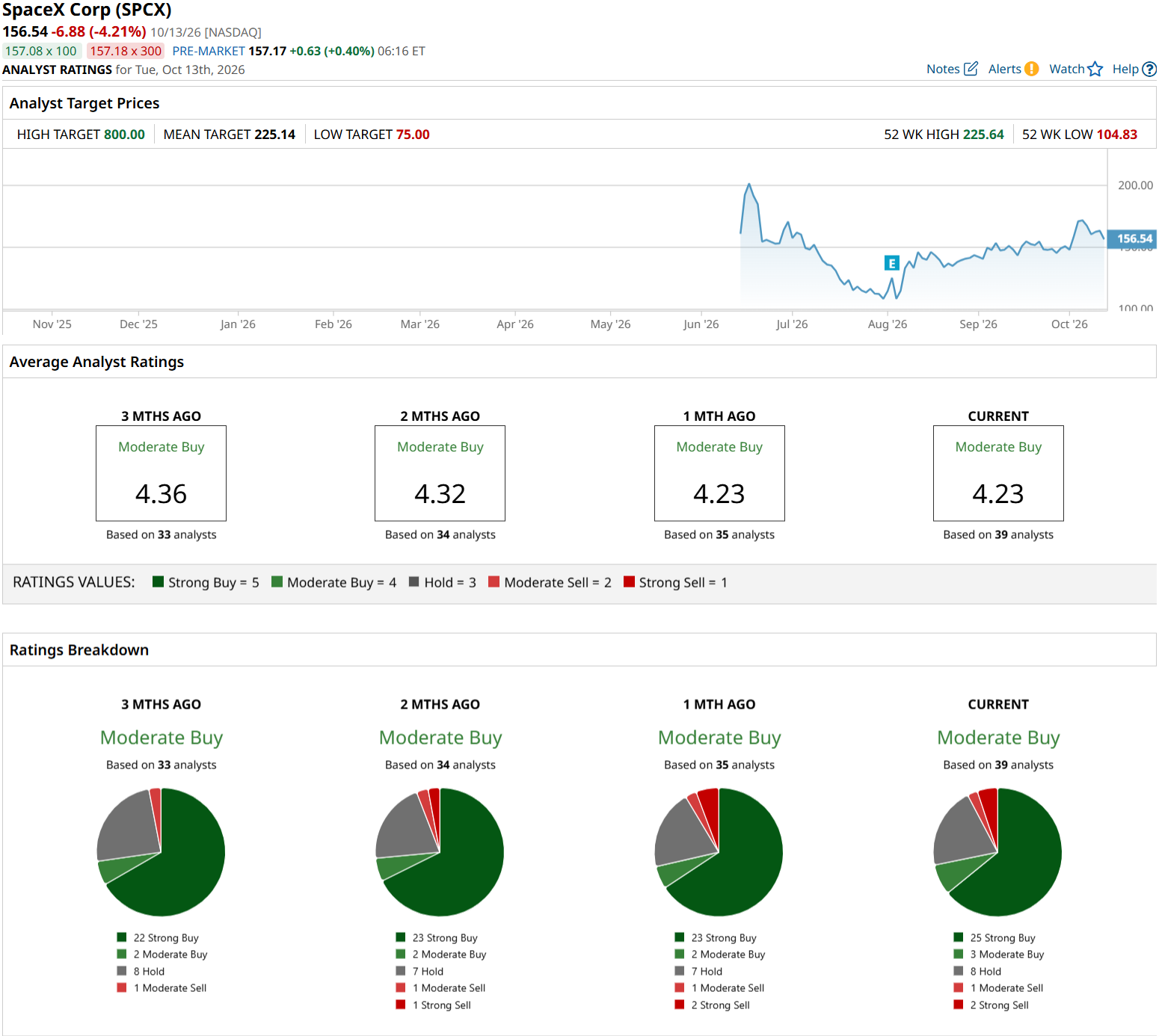
Analyst sentiment remains firmly favorable. All 39 surveyed analysts assign SPCX a consensus “Moderate Buy” rating, while the $225.14 mean price target implies 43.82% upside from current price levels.
Conclusion
The new bundle does not by itself settle the case for SPCX, but it gives the company a more coherent way to monetize the AI assets it has assembled. Bringing Grok, Cursor, Grok Bot, and X Premium under one billing relationship could improve cross-selling, retention, and recurring revenue if users see enough value to upgrade. Still, AI compute costs and execution risk remain material. Given the company’s growth profile, expanding AI revenue base, and favorable analyst outlook, SPCX shares appear more likely to trend higher over time, though the path could remain volatile until subscriber growth and margins validate the strategy.
On the date of publication, Ebube Jones did not have (either directly or indirectly) positions in any of the securities mentioned in this article. All information and data in this article is solely for informational purposes. For more information please view the Barchart Disclosure Policy here.