


How Investors May Respond To Peoples Bancorp (PEBO) Earnings Beat Expectations
- Peoples Bancorp is in focus after recent commentary highlighted its relatively high dividend yield of 4.67% and a track record of multiple dividend increases over the past five years.
- The same updates pointed to expectations for an earnings beat in the September 2026 quarter. This reinforces the picture of a bank leaning on both income generation and shareholder payouts to support its story.
- We will now assess how Peoples Bancorp's expected earnings beat and solid dividend profile could reshape its broader investment narrative.
Peoples Bancorp Investment Narrative Recap
To own Peoples Bancorp, you need to believe management can turn its growing scale, fee income mix and asset sensitive balance sheet into steadier earnings and support that 4.67% dividend yield. The short term swing factor is execution on loan growth and deposit mix while integrating recent acquisitions, so that net interest income holds up against any funding cost pressure.
The biggest risk right now is that the enlarged bank struggles to hit its revenue and efficiency targets, especially after modest historic revenue growth and pressure on net interest margin. If integration synergies or credit performance disappoint, the story around higher future earnings and a richer dividend profile could lose momentum quickly.
The most relevant update for this story is the expectation that Peoples Bancorp will beat earnings estimates for the September 2026 quarter, supported by a positive Earnings ESP and a Zacks Rank of #1. Recent upward revisions to consensus EPS and a record of four straight beats point to near term execution that aligns with the scaling and fee income thesis.
If the October 20 earnings release delivers higher revenue and EPS as anticipated, it could validate management’s integration roadmap and balance sheet positioning as catalysts. A miss, or softer outlook commentary, would refocus attention on prior concerns around margin pressure, acquisition execution risk, and how much support the dividend really gets from core profitability rather than forecasts.
Peoples Bancorp Forecasts and What They Assume
Peoples Bancorp's long term story ties directly to what analysts are building into their models today. The projections on revenue, profitability and future earnings give you a sense of how much improvement is baked into current expectations and how far the business needs to travel from where it stands now.
Peoples Bancorp's narrative projects US$1.1b revenue and US$313.5m earnings by 2029. This assumes 35.0% yearly revenue growth and an earnings increase of about US$196.4m from US$117.1m today.
Analysts are working off a view that annual revenue can compound at 35.0% for the next three years while profit margins edge higher from 27.0% to 29.3%. That combination points to a larger balance sheet and a bigger contribution from higher margin activities, all feeding into the forecast jump in net income from US$117.1m today to US$313.5m by 2029.
To line those earnings up with the current share price and target, the models assume Peoples Bancorp trades on a P/E of 6.0x in 2029, compared with 11.2x today and 11.5x for the wider US banks group. That is a meaningful reset in how the market would value each dollar of profit, which places more of the weight on the level of earnings achieved rather than on a rich earnings multiple.
Share count assumptions also matter. Analysts see the number of shares outstanding rising by about 0.7% per year over the next three years, which slightly dilutes existing holders and means absolute earnings have to rise faster for per share figures to track the same path.
On top of that, models apply a discount rate of about 7.2% to 7.24% to translate those 2029 cash flows back into today's terms. That rate reflects a view of risk and required return and it has a direct impact on what looks like a fair value for Peoples Bancorp at current prices.
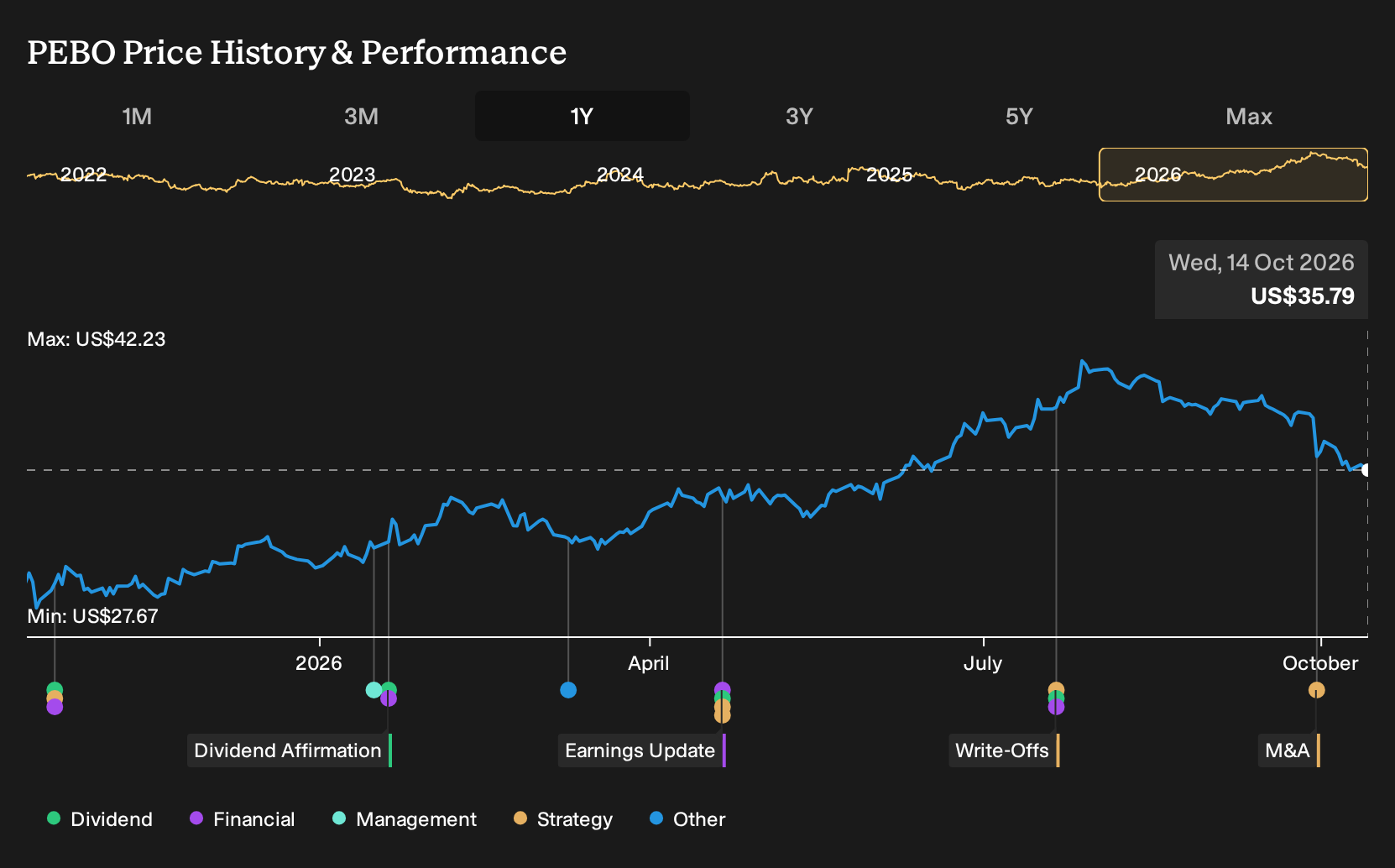
Uncover why Peoples Bancorp's fair value indicates an 18% potential upside to its current price that could narrow quickly.
Exploring Other Perspectives
Fair value estimates from 2 members of the Simply Wall St Community span roughly US$42 to US$77 per share, so private investors are publishing very different outcomes for Peoples Bancorp. That gap coincides with a fresh catalyst. Upcoming earnings expectations and acquisition execution risk give you plenty of reason to compare several alternative viewpoints before deciding how robust the story feels.
Explore another Peoples Bancorp fair value estimate, including one that suggests it could be worth just $42.33.
The Verdict Is Yours
Disagree with existing narratives? Extraordinary investment returns rarely come from following the herd, so consider forming your own view.
- A great starting point for your Peoples Bancorp research is our analysis highlighting 5 key rewards that could impact your investment decision.
- See our latest analysis for Peoples Bancorp. The report includes a comprehensive fundamental analysis summarized in a single visual, the Snowflake, making it easy to evaluate Peoples Bancorp's overall financial health at a glance.
Looking for more investment ideas beyond Peoples Bancorp?
If the Peoples Bancorp story has sharpened your focus on income, value and resilience, it can help to line it up against a wider watchlist. The Simply Wall St Screener lets you apply the same lens to other companies so you can see where the risk and reward trade off looks most compelling for your goals.
- For investors who want income without ignoring quality, review a curated set of income opportunities through the 7 dividend fortresses that meet strict yield and financial strength filters.
- If value is your main lens, compare Peoples Bancorp with a broader pool of potentially mispriced opportunities by scanning the 32 high quality undervalued stocks that pair strong fundamentals with more modest valuations.
- For a focus on resilience, stress test your portfolio ideas against balance sheet strength and earnings stability using the 32 resilient stocks with low risk scores to surface companies with lower overall risk profiles.
This article by Simply Wall St is general in nature. We provide commentary based on historical data and analyst forecasts only using an unbiased methodology and our articles are not intended to be financial advice. It does not constitute a recommendation to buy or sell any stock, and does not take account of your objectives, or your financial situation. We aim to bring you long-term focused analysis driven by fundamental data. Note that our analysis may not factor in the latest price-sensitive company announcements or qualitative material. Simply Wall St has no position in any stocks mentioned.
Have feedback on this article? Concerned about the content? Get in touch with us directly. Alternatively, email editorial-team@simplywallst.com