


Elon Musk Just Gave Investors Another Reason to Buy Micron Stock
Key Points
Memory is becoming a critical bottleneck for artificial intelligence (AI) infrastructure.
Musk publicly praised Micron during Tesla's earnings call and did so again this week on social media.
Micron is laying the foundation for long-term customer loyalty, suggesting the company can grow beyond today's cycle.
Just days ago, Elon Musk suggested that memory supply is a major bottleneck for artificial intelligence (AI) development. The CEO of Tesla and Space Exploration Technologies posted on X (formerly Twitter) that the problem boils down to RAM supply.
Now, Musk has gone a step further, singling out Micron Technology (NASDAQ: MU) for its approach to memory pricing.
Missed Nvidia in 2009? This Rare Signal Is Flashing Again. In 2009, a "Double Down" signal flashed for a little-known chipmaker called Nvidia. For the first time in years, that same "Total Conviction" signal is flashing for a company 1/100th the size of Nvidia. Continue »
His comments highlight something Wall Street may be overlooking, offering investors an important clue about why Micron's growth story might last considerably longer than the current semiconductor shortage.

Space Exploration Technologies and Tesla CEO Elon Musk. Image source: The White House.
Musk endorses Micron and calls out the competition
On Oct. 13, Musk wrote on X that Micron has been "reasonable" about future memory prices, while suggesting other suppliers are being "extortionate." He added that customers will not forget how suppliers treated them during the memory shortage, suggesting that Micron's approach is a smart move for "long-term customer loyalty."
That's a powerful endorsement from someone building some of the world's most ambitious AI infrastructure projects. Memory chips are essential tools for training AI models, running inference workloads, and supporting sophisticated autonomous systems across vehicles and robotics.
As demand accelerates, memory manufacturers are gaining substantial pricing power. But Musk's comments underscore how Micron is thinking beyond maximizing today's profits during the supply crunch. Instead, the company is smartly prioritizing relationships that could generate business as the AI infrastructure supercycle matures.
Micron's new customer strategy paves the way for long-term growth
Musk's post is particularly timely because Micron has adopted new multiyear strategic customer agreements (SCAs). During its latest earnings presentation on Sept. 30, Micron disclosed 26 strategic customer agreements covering at least 35% of projected revenue through 2030. In total, the company has $150 billion in remaining performance obligations (RPO) from the SCAs.
This is an important achievement for a company operating in one of the semiconductor industry's most cyclical markets. Historically, memory producers faced a familiar pattern: Demand surges, prices increase, manufacturers expand capacity, and eventually oversupply sends prices plummeting.
Micron's longer-term agreements should change that dynamic. By securing commitments from hyperscalers and large enterprises, Micron inherently gains more visibility into future demand. In turn, the company can plan manufacturing investments more effectively while potentially reducing its exposure to pricing swings.
Musk's commentary reinforces this exact strategy. If customers perceive that Micron is treating them fairly during periods of scarcity, they may be more inclined to commit future orders to the company.
Importantly, this does not mean Micron is sacrificing profitability. The company's latest financial results demonstrate just how lucrative the memory market has become. Micron's gross margin is materially higher than that of category leaders such as Nvidia, Broadcom, and Taiwan Semiconductor Manufacturing, each of which dominates a different layer of the AI chip value chain.
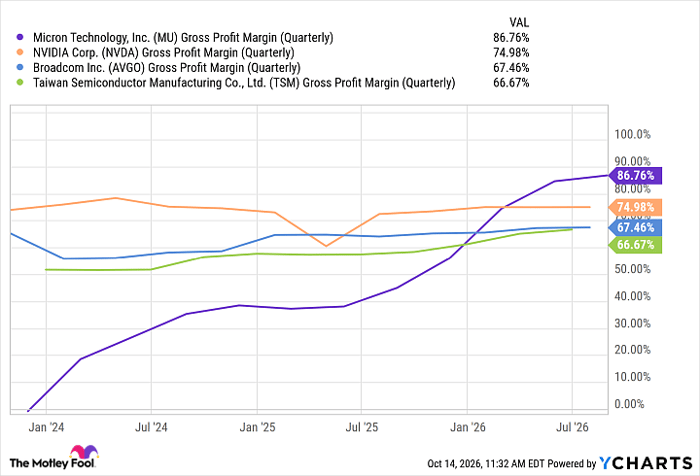
MU Gross Profit Margin (Quarterly) data by YCharts
Micron's real opportunity is to convert today's extraordinary demand into more predictable business relationships. For long-term investors, this is more important than squeezing every possible dollar out of the current memory shortage.
Micron stock looks like a no-brainer buy
Musk's overall point is that customer loyalty could become an important competitive advantage for Micron. Meanwhile, Wall Street expects the company to generate approximately $176 in earnings per share (EPS) during fiscal 2027. With shares trading around $938 as of this writing (Oct. 14), that translates into a forward price-to-earnings (P/E) ratio of approximately 5.3.
This is a modest multiple for a company benefiting from outsize AI infrastructure tailwinds. Even applying a relatively conservative multiple of 10 times projected earnings implies a stock price around $1,760, representing 87% upside from today's price.
I think there is a compelling argument that investors are undervaluing Micron stock right now. With multiyear customer agreements supporting the long-term outlook, Micron appears to be building customer loyalty and brand equity that will sustain growth beyond the current memory cycle. Combined with its attractive valuation, I see Micron as a no-brainer stock to buy and hold for the long run.
Adam Spatacco has positions in Nvidia and Tesla. The Motley Fool has positions in and recommends Broadcom, Micron Technology, Nvidia, Taiwan Semiconductor Manufacturing, and Tesla. The Motley Fool has a disclosure policy.