


TSM.US Q3 net profit increased 68.7% year-on-year, surpassing expectations. AI orders flooded in, and the 2nm process contributed 8% to wafer revenue
The Zhitong Finance App learned that TSM.US (TSM.US), a leading global foundry company, announced financial results for the third quarter of 2026 on Thursday. Driven by the continued influx of AI orders, the company's revenue and net profit for the quarter both exceeded analysts' average expectations, releasing a key signal that demand for computing power is still strong at a time when the market is becoming more cautious about AI-related transactions recently.
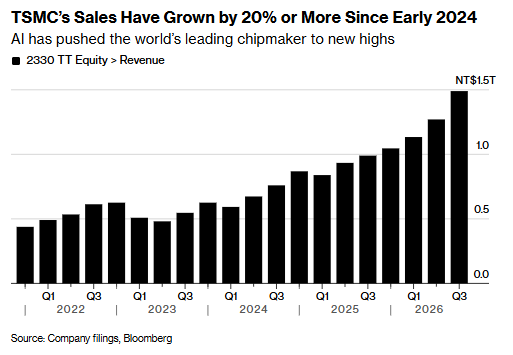
According to financial reports, consolidated revenue for the quarter was NT$1.494 trillion, up 50.9% year on year, up 17.6% month on month; net profit was NT$763.06 billion, up 68.7% year on year. Both were above market expectations. Earnings per share were NT$29.43. In US dollars, revenue for the quarter was 46.72 billion US dollars, up 41.2% year over year.
In terms of profitability, the quarter's gross profit margin was 66.4%, operating margin was 58.7%, and net profit margin was 51.1%. Looking at the process structure, the most advanced 2 nm process contributed 8% of wafer revenue during the quarter; 3 nm accounted for 33%, 5 nm accounted for 28%, 7 nm accounted for 10%, and advanced processes of 7 nm and below together accounted for 79% of wafer revenue.
As an exclusive OEM of the most advanced semiconductors from Nvidia (NVDA.US) and Apple (AAPL.US), TSMC's performance is regarded as an important weather vane for global AI demand. Major industry players such as Nvidia, AMD (AMD.US), and Google, a subsidiary of Alphabet (GOOGL.US), all rely on TSMC to transform cutting-edge chip designs into physical components.
Despite growing market concerns about long-term AI infrastructure construction, TSMC has maintained rapid growth, which has mitigated the negative sentiment faced by AI-related targets to a certain extent. However, concerns about return on investment and long-term financing downstream of the industry chain are still fermenting. Cloud service provider and Nvidia customer CoreWeave (CRWV.US) stock prices and bond prices plummeted during a widespread sell-off on Wednesday.
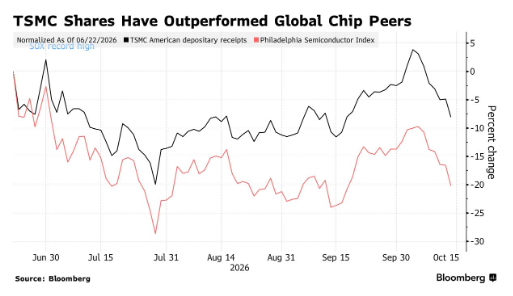
TSMC's sales growth continued to accelerate in the past two quarters, while simultaneously increasing production capacity expansion efforts. The company said that this year's capital expenditure will reach a maximum of 64 billion US dollars, a record. TSMC's stock price hit a record high this month, becoming one of the first chip stocks in the world to reach new highs after the market plummeted in July. With its dominant position in AI processor manufacturing, its stock price performance continued to outperform its peers, but it was still involved in an overall correction in technology stocks over the past week.
Market consensus expectations for TSMC's 2027 capital expenditure are continuing to improve. Goldman Sachs currently expects its capital expenditure to be $85 billion in 2027, and UBS estimates it to be $90 billion, all higher than the average estimate of $75 billion. The company is currently proceeding with the construction and equipment installation of about 20 factories, covering Taiwan and overseas. This rate is far higher than the rate at which it usually promotes 4 to 5 new plants at the same time.
According to reports, in addition to Arizona's $265 billion campus investment commitment, TSMC is also considering building an additional US plant in Texas due to the boom in US data center construction.
Industry research analyst Charles Shum pointed out in the report that the market focused more on TSMC's third-quarter results in 2027. The expansion of the Arizona plant, the possible establishment of a Texas hub, and Terafab-related negotiations may affect the dilution effect of the company's capital expenditure and overseas production capacity on gross margin; reports suggest that wafer prices have increased by 3% to 6%. Furthermore, updates to the next generation A14 process node and advanced packaging progress are expected to further clarify TSMC's response to Intel (INTC.US) challenges.