


Nike And 2 Other Top Dividend Stocks To Own
Inflation in the latest CPI report ran at 3.7%, pushed higher by fuel costs and heavy spending on AI data centers. That mix keeps pressure on interest rates and puts reliable income back in the spotlight. Investors looking for growing cash payouts, without chasing ultra high yields, are paying closer attention to companies that steadily raise dividends. This article highlights three such stocks with yields in the 2% to 5% range.
The three stocks in this article are just a starting sample, and the full screen surfaced 45 more companies with equally compelling dividend growth stories and earnings profiles that are not covered here.
To hunt for your own Type 2 dividend ideas with growing payouts and 2% to 5% yields, head straight into the Growing Dividend Payers with 2-5% yield screener.
NIKE (NKE)
Nike sits in this Growing Dividend Payers screen because its dividend story is increasingly tied to Nike Direct, where owned stores and digital channels aim to convert brand strength into recurring cash that can support a mid-range yield and measured payout growth.
"The November 2026 investor day is the deciding event. It will show whether management's targets support the recovery case or the conservative one."
What happens to that income profile hinges on how one pressure point in Nike's turnaround feeds through to future payout capacity.
That payout question is exactly what the full narrative for NIKE unpacks, including how different margin and Nike Direct scenarios could turn today’s mid-range yield into either a stall or an accelerator.

Accenture (ACN)
Accenture plugs into the Growing Dividend Payers theme through its higher margin digital, cloud and AI services, which sit on top of a broader consulting and outsourcing base and help underpin a dividend profile focused on steady growth rather than headline yield.
Accenture runs a global consulting and technology services business, with about US$22.5b from Products clients and roughly US$14.0b to US$15.0b each from Health & Public Service, Financial Services and Communications, Media & Technology, plus close to US$10.0b from Resources, and a market value around US$127.3b.
"The market is asking whether Accenture can convert AI from a threat into a growth engine. Accenture’s AI strategy is to be the enterprise AI implementation partner, not the foundation-model owner."
A single shift in how clients commit to longer term, recurring AI and cloud contracts could quietly reshape both earnings durability and dividend headroom.
That contract shift is the crux, and the full narrative for Accenture shows how Accenture’s AI work could accelerate recurring cash flows while reshaping risk in plain language.

Public Storage (PSA)
Public Storage keeps the Growing Dividend Payers theme grounded in something very simple: rent checks from thousands of storage lockers that aim to produce steady cash that can support a 2% to 5% yield and measured dividend increases over time.
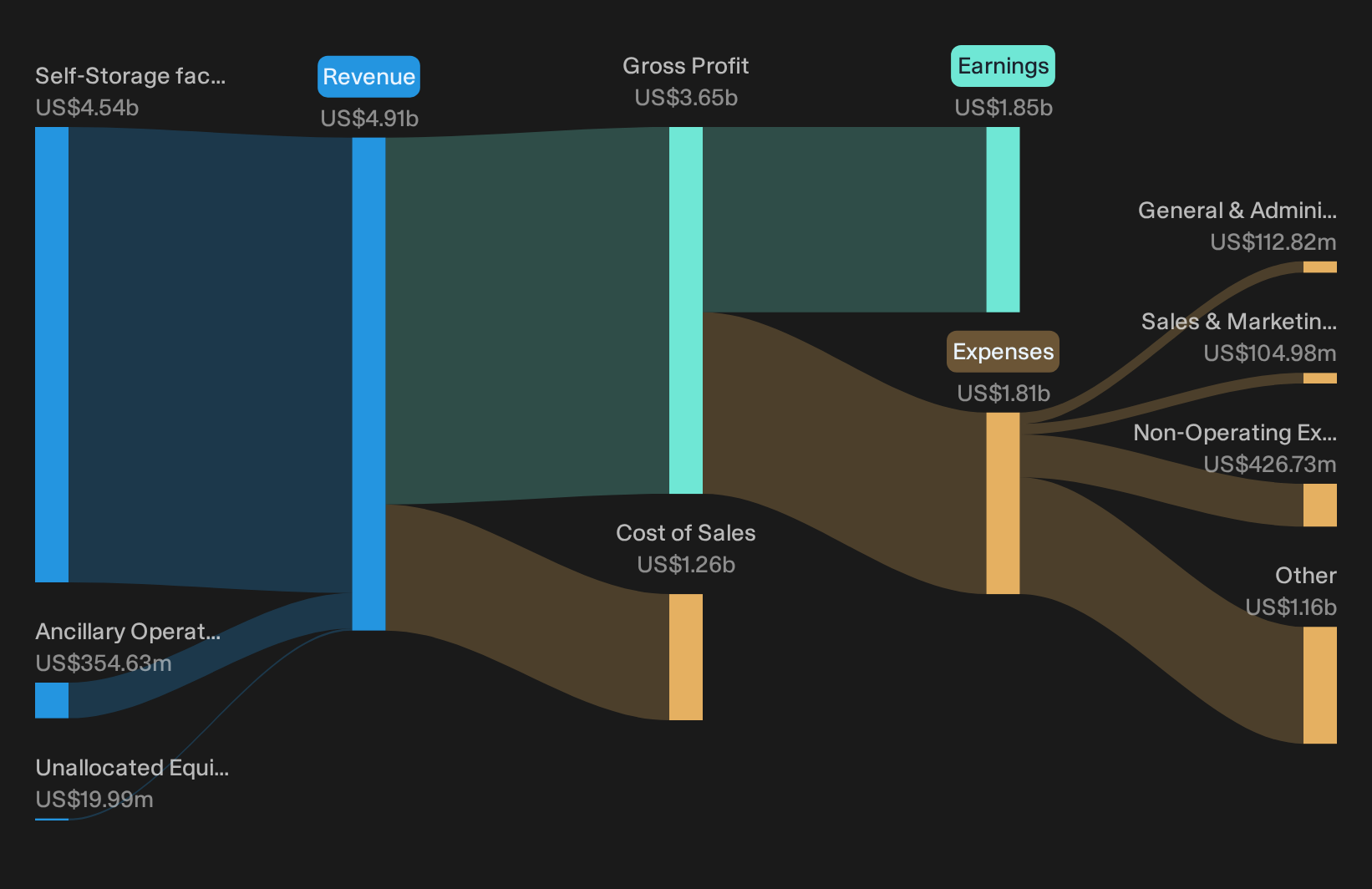
Public Storage is a US self storage giant that earns about US$4.5b from self storage facilities and roughly US$355 million from ancillary operations, with additional earnings from its Shurgard stake, and a market value near US$56b.
"Urban densification and shrinking residential living space in major metro markets continue to support demand for self storage, which can help Public Storage sustain occupancy and support future revenue growth as constrained housing markets persist."
What investors really need to watch now is how one large integration effort filters through to future cash yields and payout headroom.
That integration question is exactly what the full narrative for Public Storage tackles, explaining how acquisition execution, pricing power and capital allocation could be quietly reshaping Public Storage’s future income engine.
Seeking Fresh Alternatives Before They Fly
Fresh opportunities do not stay quiet for long. By the time momentum headlines hit, the best entry points can be gone. Check these curated ideas while it matters and get in early.
- Spot overlooked quality before momentum funds arrive by scanning the 20 high quality undiscovered gems that still trade under the radar for now.
- Track financial durability while markets chase stories and use the list of solid balance sheet and fundamentals (25 results) to see which businesses keep their numbers tight as sentiment swings.
- Position before the AI narrative gets crowded and review the 92 AI infrastructure stocks supporting the hardware and backbone behind the current software headlines.
This article by Simply Wall St is general in nature. We provide commentary based on historical data and analyst forecasts only using an unbiased methodology and our articles are not intended to be financial advice. It does not constitute a recommendation to buy or sell any stock, and does not take account of your objectives, or your financial situation. We aim to bring you long-term focused analysis driven by fundamental data. Note that our analysis may not factor in the latest price-sensitive company announcements or qualitative material. Simply Wall St has no position in any stocks mentioned.
Have feedback on this article? Concerned about the content? Get in touch with us directly. Alternatively, email editorial-team@simplywallst.com