


Forget Becoming the Next Tesla, Lucid Group Stock Has Been a Bottomless Pit
Things have been going from bad to worse for Lucid Group (LCID) stock, and it closed at a record three month low yesterday, Oct. 13. The stock has been slumping from one low to the next and has closed in the red every year since its mega listing in 2021. LCID hit its all-time intraday lows in July this year amid bankruptcy rumors. However, the company's swift denial and Saudi Prince Alwaleed Bin Talal Alsaud's subsequent disclosure of a 5% stake helped, momentarily at least, turn the tide.
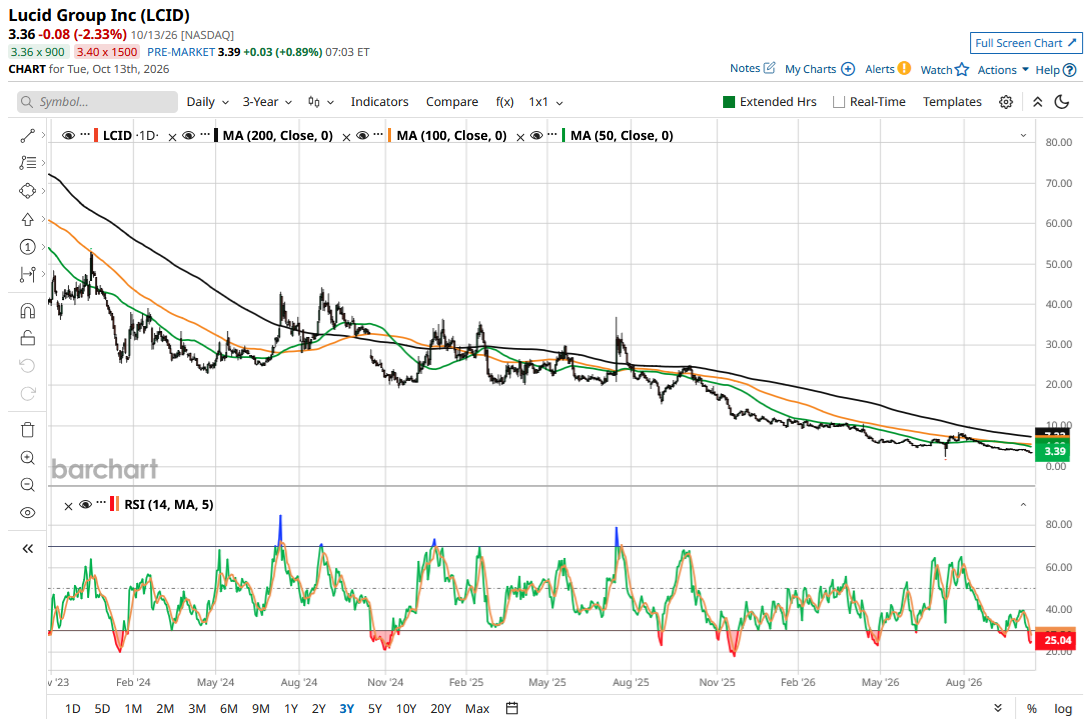
The Saudi Government Is Losing Big Time on Its Lucid Investment
The Saudi government is incidentally Lucid’s biggest shareholder through affiliates of its sovereign wealth fund, the Public Investment Fund (PIF), and the prince putting his own wealth into the company signaled that the country is not giving up on the struggling electric vehicle (EV) company. However, just as Lucid has been a losing proposition for PIF, and it has lost billions on its investment, even the Saudi prince’s investment has swung to paper losses.
LCID has been a bottomless pit, and the only thing keeping it afloat has been continued cash infusion from the PIF. Apart from directly investing in Lucid’s frequent stock sales, the PIF virtually provided a backstop in Lucid’s 2025 convertible bond sale by entering into a privately negotiated prepaid forward transaction. It also opened a delayed draw term loan credit facility for Lucid, from which the company drew another $400 million earlier this month.
Once Touted As the “Next Tesla”
During the EV boom years of 2020 and 2021, we often heard about the “next Tesla” and “Tesla killers.” No company perhaps came closer to that label than Lucid, as not only the sell-side analyst community but the company’s then-CEO Peter Rawlinson touted it as the next big thing in the EV industry after Tesla (TSLA).
Rawlinson, who has since departed the company, even predicted the EV industry to be a “two-horse race”—with Tesla, of course, being the other horse running. A mere glance at its special purpose acquisition company (SPAC) merger presentation would reveal how generously it benchmarked itself against Tesla, both in terms of car quality and valuations.
However, being ambitious is one thing and delivering on big predictions is another. Forget about becoming the next Tesla; Lucid is struggling for relevance. What a lot of “wannabe Teslas” failed to envision or incorporate was Tesla’s manufacturing prowess and the brand power—which has largely withstood the self-inflicted damage by CEO Elon Musk. To his credit, amid tepid vehicle sales, Musk successfully repositioned Tesla from an EV company to an autonomous driving and tech company, and subsequently to an artificial intelligence (AI) play with Optimus humanoid.
Despite having impressive technology that attracted interest from luxury carmaker Aston Martin, Lucid failed to create brand equity and awareness. If anything, its brand gets tarnished because it is constantly in the news for the stock falling to new lows, which raises concerns over the company's future. Buying a car is a long-term commitment, and most, if not all, buyers would want to be assured about the company’s sustainability.
Analysts on LCID Stock
Analysts have been gradually lowering Lucid’s target price, which is not surprising given the company’s state of affairs. Earlier this week, RBC lowered LCID stock's target price to $4, which is 50 cents higher than the Street-low target price that BNP Paribas has assigned to the stock. LCID's mean target price of $7.72 implies it more than doubles over the next year, but I won't harp much on that number given the frequent downside adjustments.
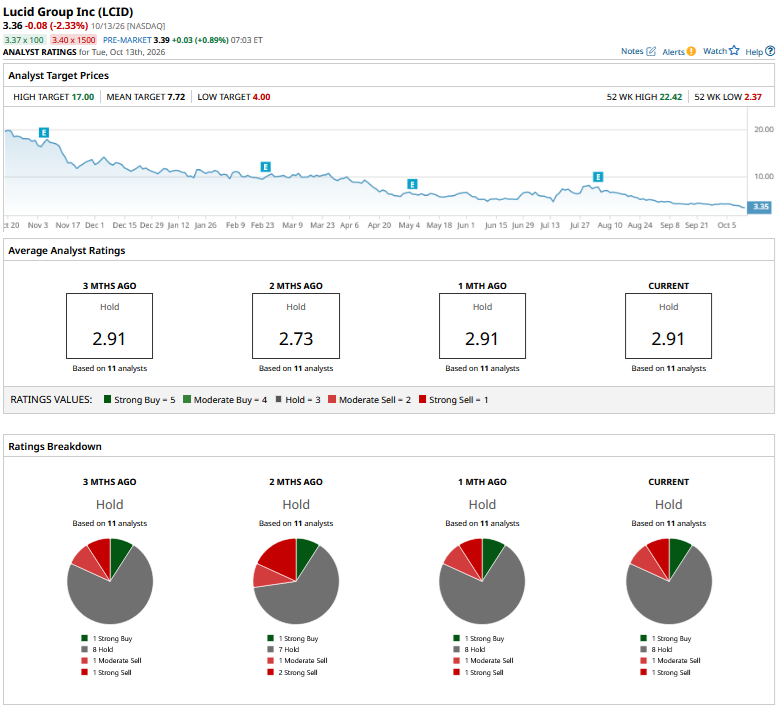
For Lucid, a lot relies on the upcoming midsize platform and potential tech-sharing partnerships with other automakers. On the former, its track record hasn’t been great, and for all practical purposes, the Gravity SUV, once touted as a gamechanger, failed despite the accolades. On the tech partnership front, automakers don’t see EVs as a promising sector as it once seemed; no wonder there haven't been more Aston Martin-like deals for Lucid in years.
In my previous article, I noted that Lucid could have bottomed even though only speculative investors should consider the stock. I was wrong on the bottoming part, as it has plummeted below $4, with its market cap falling below $1.5 billion. I maintain the same view on Lucid and see it as a speculative play that can rally on positive announcements.
On the date of publication, Mohit Oberoi had a position in: TSLA . All information and data in this article is solely for informational purposes. For more information please view the Barchart Disclosure Policy here.