


How Investors May Respond To Treasury Wine Estates (ASX:TWE) Permanent CFO Appointment
- Treasury Wine Estates has confirmed Justin Pipito as Group Chief Financial Officer after he served as Interim Chief Financial and Strategy Officer since June 2026, formalising a leadership path that began with regional CFO roles across Australia, New Zealand, Asia and Penfolds.
- The appointment of an internally experienced CFO who has worked across key geographies and brands may influence how Treasury Wine Estates manages capital allocation, cost discipline and regional performance in its premium and luxury portfolio.
- We will now explore how Treasury Wine Estates' investment narrative could be affected by Justin Pipito's appointment as permanent Group CFO.
See how Treasury Wine Estates compares with other capital-disciplined, globally focused businesses in our hand-picked list of solid balance sheet and fundamentals (12 results).
Treasury Wine Estates Investment Narrative Recap
To own Treasury Wine Estates, you need to be comfortable with a luxury heavy model that leans on Penfolds, Asia and premiumisation while the broader wine category looks mixed. The most important near term swing factor remains how well the group converts that premium focus into consistent cash generation in markets like China and the United States without overextending inventory.
Justin Pipito stepping in as permanent Group CFO should not fundamentally change that near term catalyst. His long tenure across regions means continuity on capital discipline and portfolio focus. The bigger risk still sits with demand volatility, pricing pressure and category softness in commercial and premium brands, rather than the finance leadership itself.
The stand out announcement linked to this CFO move is the board decision to run a full internal and external process before confirming Pipito. That indicates the board weighed continuity against the recent reset in profitability, given Treasury Wine Estates is currently loss making and has seen losses rise over the past five years.
Analysts currently expect earnings to recover over the next three years, and revenue growth assumptions are relatively modest. In that context, execution on cost control, capital allocation and inventory is critical. A CFO who already understands the Australian, U.S. and Asian parts of the portfolio is likely to focus on these operational levers, which is closely tied to whether those earnings forecasts and margin expectations can be met.
Treasury Wine Estates' current analyst narrative points to revenues of A$3.3b and earnings of A$605.8m by 2028. That profile is based on assumed 3.6% yearly revenue growth and an earnings move of about A$168.9m from A$436.9m today to the 2028 consensus level.
Uncover why Treasury Wine Estates' fair value is essentially aligned with its current price.
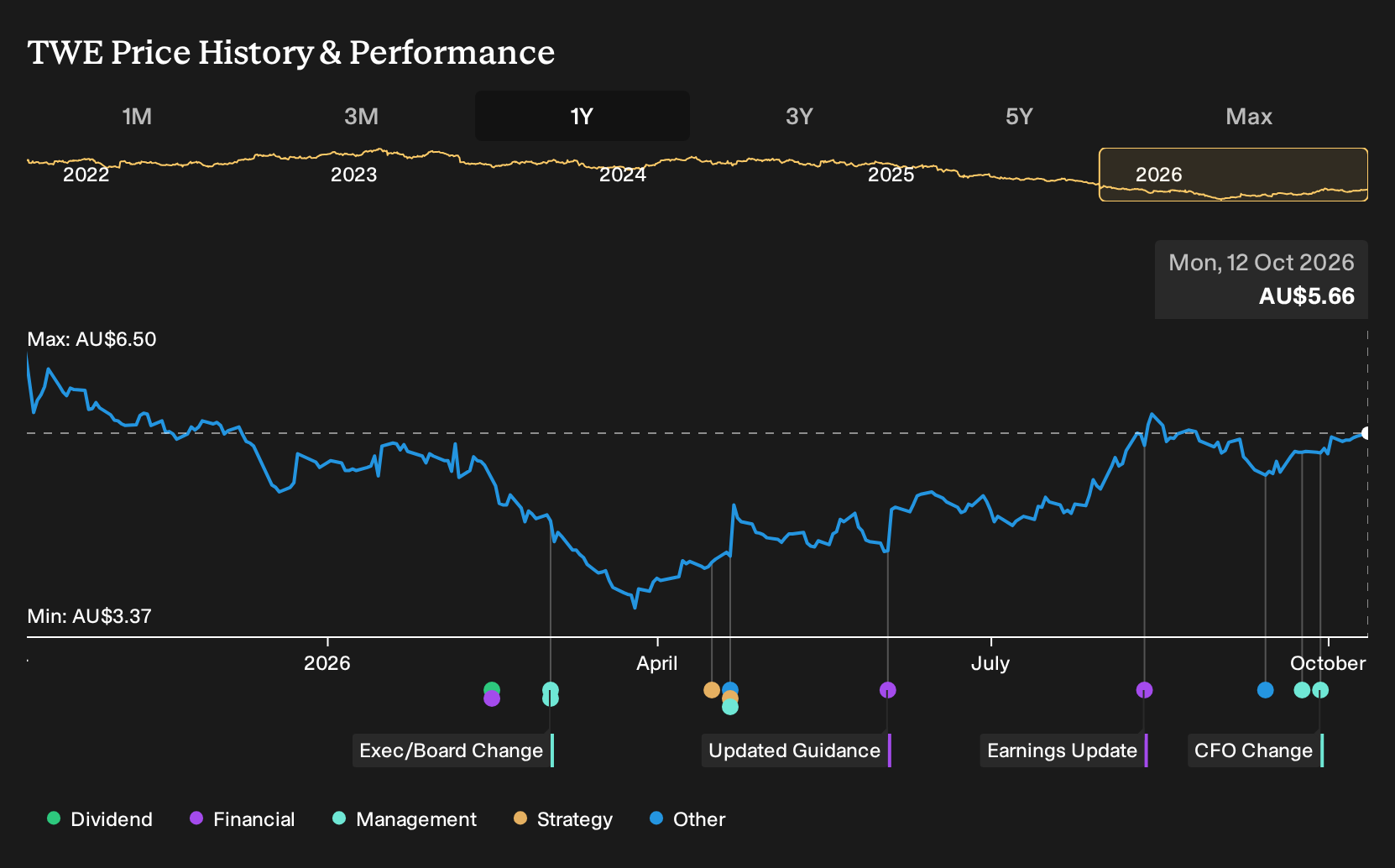
Exploring Other Perspectives
One alternate storyline around Treasury Wine Estates focuses on upside from luxury in China and the Americas. The most optimistic analysts were already pencilling in A$3.6b of revenue and A$665.2m of earnings by 2028 before this CFO news. Those expectations could shift in either direction, as investors reassess Pipito’s potential impact.
Explore 4 other Treasury Wine Estates fair value estimates, including one that suggests as much as 193% upside from the current price!
Reach Your Own Conclusion
Don't just follow the ticker. Dig into the data and build a conviction that's truly your own.
- A great starting point for your Treasury Wine Estates research is our analysis highlighting 2 key rewards that could impact your investment decision.
- See our latest analysis for Treasury Wine Estates. The report includes a comprehensive fundamental analysis summarized in a single visual, the Snowflake, making it easy to evaluate Treasury Wine Estates' overall financial health at a glance.
Looking For More Investment Ideas Beyond Treasury Wine Estates?
If Treasury Wine Estates has sharpened your focus on quality, you can apply that same approach across the wider market with the Simply Wall St Screener. You can filter for different return profiles, balance sheet strength and income potential, then build a watchlist that suits your own goals.
- For investors seeking quality at a reasonable price, start with a curated pool of companies using the 4 high quality undervalued stocks.
- If capital preservation is a priority, focus on businesses with steadier profiles by scanning the 7 resilient stocks with low risk scores.
- Income-focused investors who want yield while still considering fundamentals can review the 5 dividend fortresses as a starting shortlist.
This article by Simply Wall St is general in nature. We provide commentary based on historical data and analyst forecasts only using an unbiased methodology and our articles are not intended to be financial advice. It does not constitute a recommendation to buy or sell any stock, and does not take account of your objectives, or your financial situation. We aim to bring you long-term focused analysis driven by fundamental data. Note that our analysis may not factor in the latest price-sensitive company announcements or qualitative material. Simply Wall St has no position in any stocks mentioned.
Have feedback on this article? Concerned about the content? Get in touch with us directly. Alternatively, email editorial-team@simplywallst.com