


Too Many Investors Don’t Understand How Bonds Work
Too many investors do not understand how bonds work.
A nine-year-old study indicated that only 28% of adult Americans knew that when interest rates go up, bond prices go down. Several other studies since that time have produced similar results. Frankly, with rates being so low for so long, I’m not pointing a finger here. I’m pointing out that in late 2026, bonds matter again.
So it follows that knowing how they work is valuable. If you are now under age 70, you probably were not paying that much attention to your portfolio the last time bonds mattered 15-20 years ago.
That might explain why the iShares 20+ Year Treasury Bond ETF (TLT) went from a popular ETF in 2021 to the default for bond investing a couple of years later. Its assets doubled to $39 billion, roughly during the time its price was being cut in half. That’s the purple circle here.
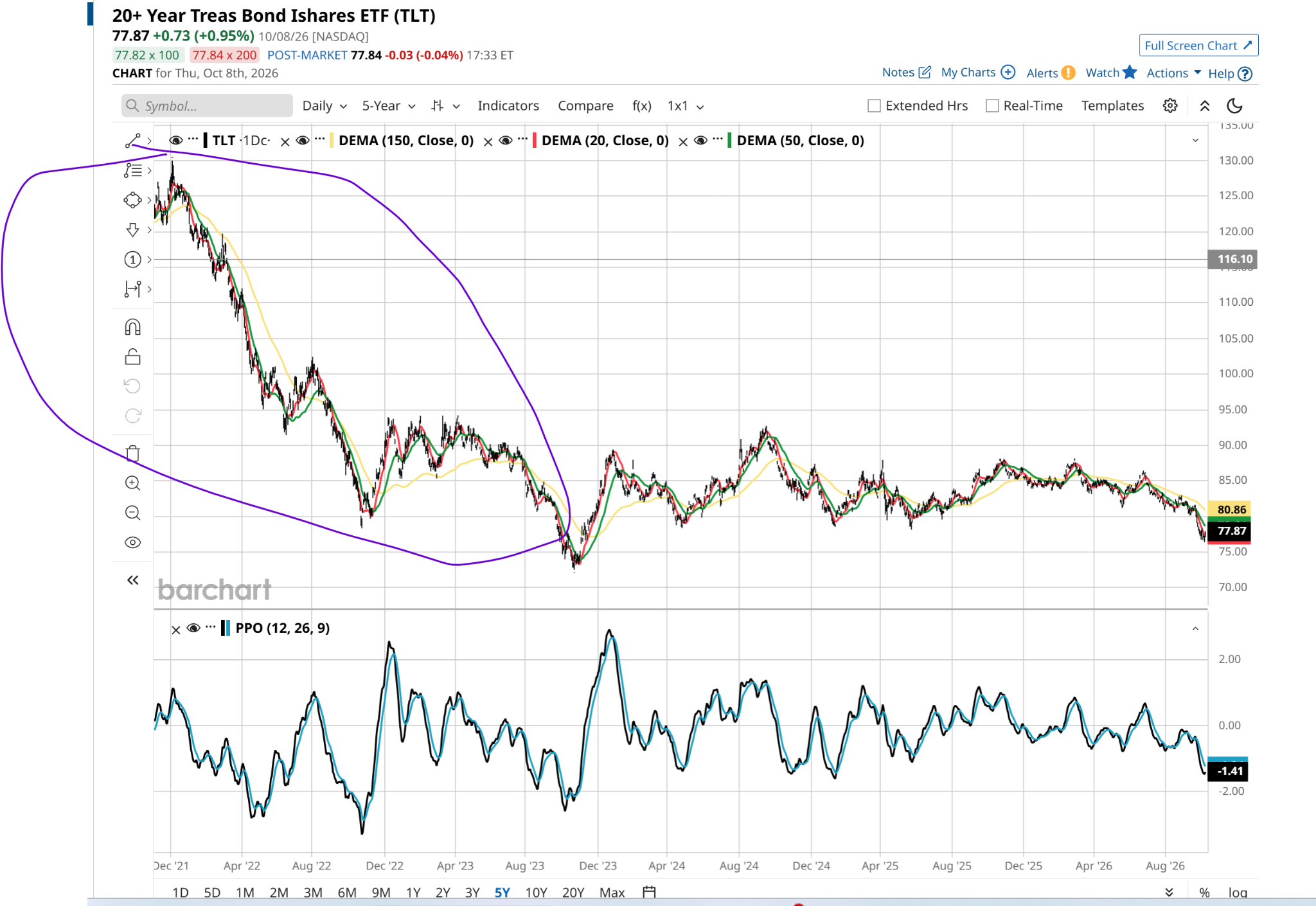
Buying the dip is popular in stocks, and I do believe that it should get more publicity as a bond investing approach too. But that’s not “BTD” behavior to me. It was probably a belief that rising rates meant bonds were automatically better to own.
Buying TLT on the fly, thinking that higher yields mean the bond’s value is rising… when it is absolutely falling… is another thing entirely. This is at the core of the little mini-series I’m thrilled to be a part of here on risk management, which we affectionately call “Look Both Ways Before You Cross Wall Street.”
So when I read that according to recent data from Bloomberg Intelligence ETF analyst Athanasios Psarofagis, shared by Bloomberg’s Eric Balchunas, roughly 50% of all bond ETFs are currently posting negative one-year nominal returns, my reaction was a simple: “of course they are!” Bonds are just doing what bonds do:
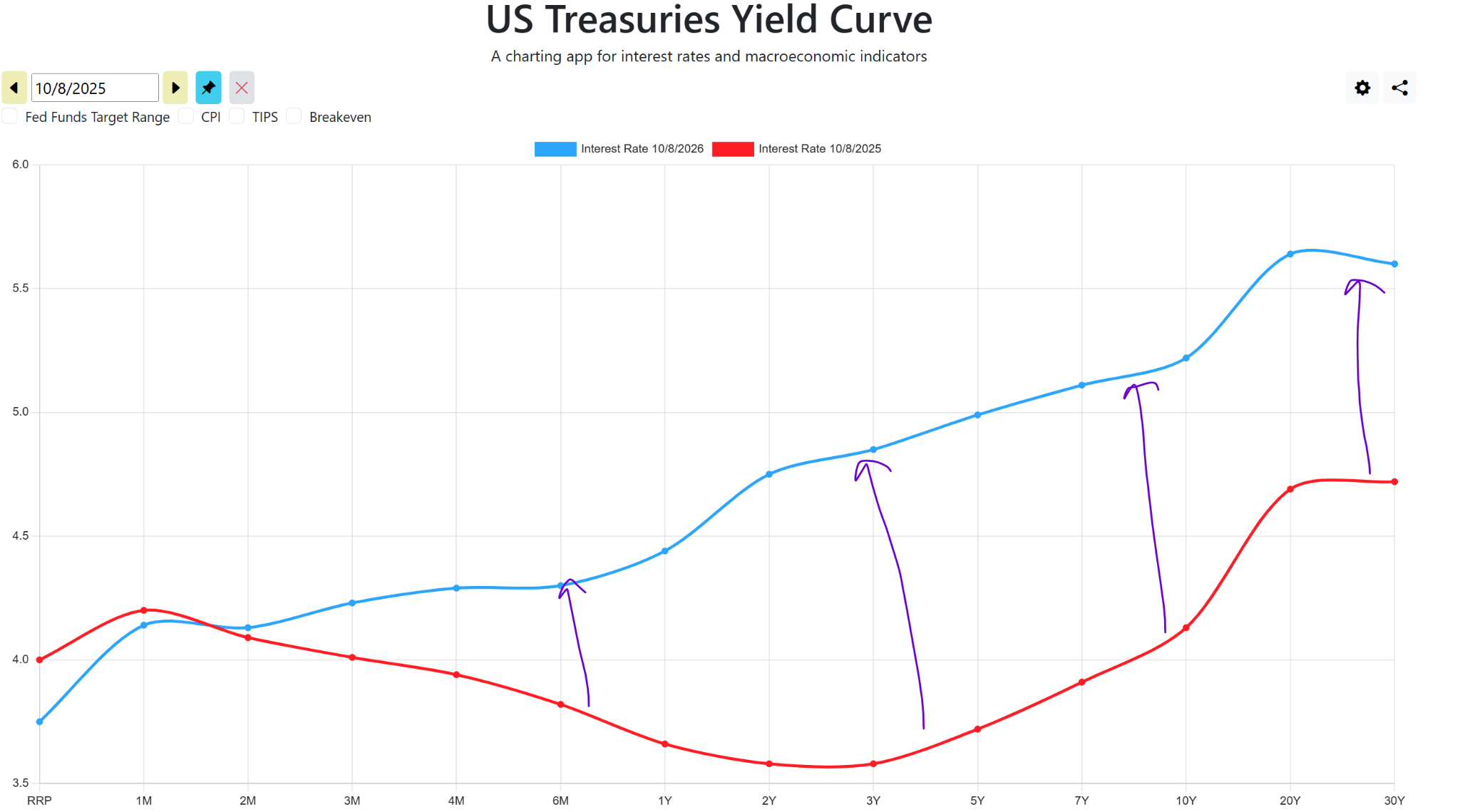
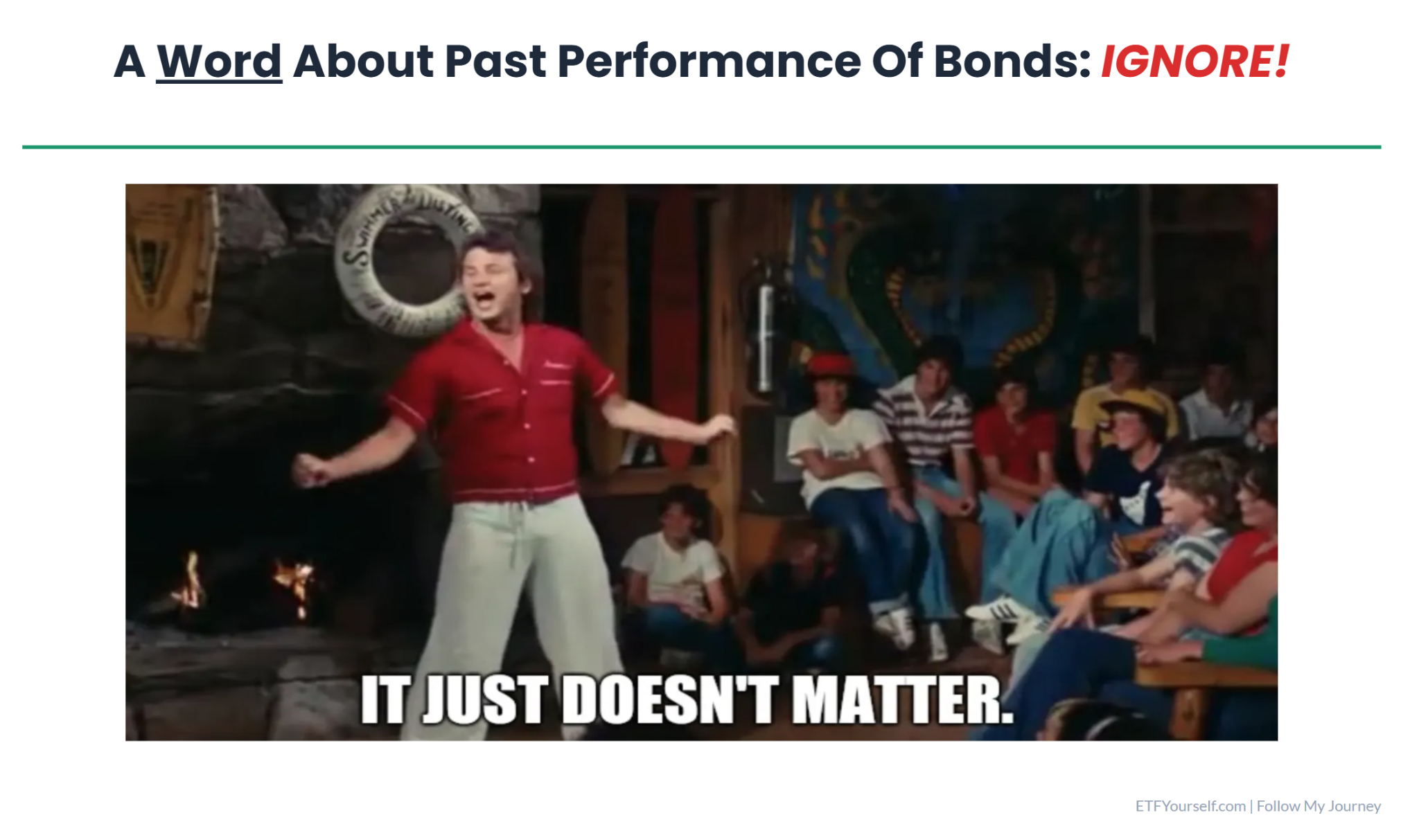
Yes, I’d say that’s more than 50% of bond ETFs taking a header, as they say. But as I told a live audience at a conference the other day, IGNORE is the one-word suggestion I have when it comes to past performance of bond ETFs. Here’s the slide I used to convey that point.
To the average passive buy-and-hold investor, a headline like that sounds like a reason to run for the hills. If half the market’s fixed-income funds are sitting in red ink over the past 12 months, why touch them?
Because bonds are not like stocks. They don’t rely on earnings. They do have a “valuation” measure of sorts. That’s the yield to maturity a bond trades at.
And they are dependent on “management’s execution,” especially with corporate and municipal bonds. For U.S. Treasuries, my primary focus, that’s a more long-term assessment. As in the confidence investors have that the one place that can print money will be able to pay its bills over time.
Money printing helps delay that. But concerns about potentially having to use a period of hyperinflation to repay the debt is a viable, modern market concern. The bottom line on past performance is that those metrics tell you where an asset has been, not where it is going.
Bond ETFs, like the vast majority of passive ETFs, are doing exactly what they are supposed to be doing. The problem isn’t the product, it is how investors are using the asset class.
Bonds CAN be a slot in an asset allocation mix. However, a chart like this one makes me increasingly confident that the best way to look at bonds is not as a slice, but as an anchor tenant.
I’ll expand on that, but here’s my thinking in a nutshell. Over the next five years, how much will the stock market make? If it is not much more than 7% a year, and participating in it means dealing with the algorithmic trading machines and other shenanigans which are now embedded in equity investing, maybe not.
Do I want to allocate to that “possessed” stock market as heavily as in the past?
Relatedly, if you treat a generic broad-market bond fund (like (AGG) or (BND)) as a passive “set-it-and-forget-it” holding, you remain permanently exposed to interest rate duration drag. That is, if rates go up for another few years, to maybe 8%-10%, you are always playing catch up. Unless you hedge, which is my approach for sure.
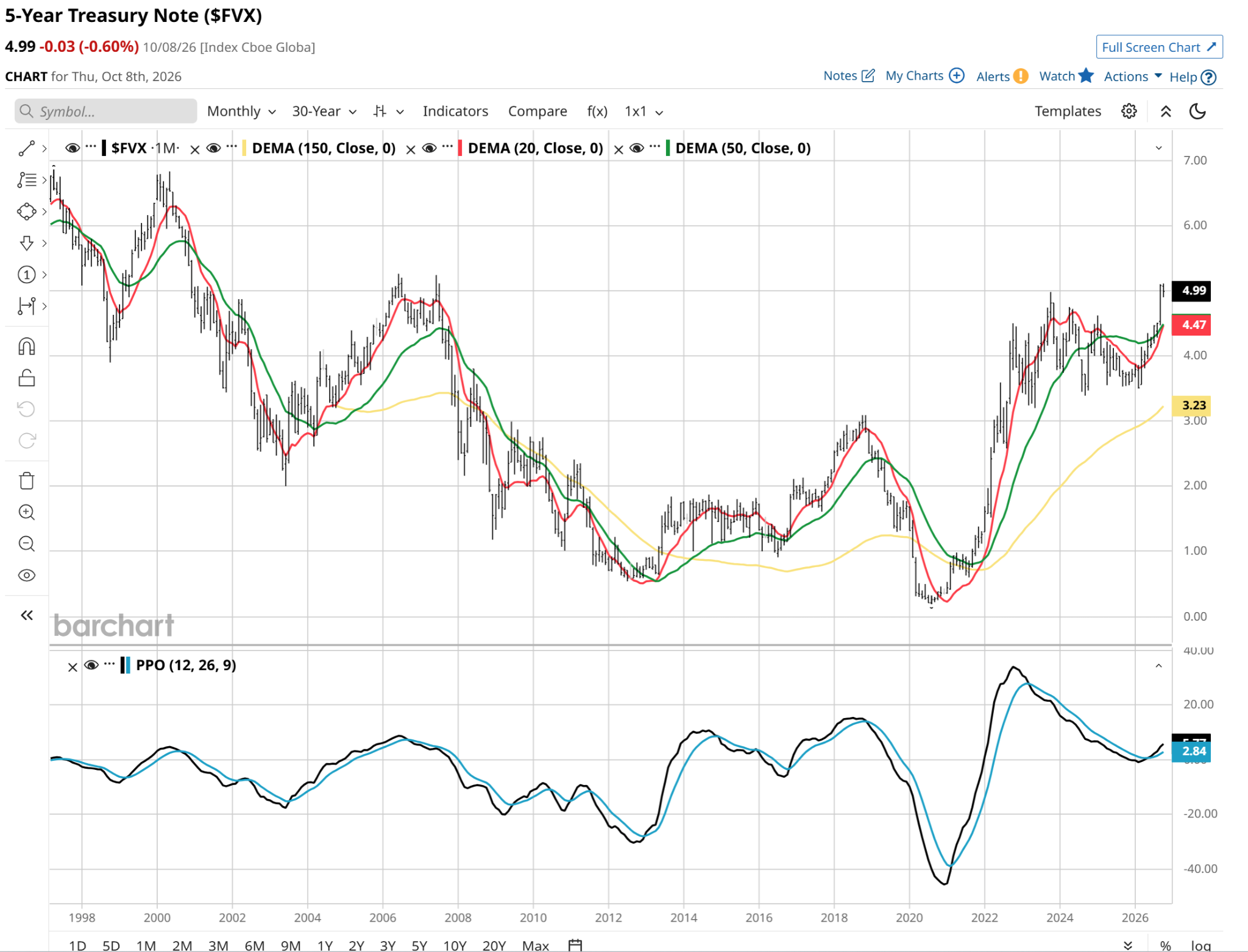
Unlike stocks, where future earnings multiples require educated guessing, bond math is transparent. With 5-year Treasury Note yields ($FVX) holding above 5%, you are getting paid a real, substantial income stream for a half decade that in my view, will be no more “normal” than the past five were.
Keep that in mind when you glance at a bond ETF performance record, and think it matters. Because right now, nothing in investing could matter less.
Rob Isbitts is a semi-retired CIO, former fiduciary investment advisor, Barchart columnist, and professional straight-talker. Download his new free e-book on hedged bond investing for retirement at ETFYourself.com. His research and model portfolios are at ROAR.PiTrade.com.
On the date of publication, Rob Isbitts did not have (either directly or indirectly) positions in any of the securities mentioned in this article. All information and data in this article is solely for informational purposes. For more information please view the Barchart Disclosure Policy here.