


Renewed Rate Anxiety Is Lifting Tobacco Giant BTI Higher. How to Play the Stock Here.
Renewed anxiety over elevated interest rates is driving yield-focused investors back toward defensive, cash-generative equities. Known for their strong pricing power, resilient balance sheets, and high dividend payouts, tobacco stocks often serve as a reliable safe haven during periods of macroeconomic uncertainty and persistent market volatility.
Benefiting from this sector-wide momentum, British American Tobacco (BTI) recently gained traction as income-oriented investors seek dependable dividend returns.
British American Tobacco
British American Tobacco, or BAT, is a London-based global tobacco and nicotine company behind brands such as Dunhill, Kent, Lucky Strike, Pall Mall, Camel, and Newport. Beyond cigarettes, it is building a growing smokeless portfolio, including Vuse vapour and Velo modern oral, which now account for nearly 20% of group revenue.
BTI Stock Pops
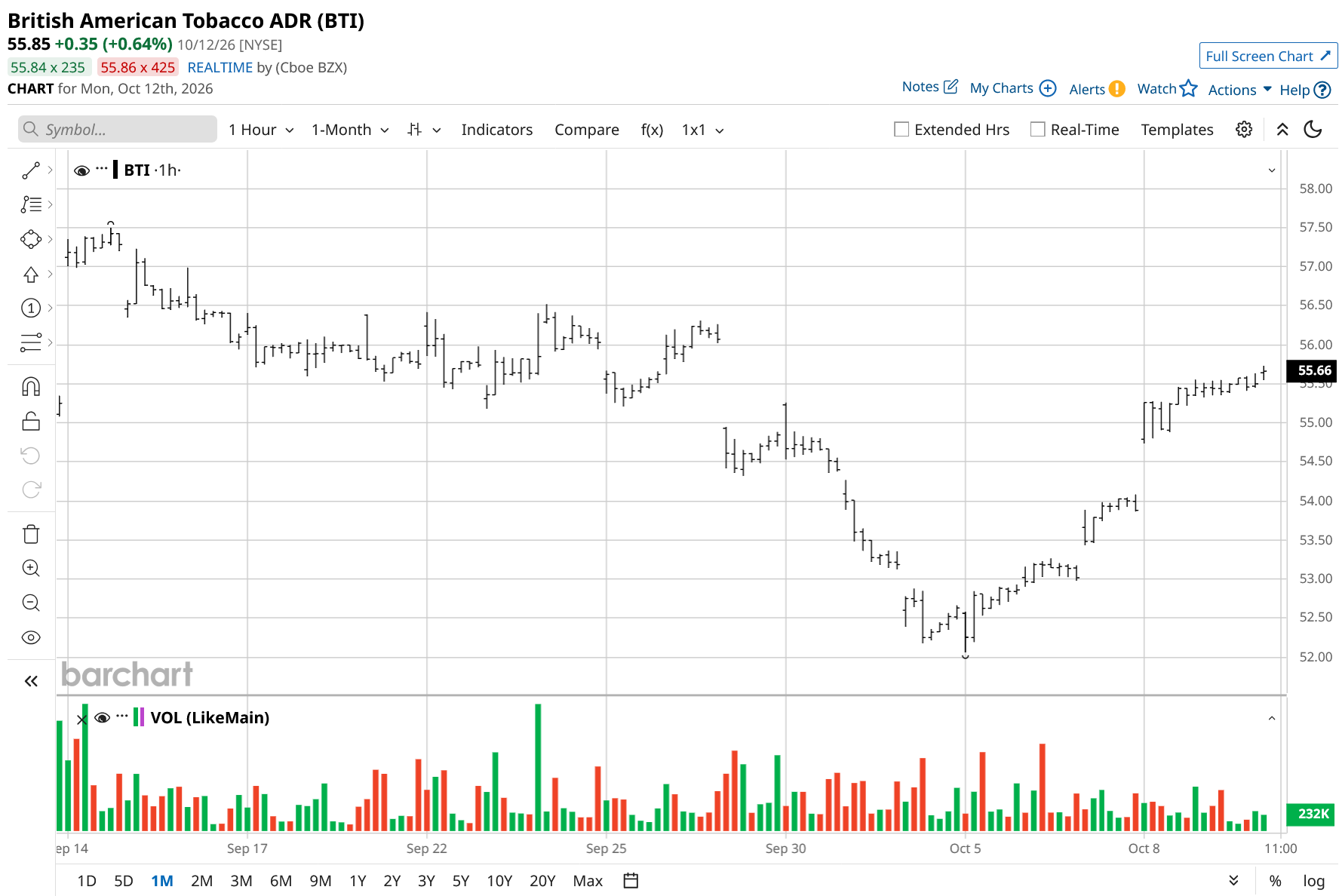
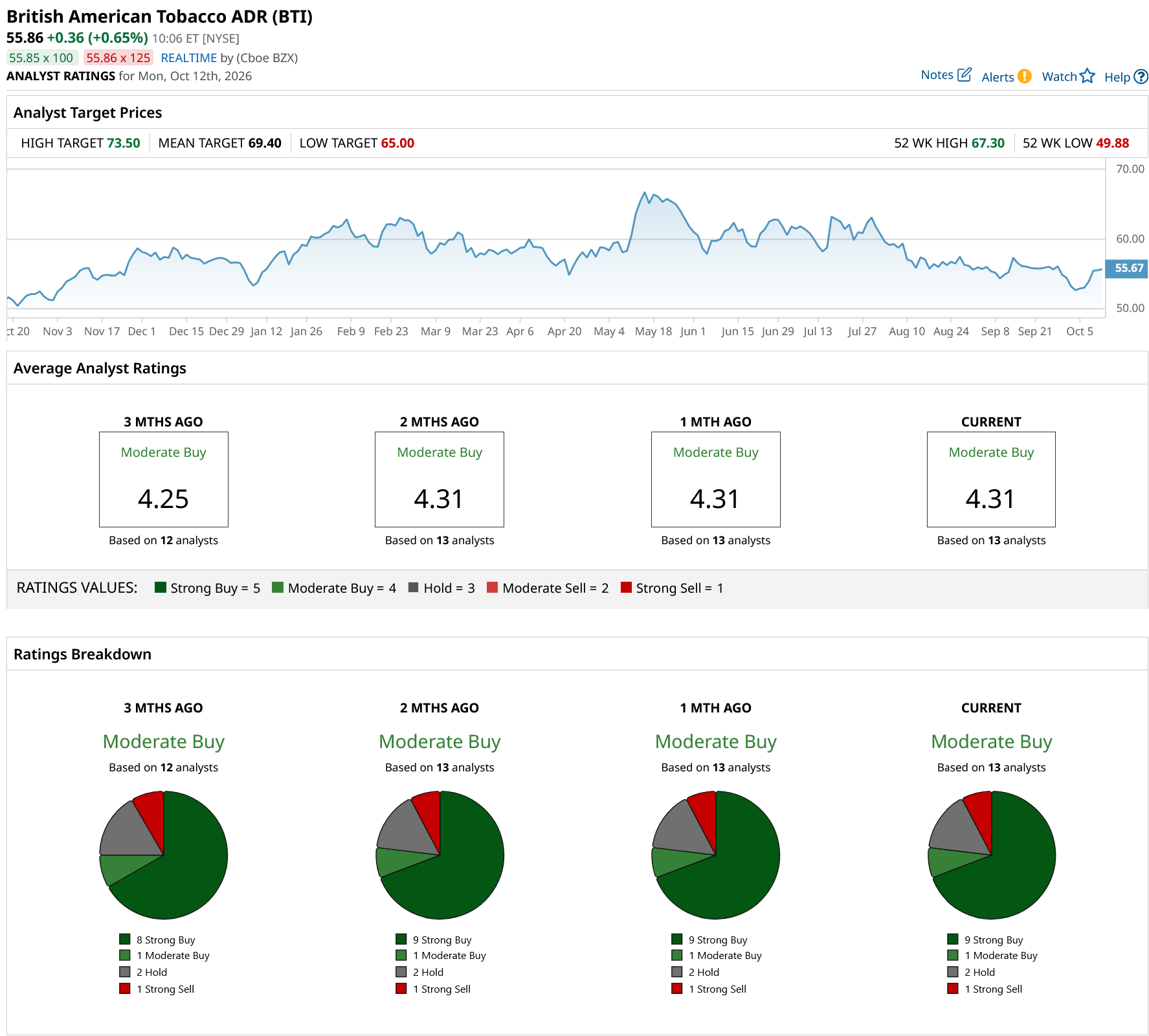
British American Tobacco's stock trades around $55, roughly 18% below its 52-week high of $67.30 reached in May and about 11% above its 52-week low of $49.88. Shares have slipped about 9% over three months, even as the company reaffirmed its 2026 guidance. Still, BTI offers one of the market's more generous payouts, with a dividend yield near 6%, a market capitalization around $121 billion, and a forward price-to-earnings ratio near 11.5, appealing to income investors seeking defensive, high-yield consumer staples exposure.
Over the past 52 weeks, BTI stock has gained roughly 8%, in line with the 6.9% return of the Consumer Staples Select Sector SPDR ETF (XLP), which tracks the S&P 500 consumer staples sector. Year-to-date (YTD), however, BTI is roughly flat, lagging the sector's 6% advance, as investors weigh slowing cigarette volumes against fast-growing smokeless products.
Results Top Estimates
British American Tobacco, which reports half-yearly, posted first-half 2026 revenue of £12.24 billion, up 1.4% reported and 2.9% at constant currency, slightly ahead of the £12.19 billion analysts expected. Adjusted diluted earnings per share rose 7.9% to 164 pence, beating the 158.5 pence consensus, although reported diluted EPS fell 28.6% to 145.3 pence. Overall, BAT described the results as in line with expectations.
Adjusted profit from operations rose 3.5% to £5.43 billion, ahead of the £5.31 billion consensus, while adjusted operating margin widened 30 basis points to 43.7%. The U.S. led, with revenue up 8.5% and adjusted operating profit up 10.1%; New Category revenue rose 18%, and smokeless products reached 19.8% of group revenue. Free cash flow jumped 85% to £2.29 billion, supporting £1.3 billion of buybacks, although Asia-Pacific, Middle East, and Africa revenue fell 6.3%.
Management reaffirmed its 2026 guidance and now expects adjusted diluted EPS growth toward the middle of its 5% to 8% range. Revenue and adjusted operating profit growth should land at the lower end of the 3% to 5% and 4% to 6% ranges, weighted to the second half as Fit2Win savings build. BAT expects mid-teens of New Categories revenue growth, plans a national Velo Max rollout in the second half, and flagged a 2% to 3% translational currency headwind to EPS.
BAT's Shares Rise as Yields Climb
BAT's shares gained about 5% last week as rising U.S. Treasury yields weighed on the broader stock market. The move put BTI stock just slightly behind U.S. tobacco peers Altria Group (MO), which rose 6%, and Philip Morris International (PM), up 7%.
Tobacco stocks can attract investors during periods of interest-rate anxiety because established companies often generate substantial cash flow and need less capital spending than many fast-growing businesses. For British American Tobacco, steady cash generation and the ability to adjust prices may help support earnings as inflation persists and cigarette sales decline. Those qualities can also make the company’s valuation appear less exposed to higher rates than that of businesses whose value depends heavily on future growth.
However, higher bond yields can make fixed-income investments more appealing to income-seeking investors, potentially limiting demand for dividend-paying tobacco shares. BTI’s rise reflects investor interest, not a guarantee of continued outperformance.
Should You Buy BTI Stock?
Rising yields may support British American Tobacco’s appeal as a cash-generative company, though higher bond yields can also compete with dividend-paying shares. Analyst sentiment is favorable: BTI has a consensus “Moderate Buy” rating and a mean price target of $69.40, implying about 26% upside from the market price. Across 13 analyst ratings, nine are “Strong Buy,” one “Moderate Buy,” two “Hold,” and one “Strong Sell.” These estimates are not guarantees; investors should weigh BTI’s potential against interest-rate risks and the challenges facing the tobacco industry.
On the date of publication, Ruchi Gupta did not have (either directly or indirectly) positions in any of the securities mentioned in this article. All information and data in this article is solely for informational purposes. For more information please view the Barchart Disclosure Policy here.