


Why It’s Time to Load Up on Amazon Stock
Amazon (AMZN) may be best-known for retail, but its biggest opportunity is more than the packages arriving at your doorstep. It now has a business that just keeps getting bigger. Amazon Web Services (AWS) is accelerating, artificial intelligence (AI) is opening up new revenue opportunities, and advertising is giving the company's retail business another way to make money.
Accordingly, it doesn’t come as a surprise that Goldman Sachs recently put AMZN stock on its Conviction List. With several growth engines working together, Amazon has a compelling case for investors looking to capitalize on the next phase of the AI boom.
Goldman Sachs Sees More Upside in Amazon Stock
Recently, Goldman Sachs added Amazon to its Conviction List, identifying the company as one of its preferred stock picks.
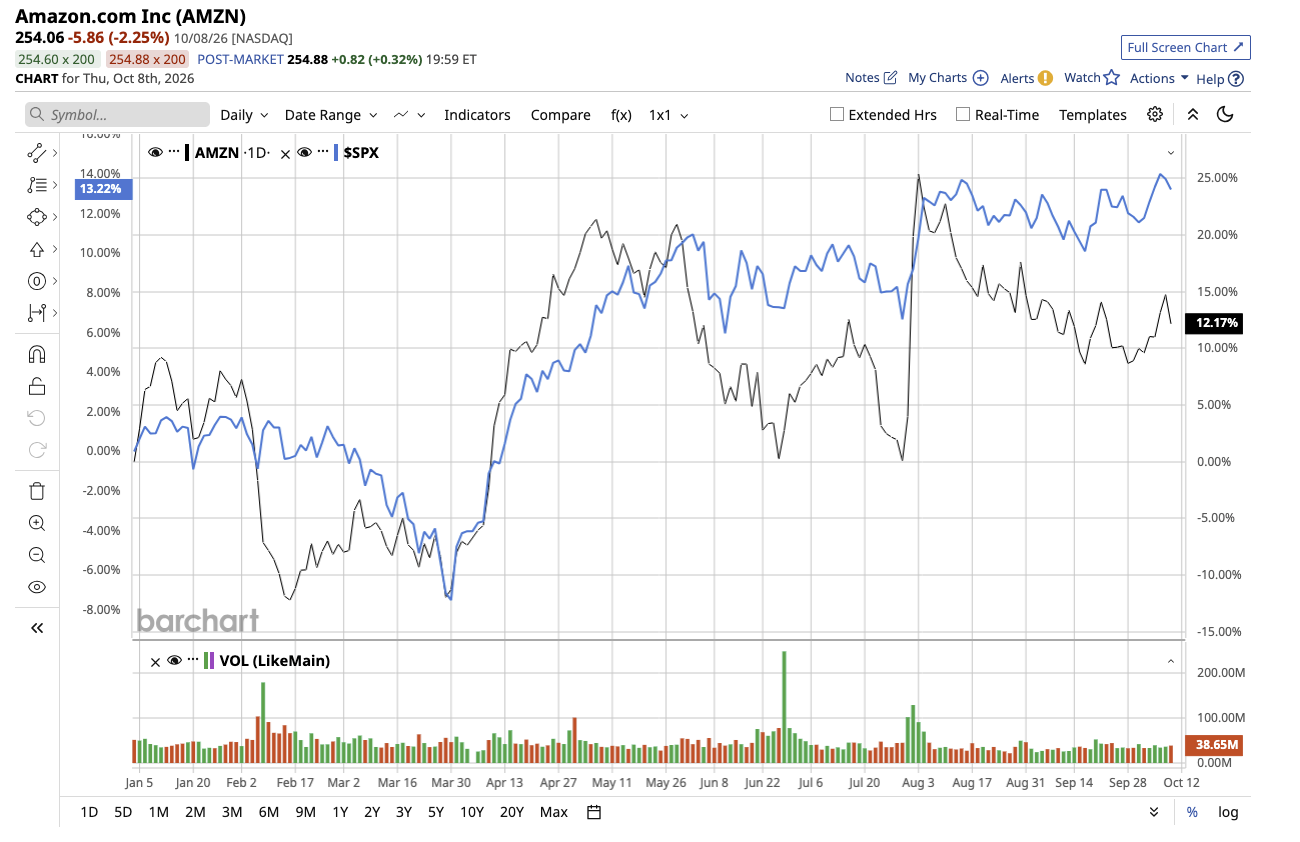
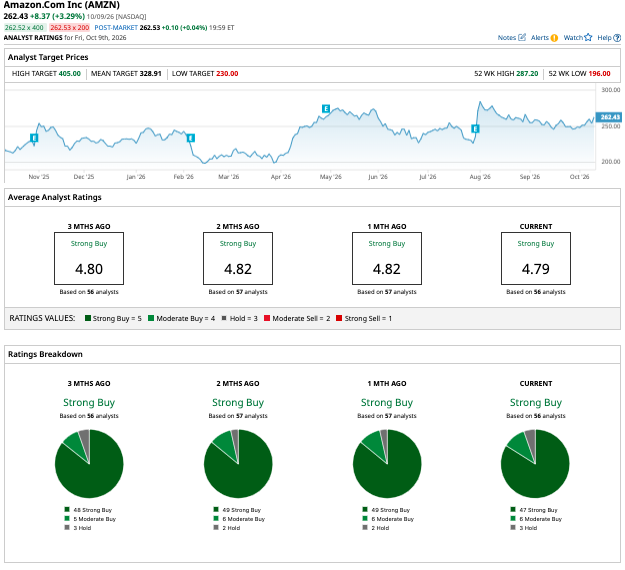
Amazon stock has climbed 14% year-to-date (YTD), currently trading around the $262 level. Goldman Sachs has given AMZN stock a 12-month price target of $375 per share, which is higher than the mean price target of $328.91 per share. Goldman Sachs' target implies roughly 43% potential upside from current levels.
Goldman Sachs' bull case goes beyond Amazon’s retail business. Analyst Eric Sheridan believes the AI boom will drive greater demand for Amazon's computing power, while improving operating leverage could allow profits to grow faster than revenue. Amazon's advertising business offers another opportunity, giving the company an additional source of growth beyond cloud computing and e-commerce.
AWS and Advertising Are Becoming the Most Important Growth Engines
Amazon’s cloud computing and advertising businesses have become core pillars. In the second quarter, AWS was a major contributor to the company's 20% year-over-year (YOY) revenue increase to $200.6 billion. Notably, AWS revenue jumped 37% YOY to $42.2 billion, its fastest growth in 18 quarters according to management. AWS also reported a $496 billion backlog of contracted business, growing at a triple-digit YOY rate. While this is not earned revenue yet, it points to substantial contracted demand as Amazon expands its cloud capacity.
Companies developing AI systems need computing power, storage, networking, and databases alongside specialized accelerators. This allows AWS to benefit from broader infrastructure spending rather than relying solely on demand for individual AI models.
Advertising revenue also increased 26% YOY in Q2, giving the company another way to monetize its large customer base. Brands can pay to reach shoppers searching for products on Amazon, allowing the company to generate revenue beyond the product sale itself.
These two businesses diversify Amazon’s growth opportunities beyond traditional retail and strengthen the case that Amazon can expand its earnings as these businesses scale.
Amazon Is Building Its Own AI Infrastructure
Amazon didn’t just stop at retail, cloud computing, and advertising. The company is building its own AI infrastructure to avoid relying entirely on outside chipmakers to serve the AI market. Its custom silicon business, including Trainium AI accelerators and Graviton processors, has become another potential growth driver. On the Q2 earnings call, management noted that the chips business had exceeded a $25 billion annualized revenue run rate (ARR), with triple-digit YOY growth.
Trainium could play a bigger role as companies look for alternatives to power AI model training and deployment. Amazon said major AI developers Anthropic and OpenAI had made multiyear commitments involving its custom chips, alongside other customers. While the opportunity is attractive, Amazon must continue proving that its hardware can provide the performance and availability that consumers want. Amazon's AI ambitions also extend beyond its own chips, with its growing demand for custom silicon creating a potential $60 billion opportunity for Qualcomm (QCOM).
The Biggest Risk Is How Much Amazon Must Spend
Amazon has built growth opportunities everywhere with its diversified business. But that growth comes at a cost. The company now expects capital expenditures of around $220 billion in 2026. Management attributed the increase partly to higher memory costs and said that most of the investment would support AI and AWS. This is an enormous commitment to infrastructure. The part that worries investors is that the benefits will not arrive all at once. Free cash flow for the trailing 12 months through June 30 was -$7.6 billion, compared to $18.2 billion a year ago.
However, management argues that data centers and the equipment inside them can generate revenue over several years. Management also says AWS has contracted demand extending well into the future and expects capacity constraints to persist.
Basically, Amazon is saying patience will ultimately be rewarded. That said, construction delays, rising equipment costs, changing customer demand, or slower monetization could push returns further into the future.
Analysts expect EPS to increase by 12% YOY to $8.03 in fiscal 2026 before climbing 32% to $10.58 in fiscal 2027, although Goldman Sachs appears to see greater earnings potential.
Is Amazon Stock a Buy Now?
Goldman Sachs’ vote of confidence isn’t the sole reason to buy Amazon stock now. The company is trying to turn its cloud infrastructure, AI chips, software, and retail reach into an even larger, more profitable collection of businesses. If AWS demand remains strong and the heavy spending eventually generates the cash flow that management expects, AMZN stock could have meaningful upside.
On Wall Street, Amazon holds a consensus “Strong Buy” rating overall. Of the 56 analysts covering the stock, 47 have a “Strong Buy,” six have a "Moderate Buy" rating, and three analysts have a “Hold.” The mean price target of $328.91 suggests potential upside of 25% from here, while the high price target of $405 suggests that shares could climb as much as 54% over the next year.
On the date of publication, Sushree Mohanty did not have (either directly or indirectly) positions in any of the securities mentioned in this article. All information and data in this article is solely for informational purposes. For more information please view the Barchart Disclosure Policy here.