


Does SendPro CX Launch Change The Bull Case For Pitney Bowes Stock?
- Pitney Bowes recently introduced the SendPro CX Series mailing systems, a customer designed line focused on simpler interfaces, faster processing, and integration with its Shipping 360 platform for centralized control.
- The CX Series pushes Pitney Bowes further toward technology enabled sending and shipping workflows, tying traditional postage equipment directly into software driven oversight of mailroom activity.
- We will now look at how Pitney Bowes' investment narrative could be influenced by the SendPro CX Series focus on usability.
Pitney Bowes Investment Narrative Recap
For Pitney Bowes, the big picture you need to buy into is a mature mailing and shipping enterprise that is trying to lean harder into technology, automation, and recurring software like Shipping 360 while legacy mail volumes face structural pressure. The SendPro CX launch fits that story by keeping hardware relevant through usability and tighter integration with cloud tools, but it does not on its own change the fact that the addressable postal market could keep shrinking.
In the near term, the key swing factor is whether newer SaaS and shipping workflows scale fast enough to stabilise overall revenue that analysts expect to remain roughly flat over the next three years. Execution risk stays high, partly because of a relatively new management team and board, and because the balance sheet still carries meaningful debt and relies on higher risk funding. That makes consistent free cash generation and cost discipline just as important as any product refresh.
The recent repricing of Pitney Bowes' US$585 million Term Loan B is closely linked to that execution story. Cutting the SOFR margin by 75 basis points and keeping the 2032 maturity intact is expected to trim annual interest expense by about US$4 million. For a business working through mail digitisation headwinds and modest revenue expectations, every dollar of lower financing cost supports earnings quality and flexibility.
That move also followed retiring more than US$46 million of long dated notes at a discount and came after an S&P upgrade to BB minus from B plus. For you as a shareholder, these steps matter because they directly address one of the core risks flagged by analysts, high leverage and refinancing needs, and they give management a slightly longer runway to prove that SendPro CX, Shipping 360, and broader digital shipping solutions can offset pressure in older lines of business.
Pitney Bowes' current earnings of US$187.3 million are expected to reach US$285.9 million by 2029, a gain of about US$98.6 million. At that point, analysts also project revenue of US$1.8b while assuming revenue remains broadly flat rather than growing at a set yearly rate.
Uncover why Pitney Bowes' fair value indicates a 16% potential upside to its current price that could narrow quickly.
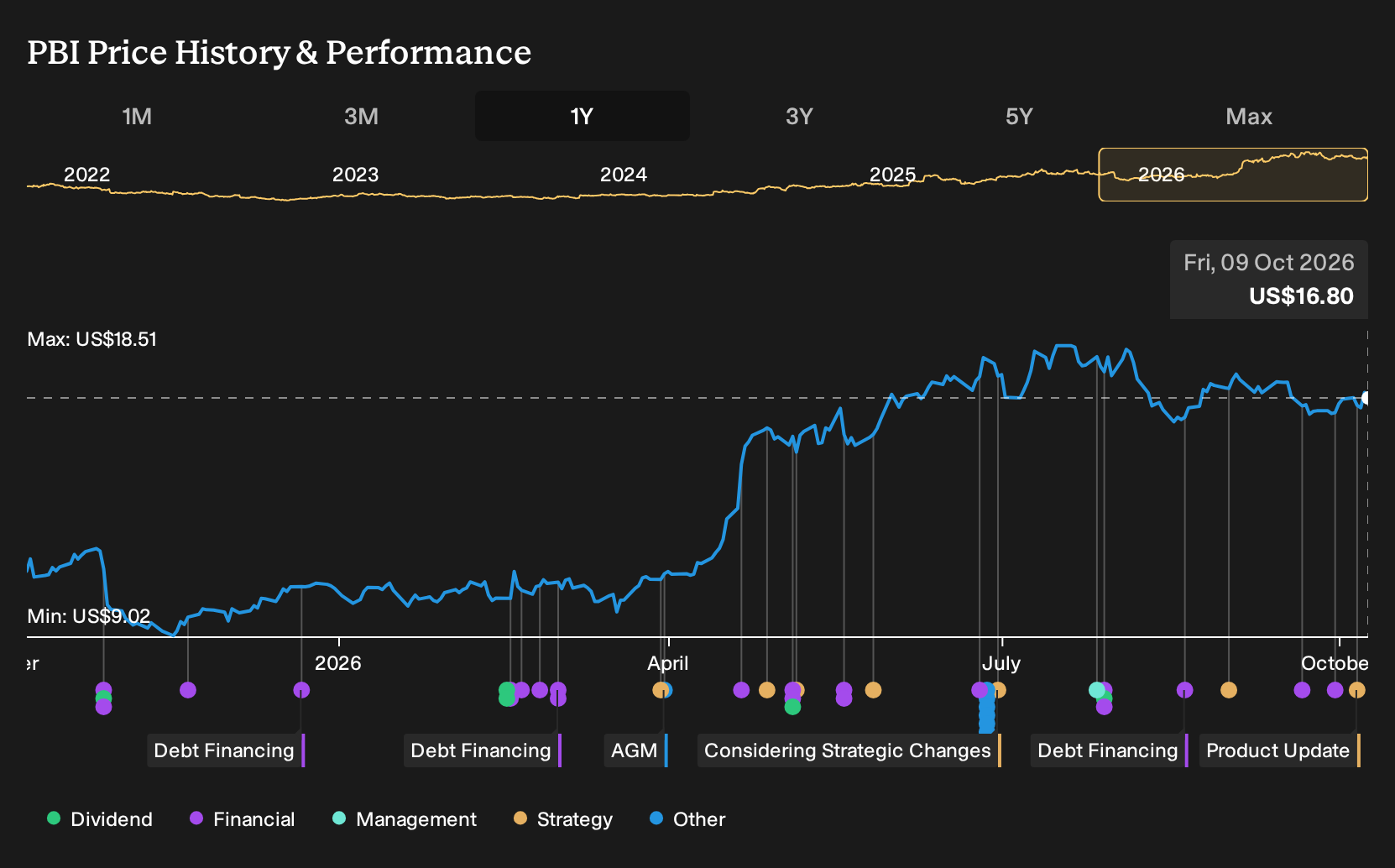
Exploring Other Perspectives
Not every analyst sees Pitney Bowes the same way. The most optimistic voices focus on the cost program as the real catalyst, not just SendPro CX. They were already modeling earnings of about US$280.1 million on roughly US$1.9b of revenue by 2029. The CX launch sits outside those estimates for now, so views may shift as results emerge.
Explore 3 other Pitney Bowes fair value estimates, including one that suggests up to 181% upside from the current price!
Form Your Own Verdict
Don't just follow the ticker. Dig into the data and build a conviction that's truly your own.
- A great starting point for your Pitney Bowes research is our analysis highlighting 4 key rewards and 3 important warning signs that could impact your investment decision.
- See our latest analysis for Pitney Bowes. The report includes a comprehensive fundamental analysis summarized in a single visual, the Snowflake, making it easy to evaluate Pitney Bowes' overall financial health at a glance.
Looking For More Ideas Beyond Pitney Bowes?
If the Pitney Bowes story has you thinking about where else disciplined balance sheets and clear business models might matter, it can help to scan a wider field of opportunities that fit similar quality filters.
- For readers who want potential mispricing combined with strong fundamentals, start with a focused set of companies that screen as 29 high quality undervalued stocks.
- If dependable income is a priority, check out businesses that appear more resilient on yield and payout strength through a curated group of 8 dividend fortresses.
- For a broader quality check on financial footing, cast the net across a diversified 31 resilient stocks with low risk scores to see which stocks line up with your risk tolerance.
This article by Simply Wall St is general in nature. We provide commentary based on historical data and analyst forecasts only using an unbiased methodology and our articles are not intended to be financial advice. It does not constitute a recommendation to buy or sell any stock, and does not take account of your objectives, or your financial situation. We aim to bring you long-term focused analysis driven by fundamental data. Note that our analysis may not factor in the latest price-sensitive company announcements or qualitative material. Simply Wall St has no position in any stocks mentioned.
Have feedback on this article? Concerned about the content? Get in touch with us directly. Alternatively, email editorial-team@simplywallst.com