


Ciena (CIEN) Gains On AI Networking Demand, Is It Still 12% Undervalued?
Fresh enthusiasm around Ciena (CIEN) followed a sharp share price move, as investors reacted to aggressive cloud spending on AI focused optical networking. This spending is feeding into the company’s order backlog and long term targets.
For context, Ciena’s share price has climbed 28.67% over the past month and 82.79% year to date, while the 1 year total shareholder return of 188.43% and very large 3 year and 5 year total shareholder returns signal powerful, AI driven momentum that investors are reassessing in light of the recent backlog and long term targets.
Scan beyond Ciena and spot other AI infrastructure plays showing strong momentum with our hand picked 92 AI infrastructure stocks in this space.
Ciena has already rewritten its share price story in 2026. The real test now is whether the current AI order book and long term targets still leave meaningful upside on the table, or mostly lock in gains already earned.
Most Popular Narrative: 12% Undervalued
Ciena's most followed narrative pegs fair value at $512.99 against a last close of $449.77, which frames the recent AI fueled rally as still leaving a valuation gap according to that framework. The story hinges on whether current demand for high capacity networking can support the earnings and margins that model assumes.
Major cloud providers and a new wave of neo-scalers are aggressively investing in high-capacity, low-latency optical networking infrastructure to support AI workloads, driving multiyear, global network buildouts that should significantly expand Ciena's addressable market and underpin sustained, above-trend revenue growth.
See why 53 investors see Ciena as 12% undervalued.
That narrative uses an 8.96% discount rate and ties its valuation to revenue rising from $6.0b to $12.4b by 2029, earnings climbing from $654.4m to $2.8b, and a future P/E of 34.4x instead of the current higher multiple. It effectively asks investors to judge whether a communications equipment stock should trade in line with the broader US communications sector multiple once those earnings arrive.
Under this view, the roughly 12.3% discount to fair value and a 14.1% gap to the $512.99 analyst consensus target both rely on AI related optical orders flowing through the existing $8.5b backlog into higher margins over time, while acknowledging risks from customer concentration, supply constraints, and possible multiple compression. For readers, the key question is whether the projected 27.3% annual revenue growth and profit margins moving toward 22.5% feel realistic given that risk profile.
Result: Fair Value of $512.99 (UNDERVALUED)
Still, the Ciena narrative can crack if hyperscaler orders slow or shift to rivals, or if new networking paradigms erode pricing power faster than expected.
Find out about the key risks to this Ciena narrative.
Another View: Ciena On Earnings Multiples
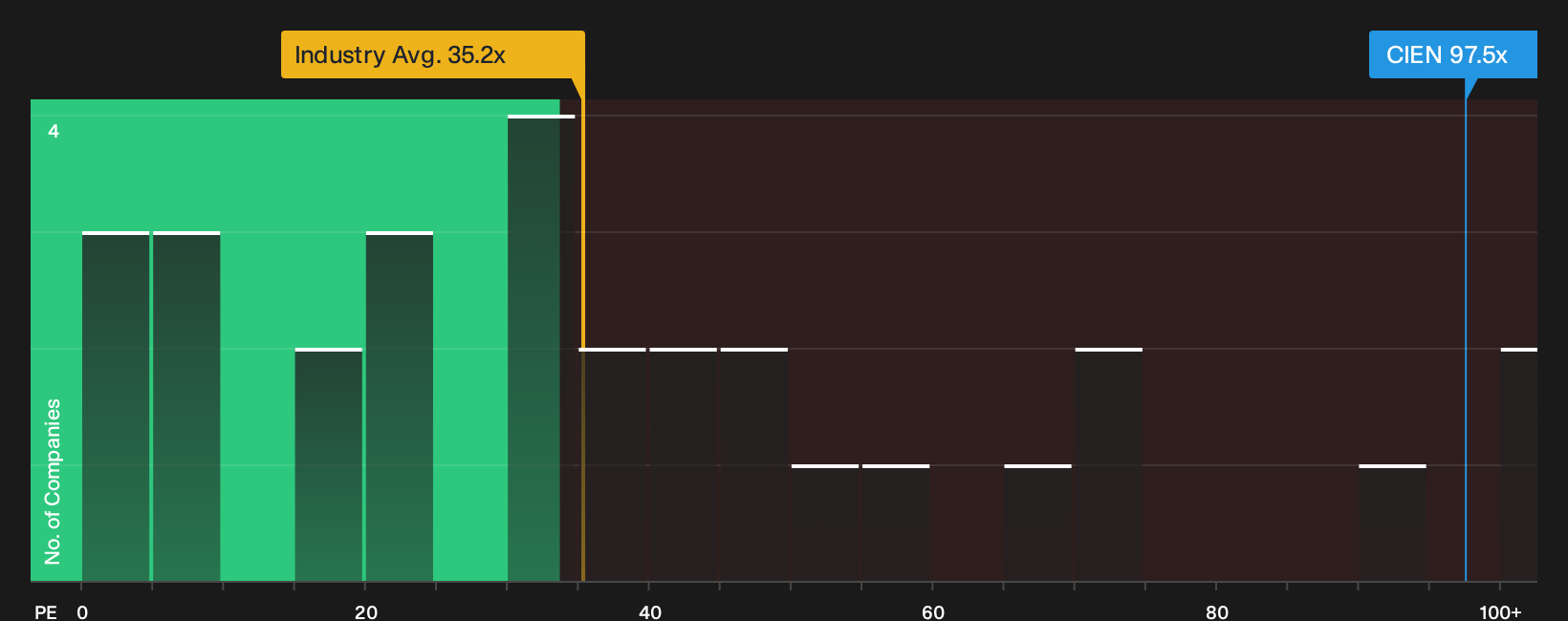
The fair value story built on AI heavy growth assumptions runs into a very different signal once you look at what investors are currently paying for Ciena's earnings. The stock trades on a P/E of 97.5x, compared with a fair ratio of 56.5x and a US Communications industry average of 35.2x. That gap points to rich expectations in practical terms, because even if profits land where forecasts suggest, a move toward that fair ratio or sector level would mean a lot of the adjustment comes through the share price rather than just higher earnings power. The question for you is simple: does that trade off feel like a margin of safety or a valuation risk at this stage of the AI build out?
See what the numbers say about this price — find out in our valuation breakdown.
Next Steps
Plenty in this Ciena story points to strong enthusiasm; however, the full picture includes clear concerns alongside genuine bright spots. Act quickly, stress test the assumptions against your own expectations, and weigh both sides by reviewing the 3 key rewards and 2 important warning signs.
Looking for more investment ideas beyond Ciena?
If Ciena has sharpened your focus on AI and infrastructure plays, do not stop here. Broader ideas can help balance risk, reveal alternatives, and sharpen your conviction.
- Hunt for mispriced quality by scanning our hand picked 29 high quality undervalued stocks that combine solid fundamentals with potential upside drivers.
- Secure your income stream by reviewing a curated group of 8 dividend fortresses that pair higher yields with resilient business profiles.
- Sleep easier at night by focusing on a 31 resilient stocks with low risk scores that keeps balance sheet strength and risk scores front and center.
This article by Simply Wall St is general in nature. We provide commentary based on historical data and analyst forecasts only using an unbiased methodology and our articles are not intended to be financial advice. It does not constitute a recommendation to buy or sell any stock, and does not take account of your objectives, or your financial situation. We aim to bring you long-term focused analysis driven by fundamental data. Note that our analysis may not factor in the latest price-sensitive company announcements or qualitative material. Simply Wall St has no position in any stocks mentioned.
Have feedback on this article? Concerned about the content? Get in touch with us directly. Alternatively, email editorial-team@simplywallst.com