


Class Action Settlement Could Be A Game Changer For CAE (TSX:CAE)
- CAE Inc. has agreed to a proposed CAD 38,250,000 settlement to resolve a Québec securities class action concerning alleged misrepresentations and disclosure failures, with CAE funding up to CAD 5,000,000 under its insurance deductible and insurers covering the balance, subject to court approval and formal claims and opt out timelines.
- The settlement structure limits CAE's direct cash outlay relative to the total amount and, if approved, could cap a period of legal uncertainty tied to past disclosures while clarifying potential future insurance funded litigation costs.
- We will now examine how CAE's investment narrative might be affected by this largely insurer funded class action settlement proposal and related timelines.
CAE Investment Narrative Recap
To own CAE, you need to be comfortable with a training and simulation specialist that leans on civil aviation, defense programs, and sizable debt to fund growth. The story hinges on efficient use of its installed simulator base, execution on defense contracts, and digestion of past acquisitions. The proposed Québec class action settlement looks contained financially, so it does not appear to alter that near term operating focus.
The bigger swing factor right now is operational follow through. Civil training utilization softness, business aviation cyclicality, and the effort to lift margins from 5.8% while integrating deals matter more to the next few years than this lawsuit. Debt of roughly CA$3.2b and reliance on higher risk funding keep balance sheet discipline front of mind.
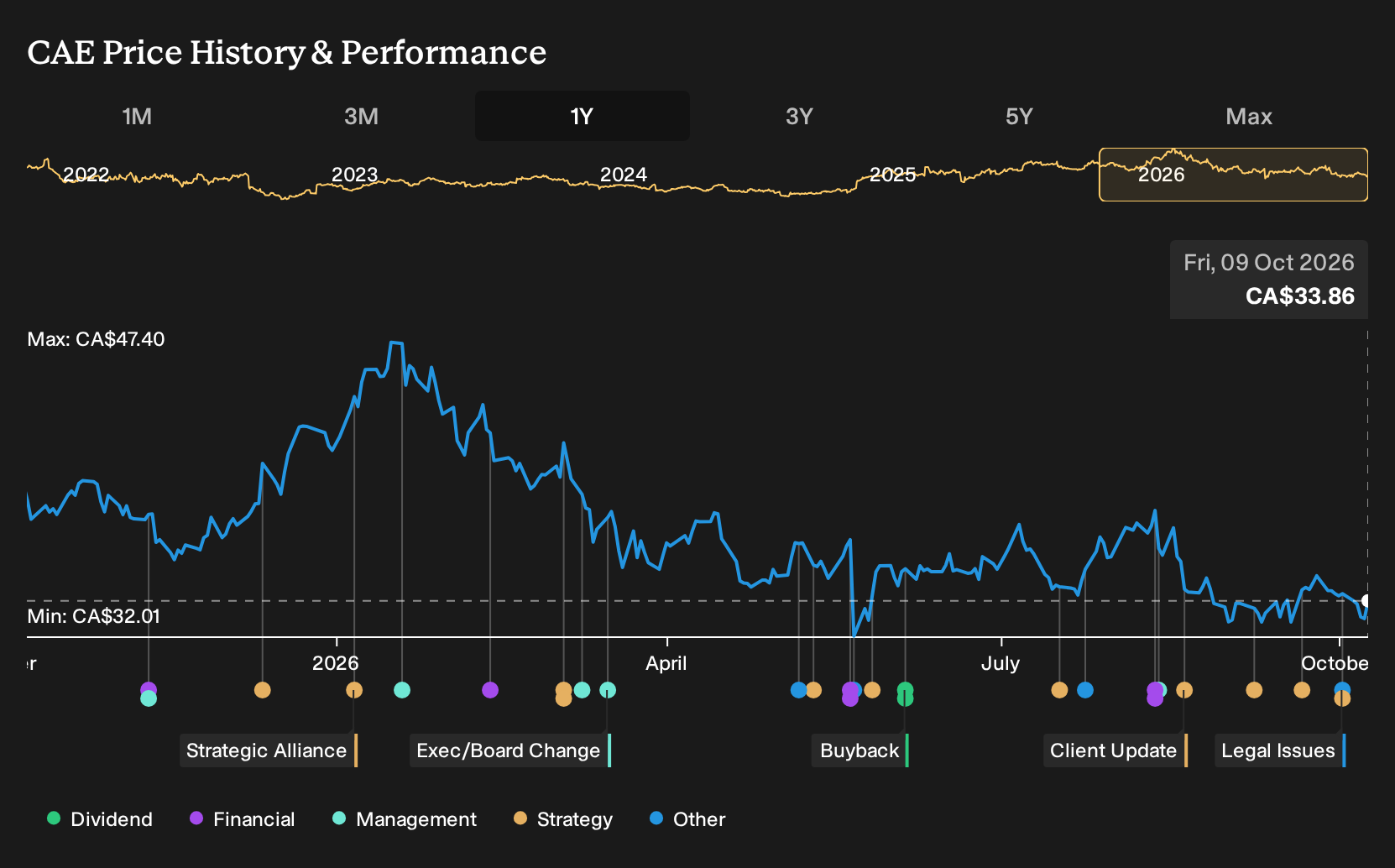
The Québec class action settlement proposal itself is the key announcement that ties most directly to short term sentiment. CAE has agreed to a CAD 38.25m resolution, with up to CAD 5m coming from the firm under its insurance deductible and the rest funded by insurers, subject to court approval. That structure limits direct cash impact if the settlement is approved.
Timelines also matter for investors. The approval hearing is set for December 22, 2026, with a claims deadline on March 22, 2027 and an opt out cutoff on December 1, 2026. Until those dates pass, the legal file remains open in the background. For anyone weighing CAE, the core question is whether this contained legal overhang distracts from execution on aviation training demand, defense backlog quality, and margin repair after recent one off items.
Analysts currently frame CAE's story around revenue reaching CA$5.4b and earnings of CA$523.0m by 2029, built on 2.7% yearly top line growth and a rise in profit from CA$286.9m today. This implies earnings almost doubling over that period.
Uncover how CAE's fair value indicates a 31% potential upside to its current price that could narrow quickly as sentiment stabilizes around CAE.
Exploring Other Perspectives
Some of the most optimistic analysts focus less on legal noise and more on CAE squeezing better returns from its training network. Before this Québec case hit the headlines, the bullish camp was already pencilling in revenue of about CA$5.8b and earnings near CA$566.1m by 2029. That is a much brighter script than consensus and could evolve as the settlement process unfolds.
Explore 3 other CAE fair value estimates, including one that suggests as much as 59% upside from the current price!
Reach Your Own Conclusion
Don't just follow the ticker. Dig into the data and build a conviction that's truly your own.
- A great starting point for your CAE research is our analysis highlighting 3 key rewards and 2 important warning signs that could impact your investment decision.
- See our latest analysis for CAE. The report includes a comprehensive fundamental analysis summarized in a single visual, the Snowflake, making it easy to evaluate CAE's overall financial health at a glance.
Looking for more investment ideas beyond CAE?
Once you have a view on CAE, it can help to benchmark that thesis against a wider set of opportunities using the Simply Wall St Screener.
- If you want a focus on potential value opportunities with quality fundamentals, scan through 8 high quality undervalued stocks that pass a mix of earnings, cash flow, and balance sheet checks.
- For investors who care most about resilience, compare CAE with a list of solid balance sheet and fundamentals (7 results) to see which businesses pair steady finances with cleaner leverage profiles.
- If you prefer ideas that fly under the radar, widen your net with a 9 high quality undiscovered gems that may not be widely followed yet but still show robust underlying metrics.
This article by Simply Wall St is general in nature. We provide commentary based on historical data and analyst forecasts only using an unbiased methodology and our articles are not intended to be financial advice. It does not constitute a recommendation to buy or sell any stock, and does not take account of your objectives, or your financial situation. We aim to bring you long-term focused analysis driven by fundamental data. Note that our analysis may not factor in the latest price-sensitive company announcements or qualitative material. Simply Wall St has no position in any stocks mentioned.
Have feedback on this article? Concerned about the content? Get in touch with us directly. Alternatively, email editorial-team@simplywallst.com