


FIS (FIS) Stock May Be Undervalued As It Tops Fintech Rankings
Fidelity National Information Services has seen its share price fall sharply in recent years, even as the business continues to feature in major industry rankings and win new banking clients. That gap between the stock chart and the headlines raises a straightforward question for investors who follow Fidelity National Information Services: are today's earnings enough to support the current valuation?
- Over the past 5 years the share price has fallen 68.8%, which puts the focus squarely on whether the current earnings justify where the stock now trades.
- Recent news such as ranking first in the 2026 IDC FinTech Rankings Top 100 and new bank wins for its issuing platform can shape how investors think about future profitability, capital needs and therefore what multiple they are prepared to pay for Fidelity National Information Services.
- The analysts covering Fidelity National Information Services have run their own numbers. See what analysts think Fidelity National Information Services's shares could be worth.
For investors, the debate is whether the current price of Fidelity National Information Services is fully backed by its earnings when judged against the Fair Ratio benchmark.
If you are weighing Fidelity National Information Services against other options that also put earnings under the microscope, a focused screener of 28 high quality undervalued stocks.
Is Fidelity National Information Services Still Cheap on Earnings?
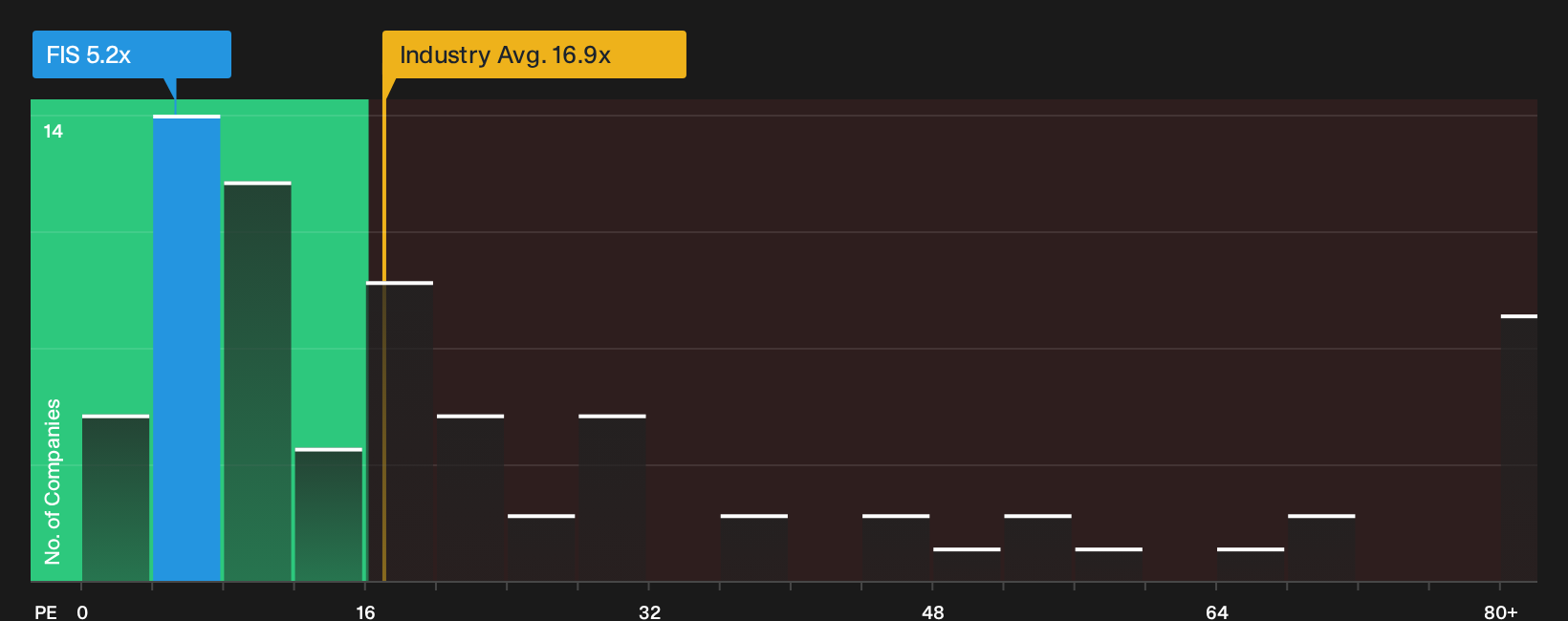
The P/E ratio is a useful metric for Fidelity National Information Services because earnings are a key focus for how investors judge payment and banking technology providers. On this basis, the stock trades on a P/E of 5.2x, which is far below the Diversified Financial industry average of 16.9x and also trails the peer group on roughly 28.2x. That gap shows the market is attaching a much lower price tag to each dollar of FIS earnings than to sector rivals.
The Fair Ratio framework adjusts for factors such as expected profitability, balance sheet needs and scale. Based on this, it indicates that Fidelity National Information Services would typically support a higher P/E than the level implied by the current share price. Despite the recent IDC FinTech ranking that highlights FIS as a large technology supplier to banks, the earnings multiple still reflects a discount relative to what this tailored benchmark suggests. Explore the numbers behind Fidelity National Information Services's P/E valuation.
The Fidelity National Information Services Narrative: What Would Justify Today's Price?
Simply Wall St Narratives pick up where the Fidelity National Information Services' P/E puzzle leaves off and explain what combination of future growth, profitability and earnings power would need to occur for the stock to be worth meaningfully more or less than its current price on the screen. Instead of a single output from a ratio or model, they outline the future that number relies on so you can watch in real time whether the business is tracking that path on the Community page.
One of the top community narratives on Fidelity National Information Services: 8% undervalued
"Fidelity National Information Services is a technology provider to banks and capital markets clients, focusing on core processing, digital banking and payments..."
Discover why this Narrative puts Fidelity National Information Services at 8% undervalued.
One more check for Fidelity National Information Services beyond the share price and P/E
The last piece that belongs beside any view on Fidelity National Information Services is who is steering the business and how those leaders are rewarded, because that structure shapes the choices behind every future earnings line. See who runs Fidelity National Information Services and how they are paid.
This article by Simply Wall St is general in nature. We provide commentary based on historical data and analyst forecasts only using an unbiased methodology and our articles are not intended to be financial advice. It does not constitute a recommendation to buy or sell any stock, and does not take account of your objectives, or your financial situation. We aim to bring you long-term focused analysis driven by fundamental data. Note that our analysis may not factor in the latest price-sensitive company announcements or qualitative material. Simply Wall St has no position in any stocks mentioned.
Have feedback on this article? Concerned about the content? Get in touch with us directly. Alternatively, email editorial-team@simplywallst.com