


Should Cloud Native Network Upgrades Require Action From F5 (FFIV) Investors?
- F5 recently announced new cloud-native network functions and eBPF-based observability for Kubernetes environments, with Tolly Group tests citing materially lower CPU, memory use and latency for DNS and CGNAT workloads versus virtualized network functions.
- The push to run subscriber-aware policies, Layer 4–7 traffic management and kernel-level telemetry directly in Kubernetes targets service providers trying to cut infrastructure costs while keeping critical network services performant and easier to operate.
- We will examine how F5's investment narrative is affected by these cloud native efficiency gains and expanded Kubernetes-centric service provider focus.
F5 Investment Narrative Recap
To own F5, you need to believe its multicloud application and security platform can keep attracting heavier workloads as customers spread apps across on premises and public clouds. The new cloud native network functions and eBPF observability speak directly to that, because they aim to keep critical carrier services efficient while apps move deeper into Kubernetes.
The key near term swing factor remains how reliably F5 converts this product interest into recurring software revenue, given earlier signs of hesitation on long contracts. The biggest risk still sits around margin pressure from higher component costs. This announcement looks helpful on product relevance but not transformative on that cost story.
The recent focus on BIG IP Cloud Native Edition and eBPF Observability is the announcement that most clearly aligns with existing catalysts. It targets the same themes analysts highlight, such as customers running across many environments and looking to simplify networking, security and app delivery on a unified platform that spans BIG IP, Distributed Cloud and NGINX.
For you as an investor, the operational question is whether these capabilities deepen F5 penetration with large service providers and support more multi modal deployments. Execution risk remains around converting that usage into steadier annual recurring revenue and doing so while non GAAP gross margins face pressure from higher memory and SSD costs.
F5 Long Term Analyst Set Up
F5's published analyst framework leans heavily on where revenue and earnings are expected to land by the end of the decade rather than on any single product launch. The models behind that view tie the Kubernetes focused push to a broader assumption that the business can keep compounding its top line while steadily lifting profitability.
F5's narrative projects US$4.2b revenue and US$1.0b earnings by 2029. This assumes 8.1% yearly revenue growth and an earnings increase of about US$273.5m from US$726.5m today.
Those projections come with a clear internal hurdle. Consensus work implies earnings margins move from 22.0% today to 24.4% by the forecast window, which asks the company to convert more of each incremental dollar of traffic management and security spend into bottom line profit. That puts a spotlight on mix between high margin software, more component intensive hardware and any incremental costs that come with supporting deeper Kubernetes adoption.
Valuation thinking around F5 then plugs those assumptions into a 2029 view of roughly US$4.2b of sales and US$1.0b of profit on a P/E of 28.8x, compared with 35.1x today. For readers, the practical question is whether that combination of revenue, earnings and multiple feels realistic when set against rising memory and SSD costs, the gradual share count reduction of about 2.52% per year and the effort required to translate cloud native wins into recurring software cash flow.
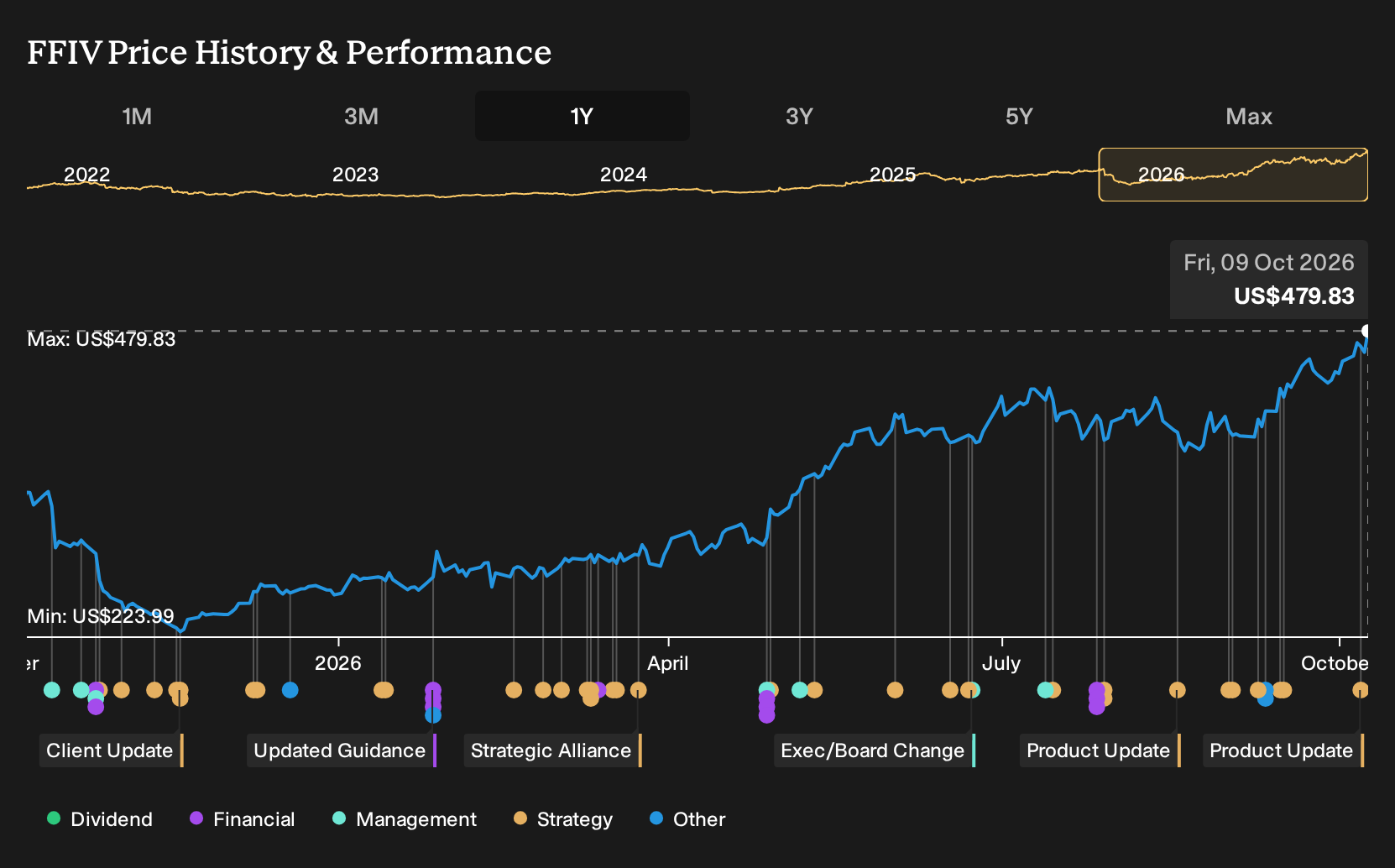
Uncover why F5's fair value indicates a 9% potential downside to its current price, leaving little room for error.
Exploring Other Perspectives
One alternate, more optimistic take focuses on F5’s margin potential rather than on recurring revenue worries. The most bullish analysts were penciling in revenue of about US$4.3b and earnings of US$1.2b by 2029, assuming margins reach 27.1%. After this Kubernetes efficiency news, those forecasts might look conservative or need a rethink.
Explore 2 other F5 fair value estimates, including one that suggests it could be worth as much as $436.10.
Reach Your Own Conclusion
Disagree with existing narratives? Extraordinary investment returns rarely come from following the herd, so go with your instincts.
- A great starting point for your F5 research is our analysis highlighting 2 key rewards and 1 important warning sign that could impact your investment decision.
- See our latest analysis for F5. The report includes a comprehensive fundamental analysis summarized in a single visual, the Snowflake, making it easy to evaluate F5's overall financial health at a glance.
Looking For More Investment Ideas Beyond F5?
If the F5 story has sharpened your thinking about cloud, efficiency and risk, you can use that same lens to widen your opportunity set. The Simply Wall St Screener lets you filter for traits that match your own playbook, so you can build a watchlist that fits your risk tolerance rather than chasing whatever is moving today.
- For investors who care most about quality on sale, you can start with companies that combine resilient fundamentals with valuations that still look reasonable by scanning our 28 high quality undervalued stocks.
- If capital preservation and steadier price moves matter more to you than headline growth, you can narrow the universe to businesses with stronger balance sheets and lower risk profiles through the 31 resilient stocks with low risk scores.
- For readers hunting for less crowded ideas with solid financial footing, you can focus on lesser known companies that still post robust metrics by searching the 20 high quality undiscovered gems.
This article by Simply Wall St is general in nature. We provide commentary based on historical data and analyst forecasts only using an unbiased methodology and our articles are not intended to be financial advice. It does not constitute a recommendation to buy or sell any stock, and does not take account of your objectives, or your financial situation. We aim to bring you long-term focused analysis driven by fundamental data. Note that our analysis may not factor in the latest price-sensitive company announcements or qualitative material. Simply Wall St has no position in any stocks mentioned.
Have feedback on this article? Concerned about the content? Get in touch with us directly. Alternatively, email editorial-team@simplywallst.com