


What Casey's General Stores Stock Earnings And Growth Plan Mean For Shareholders
- Casey's General Stores recently reported strong first quarter fiscal 2027 results, with solid inside sales, firm fuel profit and confirmation of its existing outlook, alongside higher shareholder returns and store expansion.
- The new three year plan places significant emphasis on accelerating store growth and operational efficiencies, which reflects management confidence in scaling the Casey's General Stores model.
- We will now look at how Casey's new three year expansion plan could reshape the existing investment narrative around growth and margins.
Casey's General Stores Investment Narrative Recap
For Casey's General Stores, the long term belief is simple. You have to think this chain can keep turning small town convenience into steady earnings through more stores, strong prepared food sales and a reasonably efficient supply chain. The latest quarter fits that story, with firm inside sales and fuel profit backing up management's confidence in its fiscal 2027 outlook.
In the near term, the key swing factor is execution on acquired and newly built locations while keeping labor and other operating expenses in check. The main risk is that integration and store growth stretch the cost base before efficiencies show up, which would pressure margins even if revenue holds up.
The most relevant update is Casey's new three year growth plan built around heavier store expansion and better operational efficiency. That ties directly into the existing catalysts around footprint growth, prepared foods scale and supply chain improvements, because the plan effectively leans harder into each of those levers.
For you as an investor, the plan raises the importance of execution quality. Faster unit growth and more remodels can support the prepared foods margin story and digital engagement, yet they also amplify risks tied to high debt levels, labor costs and the need to integrate deals like Fikes/CEFCO without margin drag.
What The New Plan Implies For Casey's General Stores Numbers
Analysts currently frame the Casey's General Stores story around a few headline assumptions. Revenue is projected to increase by 5.9% a year over the next three years, with profit margins moving from 4.1% today to 4.4% on roughly the same timeline. On earnings, forecasts point to US$979.7 million by about 2029 compared with US$772.8 million today, with the more optimistic estimates running closer to US$1.1b.
Those profit expectations sit inside a broader valuation sketch. Consensus models reference revenue of US$22.2b and earnings of US$979.7 million by 2029, paired with a P/E of 36.5x on those projected earnings compared with 28.7x today and 18.1x for the wider US consumer retail group. That outlook also incorporates a modest 0.29% yearly decline in share count over the next three years and uses a discount rate a little above 7% to translate future cash flows back to today.
Casey's General Stores is effectively being treated as a business that can grow into a larger store base and more efficient operations over time, but the bar is clearly set. The equity story now leans on the chain reaching multi billion top line levels while also lifting profitability per dollar of sales. For anyone assessing the investment case, the important step is to test whether those revenue, margin and P/E hurdles feel realistic against personal expectations for the pace and quality of the new three year expansion plan.
Casey's General Stores' narrative projects US$22.2b revenue and US$979.7 million earnings by 2029. This requires 5.9% yearly revenue growth and an earnings increase of about US$206.9 million from current earnings of US$772.8 million.
Uncover why Casey's General Stores' fair value indicates a 22% potential upside to its current price that may not last much longer.
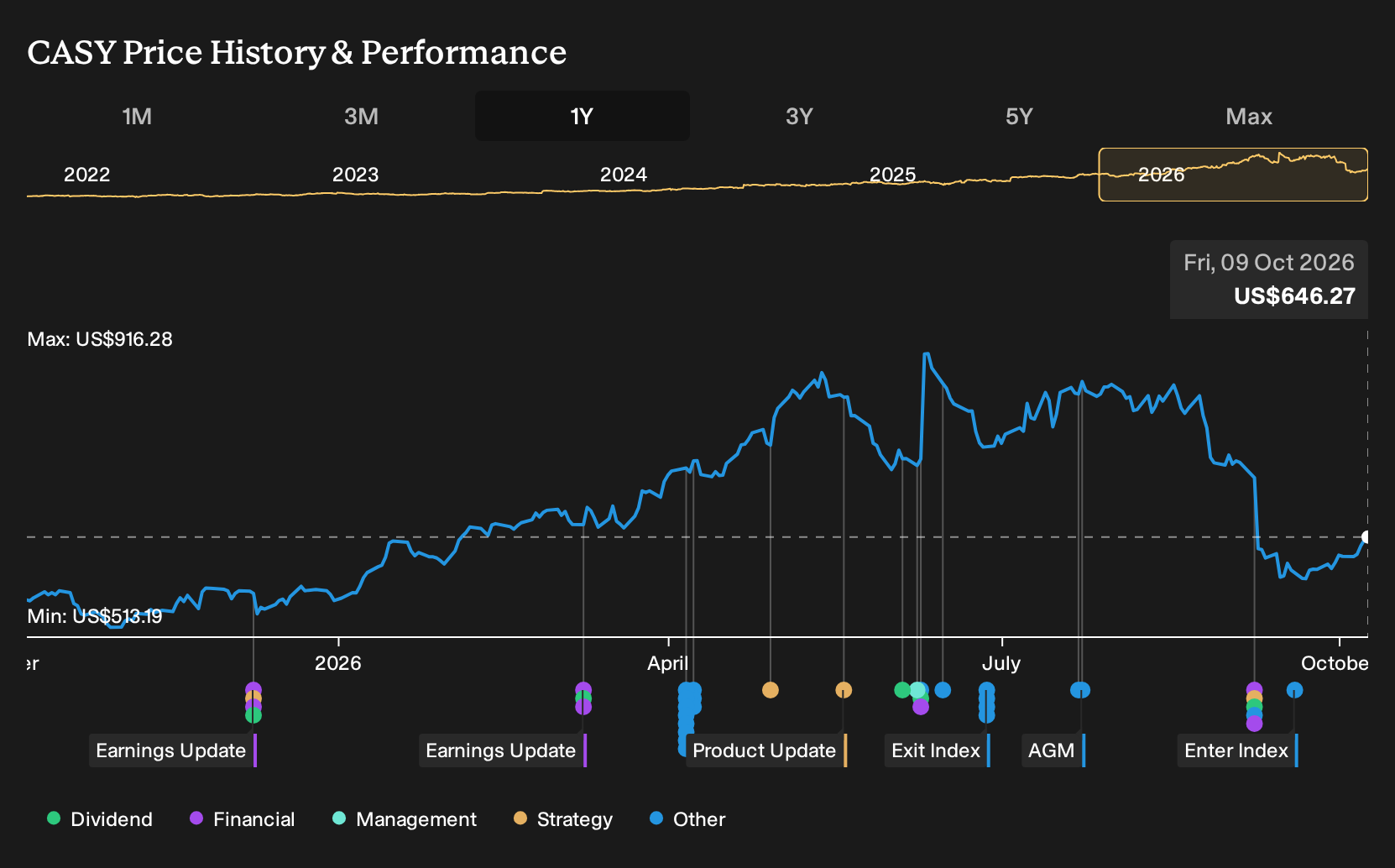
Exploring Other Perspectives
One alternate Casey's General Stores storyline focuses heavily on fuel margin risk. The lowest analysts were penciling in revenue of about US$19.8b and earnings of roughly US$917.0 million by 2029, well below consensus. Those forecasts came before this quarter, so you can treat them as a starting point to reassess where you stand.
Explore 3 other Casey's General Stores fair value estimates, including one that suggests it could be worth just $722.31.
Form Your Own Verdict
Disagree with existing narratives? Extraordinary investment returns rarely come from following the herd, so consider conducting your own research.
- A great starting point for your Casey's General Stores research is our analysis highlighting 4 key rewards and 1 important warning sign that could impact your investment decision.
- See our latest analysis for Casey's General Stores. The report includes a comprehensive fundamental analysis summarized in a single visual, the Snowflake, making it easy to evaluate Casey's General Stores' overall financial health at a glance.
Looking For More Investment Ideas Beyond Casey's General Stores?
If Casey's General Stores has sharpened your interest in expansion stories and resilient business models, it can be useful to line it up against a wider pool of potential opportunities using screeners that focus on different strengths.
- If capital preservation is high on your list, consider starting with 31 resilient stocks with low risk scores to focus on keeping downside risk more contained.
- If you prefer balance sheets that can better absorb shocks, scan through a list of solid balance sheet and fundamentals (25 results) that pairs financial resilience with underlying fundamentals.
- If you want earlier stage stories that the market may be overlooking, broaden your watchlist with a 20 high quality undiscovered gems that highlights under-the-radar businesses with stronger underlying numbers than their profiles suggest.
This article by Simply Wall St is general in nature. We provide commentary based on historical data and analyst forecasts only using an unbiased methodology and our articles are not intended to be financial advice. It does not constitute a recommendation to buy or sell any stock, and does not take account of your objectives, or your financial situation. We aim to bring you long-term focused analysis driven by fundamental data. Note that our analysis may not factor in the latest price-sensitive company announcements or qualitative material. Simply Wall St has no position in any stocks mentioned.
Have feedback on this article? Concerned about the content? Get in touch with us directly. Alternatively, email editorial-team@simplywallst.com