


How Five Years Of Growth At Ares Management Stock Has Changed Its Investment Story
- Ares Management has reported strong long term business momentum, with revenue, fee related earnings and earnings per share each recording robust compounded annual growth over the past five years.
- The same period of compounding in fee related earnings indicates that Ares Management has been steadily deepening its recurring, fee based profitability engine.
- We will now examine how Ares Management's multi year fee related earnings strength could influence the broader investment narrative around the firm.
Scan beyond Ares Management and line up other asset managers with strong recurring fee engines using our curated list of 20 high quality undiscovered gems that may still be flying under most investors' radar.
Ares Management Investment Narrative Recap
Ares Management appeals to shareholders who see potential in a long runway for alternative assets, especially private credit and real assets, supported by fee based, recurring income. The key question is whether that fee engine can keep compounding while private credit funds, including those tied to Ares, experience pressure on values and dividend payouts.
The main near term swing factor is how effectively Ares converts its high level of dry powder into fee paying assets, and whether it can do so without triggering additional stress in wealth channel vehicles. The most significant current risk is that private credit fund underperformance and payout cuts weigh on fundraising and redemptions, which could slow fee related earnings momentum.
A particularly relevant development is the recent weakness in private credit funds and their dividend reductions, even with double digit yields. For Ares Management, this links directly to the core catalyst that many investors watch: turning committed but non fee paying capital into earning assets at terms that still look acceptable to both lenders and borrowers.
If private credit returns remain under pressure, investors may focus on any change in Ares fundraising mix between institutional and wealth channels, as well as on the pace at which that US$170b of dry powder is deployed. Execution on expansion across infrastructure, real estate and secondaries takes on greater importance when one product set is under scrutiny.
Ares Management Forecasts and Implied Earnings Step Up
Ares Management's current analyst narrative rests on a model that combines steady revenue expansion with a sharp uplift in profitability over the next few years. Analysts are working off an assumption that revenue grows by 9.5% each year and that profit margins rise from 9.3% today to 29.0% in three years. That margin shift is what underpins the jump in forecast earnings from US$487.4m today to a consensus of US$2.0b by 2029, with the most optimistic forecasts reaching as high as US$2.8b.
Ares Management's narrative projects US$6.9b revenue and US$2.0b earnings by 2029. This rests on analysts using a 9.5% yearly revenue growth rate and an earnings increase of about US$1.5b from current earnings of US$487.4m.
For investors, that move in earnings effectively implies that the business would be producing a little more than 4x its current profit pool by the 2029 forecast point. The consensus framework also bakes in some dilution, since analysts expect the share count to expand by 3.22% per year over the next 3 years. That means any per share outcome relies not only on higher margins and revenue but also on the fee engine scaling fast enough to offset the impact of new equity.
The valuation overlay on these forecasts is equally important. To align with the analyst targets, the shares would need to trade on a P/E of 23.7x those US$2.0b earnings in 2029, compared with 55.5x today and a current industry multiple of 39.6x for US capital markets peers. That framework suggests the narrative assumes both stronger profitability and a lower earnings multiple over time, which together help anchor the fair value arguments that analysts are using.
Uncover why Ares Management's fair value indicates a 26% potential upside to its current price before the market closes the gap.
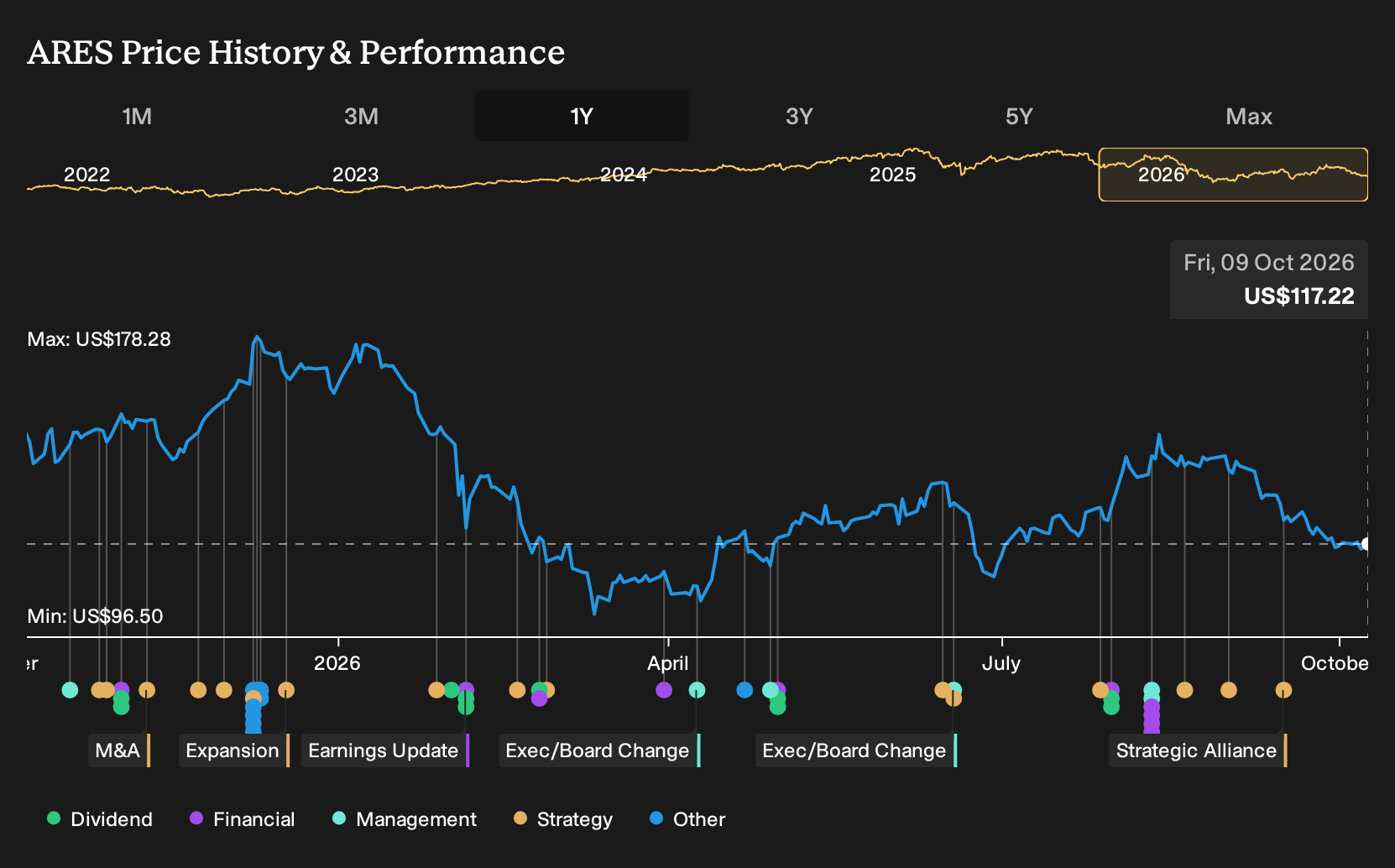
Exploring Other Perspectives
One alternate angle on Ares Management focuses less on wealth channel stress and more on an earnings upside catalyst if dry powder deployment accelerates. The most optimistic analysts were already pencilling in about US$7.2b of revenue and US$2.7b of earnings by 2029. You can treat those pre news forecasts as one end of a wide opinion range that may shift again after this private credit setback.
Explore 2 other Ares Management fair value estimates, including one that suggests as much as 43% upside from the current price.
Decide For Yourself
Don't just follow the ticker. Dig into the data and build a conviction that's truly your own.
- A great starting point for your Ares Management research is our analysis highlighting 3 key rewards and 3 important warning signs that could impact your investment decision.
- See our latest analysis for Ares Management. The report includes a comprehensive fundamental analysis summarized in a single visual, the Snowflake, making it easy to evaluate Ares Management's overall financial health at a glance.
Looking For More Investment Ideas Beyond Ares Management?
Once you have a view on Ares Management, it can help to widen the search and compare it with other businesses that fit different portfolio roles, from income anchors to lower volatility holdings.
- If you want potential upside with a focus on strong fundamentals, start with our curated set of 20 high quality undiscovered gems that many investors may not be watching closely yet.
- For readers who care most about capital preservation and steadier profiles, consider filtering for 31 resilient stocks with low risk scores that might help smooth out the bumpier parts of your portfolio.
- Income focused investors can zero in on dependable payout candidates by scanning 8 dividend fortresses that combine higher yields with an emphasis on resilience.
This article by Simply Wall St is general in nature. We provide commentary based on historical data and analyst forecasts only using an unbiased methodology and our articles are not intended to be financial advice. It does not constitute a recommendation to buy or sell any stock, and does not take account of your objectives, or your financial situation. We aim to bring you long-term focused analysis driven by fundamental data. Note that our analysis may not factor in the latest price-sensitive company announcements or qualitative material. Simply Wall St has no position in any stocks mentioned.
Have feedback on this article? Concerned about the content? Get in touch with us directly. Alternatively, email editorial-team@simplywallst.com