


What a New Groq Lawsuit Means for Nvidia Stock Holders
Nvidia (NVDA) investors have a new legal development to watch following a lawsuit filed on Oct. 2 by two former Groq employees and shareholders over the artificial intelligence (AI) chip startup’s deal with Nvidia. The transaction, announced in December 2025, was structured as a non-exclusive licensing agreement rather than a traditional acquisition.
Nvidia agreed to pay $17 billion to license Groq’s language-processing-unit (LPU) technology, while also hiring Groq’s founder Jonathan Ross, senior executives, and much of its engineering team. A separate $3 billion Nvidia stock pool was created for certain Groq employees who joined Nvidia, bringing the widely reported value of the arrangement to about $20 billion.
The lawsuit, filed in Delaware, alleges that Groq’s board failed to maximize value for all shareholders and that the unusual structure allowed Nvidia to acquire the startup’s key technology and talent without formally buying the company. The plaintiffs argue that some shareholders were effectively shortchanged, while insiders and selected employees received greater benefits. Nvidia is not named as a defendant, and Groq calls the lawsuit “meritless.”
However, the case could nevertheless raise questions about the regulatory risks surrounding Nvidia’s aggressive strategy of acquiring AI technology and talent through licensing and “acqui-hire” arrangements.
About Nvidia Stock
NVIDIA is a global leader in accelerated computing and AI, renowned for pioneering the GPU that revolutionized gaming, data centers, and AI-driven computing. Headquartered in Santa Clara, California, Nvidia’s technology now powers everything from high-performance gaming and cloud computing to autonomous vehicles and generative AI applications. With a market cap of $5.7 trillion, Nvidia stands among the world’s most valuable companies, driven by its dominance in AI infrastructure and continued innovation in next-generation chip design.
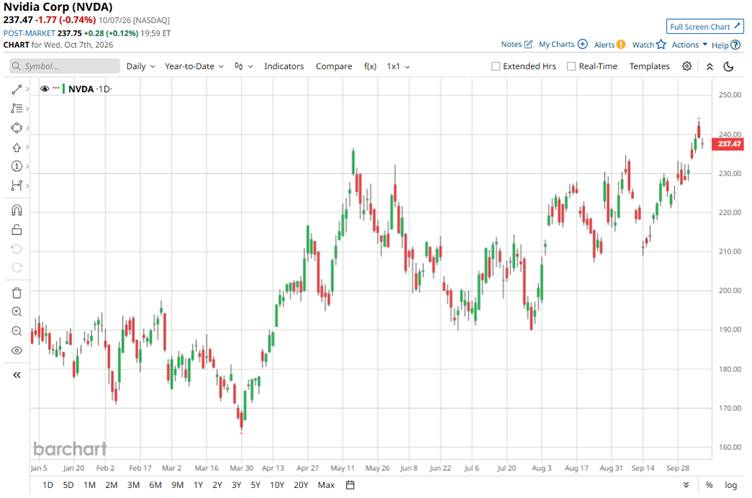
Nvidia has delivered a significant performance in 2026, with shares up 27.3% year-to-date (YTD) and 28.3% over the past 52 weeks. The stock climbed to a record $243.37 on Oct. 6, highlighting renewed investor confidence in the AI semiconductor leader.
The latest rally has been driven primarily by expectations that AI infrastructure spending will remain exceptionally strong. Nvidia continues to dominate the market for accelerated computing, while demand for its GPUs and full-stack AI systems remains robust as hyperscalers and enterprises expand their AI infrastructure.
Moreover, Nvidia reached its new 52-week high on Oct. 6, when shares touched $243.37 intraday and closed at $239.24, with a marginal decline in the following session. The move came as the broader technology sector rallied and investors increasingly positioned for another strong AI-driven earnings season.
Nvidia is also positioned to benefit from recent reports that SpaceX could purchase Nvidia chips as it seeks a potential $40 billion financing deal, while renewed analyst optimism reinforced the bullish sentiment. Meanwhile, the Groq lawsuit does not appear to have materially hurt Nvidia shares so far.
With Nvidia now approaching a $6 trillion market cap, investors appear willing to look beyond near-term valuation concerns as long as AI spending and the company’s earnings growth remain strong.
NVIDIA trades at 25.84 times forward earnings and 26.66 times sales, which is currently a premium compared to industry peers.
Q2 Earnings Exceeded Expectations
Nvidia delivered another blockbuster quarter, reporting its fiscal second-quarter 2027 results on Aug. 26, for the quarter ended July 26. Revenue reached a record $96.2 billion, up 106% year-over-year (YOY) from $46.7 billion, and increased 18% sequentially. The result also comfortably exceeded Nvidia’s prior guidance of $91 billion, plus or minus 2%.
The company’s profitability expanded even faster. On a non-GAAP basis, net income climbed 118% to $54 billion, versus $24.8 billion in Q2 fiscal 2026, while adjusted EPS jumped 120% to $2.22, exceeding expectations. Non-GAAP gross margin rose to 75% from 72.5%. Operating income surged 124% YOY to $63.7 billion.
Nvidia’s Data Center segment remained the primary growth engine, generating $89 billion in revenue, up 117% YOY from the prior-year quarter and representing the majority of total company revenue. The performance reflects continued demand for Nvidia’s accelerated-computing platforms as hyperscalers and AI companies expand infrastructure.
Furthermore, Nvidia issued an even stronger outlook. For Q3 fiscal 2027, the company expects revenue of $108 billion, plus or minus 2%. Importantly, the forecast assumes no Data Center compute revenue from China. Nvidia expects GAAP and non-GAAP gross margins of approximately 74%, plus or minus 50 basis points.
It’s worth noting that Nvidia is not merely maintaining its AI growth trajectory; it is accelerating it, with management pointing to full production of its next-generation Vera Rubin platform and continued strength across AI infrastructure.
Street expects Nvidia’s momentum to continue, with analysts forecasting EPS growth of 102.4% YOY to $9.25 in fiscal 2027, followed by another 67.9% increase to $15.53 in fiscal 2028.
Wall Street Is Highly Bullish About Nvidia
Daniel Ives’ new coverage of Nvidia provides another bullish signal for the AI chipmaker. On Oct. 7, Ives initiated coverage at Yorkville Ives & Co. with an “Outperform” rating and a $300 price target. The call is particularly notable because Ives is restarting technology-sector coverage through his new firm after leaving Wedbush. In his initial Yorkville coverage, Nvidia was identified as one of his top technology stocks.
Also, Citi analyst Atif Malik reiterated a “Buy” rating on Nvidia on Oct. 6, with a $315 price target, while Morgan Stanley analyst Joseph Moore reiterated an “Overweight” rating on Nvidia on Oct. 2, with a $300 price target, and reinstated Nvidia as its top semiconductor pick.
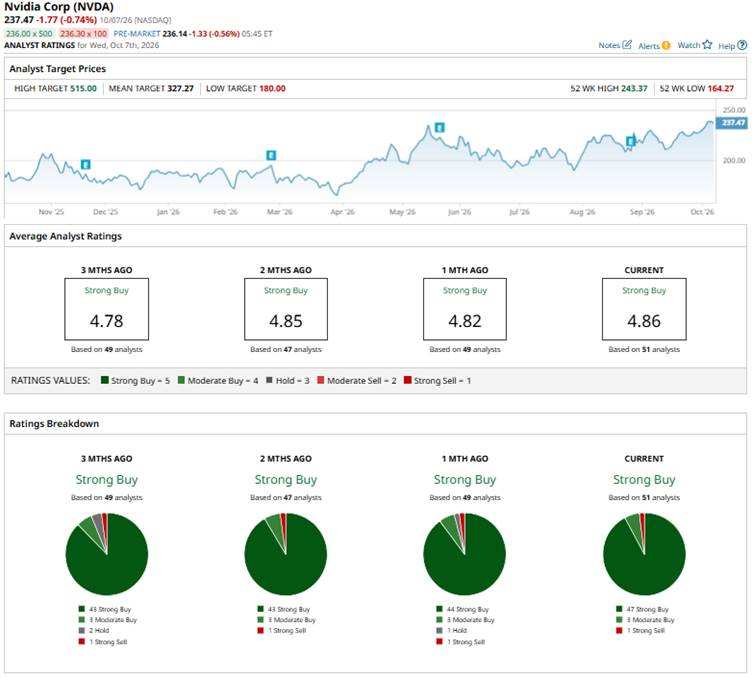
Overall, NVDA has a consensus “Strong Buy” rating. Of the 51 analysts covering the stock, 47 advise a “Strong Buy,” three suggest a “Moderate Buy,” and one offers a “Strong Sell” rating.
The average analyst price target for NVDA is $327.27, indicating a potential upside of 37.8%. Also, the Street-high target price of $515 suggests that the stock could rally as much as 116.9%.
On the date of publication, Subhasree Kar did not have (either directly or indirectly) positions in any of the securities mentioned in this article. All information and data in this article is solely for informational purposes. For more information please view the Barchart Disclosure Policy here.