


When major asset management deleveraging was underway: ultra-long US bond futures were sold off for 7 consecutive days, and technical pressure surfaced
The Zhitong Finance App learned that asset management companies are selling long-term US Treasury futures contracts, which indicates that a passive sell-off is taking place at a time when cash yields are hovering near multi-year highs.
According to data from the US Commodity Futures Trading Commission (CFTC), in the two weeks ending October 6, fund management agencies cut long positions in ultra-long-term bond futures. The risk exposure drop was about US$27 million per basis point, which is roughly equivalent to US$38 billion in stock of 10-year cash securities.
Over the same period, futures contract prices fell sharply as the 30-year yield rose to a 24-year peak of 5.68%. This is part of a month-long wave of sell-offs. The background includes concerns about the inflationary impact of the US-Israel war on Iran, the worsening financial situation of global governments, and the artificial intelligence (AI) boom fueling the economic fires facing the Federal Reserve, which is already trying to cool down.
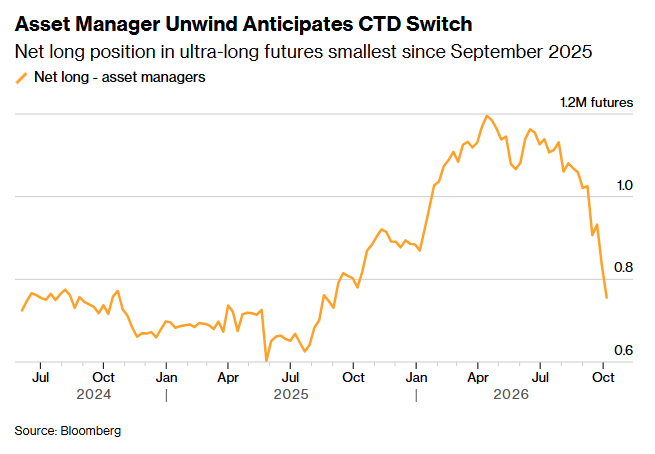
The latest CFTC data released on Friday also provides new evidence that technical factors are driving the recent decline in long-term bonds. According to the data, asset management companies have shown signs of passive sell-off, and the longevity of their portfolios has been lengthened due to securities mechanisms involving the cheapest deliverable bonds.
When the basket of deliverable securities changes and the cheapest deliverable (CTD) securities begin to migrate to longer-term bonds, the so-called “switch risk” dynamic is triggered. This could lead to passive sell-off.
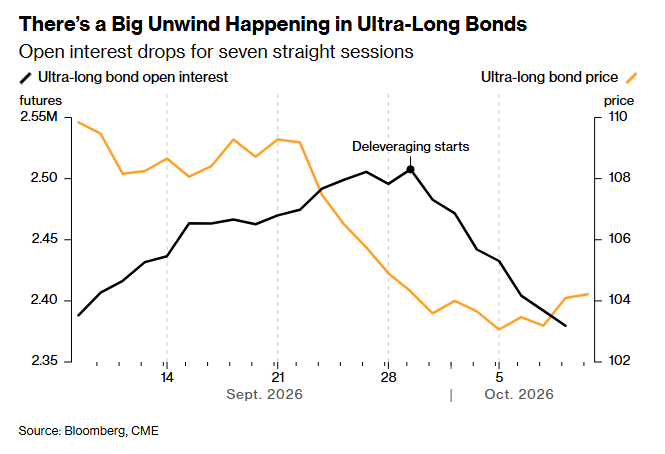
The volume of unclosed contracts, that is, the additional risk exposure held by traders, also confirms the trend of deleveraging in ultra-long-term bond futures.
According to the data, the number of open contracts on ultra-long-term bonds has declined for seven consecutive trading days, reducing the total risk by about 20 million US dollars per basis point. The increase in yield over the same period also indicates that long positions are being closed.