


Is a new round of the “European debt crisis” poised to begin? The premium on French treasury bonds set a record. Will the “Five European Pigs” script be repeated in France?
The Zhitong Finance App learned that the most disturbing and profound change in the European bond market at present is that France is losing its financing advantage as a traditional Western core country. On October 9, the yield on French 10-year treasury bonds reached 30 basis points higher than Italy's, setting a historical record since the birth of the euro; the interest rate spread between France and Germany once broke through 150 basis points last week, returning to the extreme point level of the European debt crisis after a lapse of nearly 20 years. France's 10-year yield has accumulated a cumulative increase of nearly 80 basis points and is close to 5% since the beginning of September, reaching the highest level since 2002. Fiscal deficits are difficult to reduce, budget execution is hampered by politics, and global long-term capital costs are rising due to spillover effects brought about by a surge in 10-year and longer-term US bond yields, which is driving France into the center of the European bond market storm.
According to the latest statistics, global bond investors are demanding additional income compensation from holding French treasury bonds compared to Italian treasury bonds, reaching the highest level since the birth of the euro, Europe's benchmark sovereign currency.
On Friday, the difference in yield between the two countries' benchmark 10-year treasury bonds reached a record 30 basis points. Until last year, Italy was still considered the riskier side of the treasury bond market between the two countries, and borrowing costs were higher than those of France.
Today, investors are punishing France because it has cut its budget deficit less than expected, and there is no sign that its 117.6% debt-to-GDP ratio has declined. Fund managers are also demanding higher yields to make up for the political uncertainty ahead of next April's presidential election; at that time, the extreme right and extreme left may face off.
Meanwhile, Italy has implemented difficult fiscal austerity over the years, reducing the level of government debt and boosting economic growth, and its treasury bonds have reaped market returns as a result. Although Italian treasury bonds have been hit hard by the recent sell-off, investors believe these declines lack sufficient grounds.
Alex Everett, who manages Aberdeen Investments Management's Euro Government Bond Fund, said: “In recent weeks, interest spreads in some European markets have followed France, and we have seen an opportunity in this. “Considering the overall strength of an integrated EU and a better debt development trajectory, Italy, Spain, and some other smaller markets are expected to outperform.”
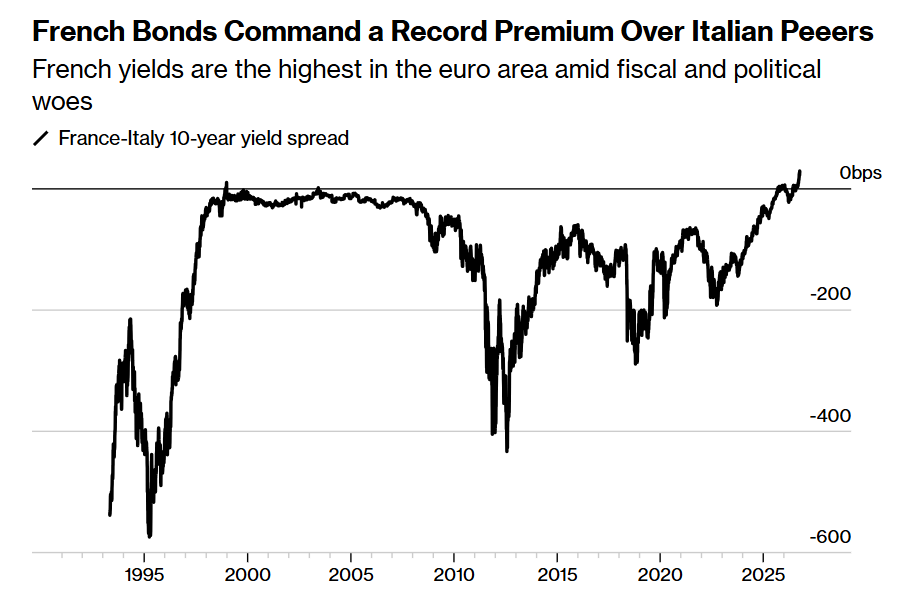
As shown in the chart above, the 10-year yield premium on French treasury bonds compared to Italian treasury bonds has set a record — French treasury yields are already at the highest level in the Eurozone due to financial and political difficulties.
The performance of French treasury bonds also lags behind other European countries, but the change compared to Italy is particularly interesting, because Italy has been viewed as a weather vane for Eurozone sovereignty risks for many years. At the height of the European debt crisis in July 2012, the yield on Italian 10-year treasury bonds was more than 400 basis points higher than France's.
Today, the situation has been reversed, and France is at the center of the Eurobond sell-off. The yield spread between France and regional safe-haven German treasury bonds has widened to a level not seen since the European debt crisis, breaking 150 basis points last week. As the sell-off stabilized, the spread narrowed by 5 basis points to 135 basis points on Friday.
Irina Kurochkina, portfolio manager from Aegon Investment Management, said investors took advantage of recent sell-offs to buy cheaper Italian and Spanish bonds. However, she added that investors are still generally avoiding France.
She said, “After interest spreads widened, bonds from some other countries have indeed become more attractive, especially in peripheral countries with better budget conditions and GDP prospects. The price of French treasury bonds is low enough to moderately make up for the bears, but given the fluctuations brought about by budget discussions and escalating protests, we are not ready to adjust our French treasury positions to neutral.”
French-Italian risk ranking reversal: European debt crisis warning shifts from the “Five European Pig Countries” to Paris
The Five European Pigs (the Chinese version of “PIIGS”) refers to the five European countries Portugal (Portugal), Italy (Italy), Ireland (Ireland), Greece (Greece), and Spain (Spain). It is Wall Street's derogatory term for five European economies with low credit ratings for sovereign debt.
However, the country that is likely to trigger a new round of European debt crisis this time is the “Five European Pig Countries” that have been at the end of the European economy for a long time, but France, the second-largest economy in Europe.
As the second-largest economy in Europe, France's treasury bond market's influence on Europe as a whole and the global economy is much larger than the “Five European Pigs” that sparked the European debt crisis 14 years ago. More and more investment institutions are worried that French treasury bonds will continue to be drastically sold off. The spillover effects may trigger a new round of euro depreciation crises and European debt crises impacting global financial markets.
Looking back at the last round of the European debt crisis — Greece drastically raised its fiscal deficit in 2009. The recession after the financial crisis and the burden of bank bailouts further revealed the financial vulnerability of member states. The pressure then spread to Ireland, Portugal, Spain, and Italy. Falling treasury bonds have weakened banks' assets and financing capacity, and bank bailouts have increased the burden on the government, creating a “vicious circle of sovereign banks”; fiscal austerity further depressed growth. The European bailout mechanism was gradually established. In particular, market confidence gradually recovered after then-ECB President Mario Draghi promised to maintain the euro “at any cost” in 2012 and the ECB introduced a conditional direct currency transaction instrument (OMT).
This time, the European debt crisis alert first points to the core economies of the Eurozone. Although the bond market took a breather on Friday — France's 10-year yield fell back to about 4.825% in early European trading, and the Franco-German spread narrowed at one point to 135 basis points — the brief rebound did not resolve the issue of budget credibility. What determines whether this storm can subside is whether France can convince investors that financial promises can eventually be turned into an enforceable and implementable monetary or fiscal policy.
US debt is raising capital prices, and the French treasury is approaching a “credit slaughter line”
The sharp rise in US bond yields with maturities of 10 years or more is undoubtedly providing external impetus for European debt revaluation. The US 10-year yield rose rapidly from about 4.7% at the end of August to more than 5.3%; on October 8, the 10-year and 30-year yields hit about 5.35% and 5.73%, respectively, and then fell back to about 5.23% and 5.61% due to strong demand for long-term treasury bond auctions. The sharp rise in long-term interest rates within a few weeks means that global investors are demanding higher returns in order to continue to bear the risk of price fluctuations and inflation in long-term bonds.
Looking at the pricing mechanism, long-term yield is determined by a combination of future short-term interest rate expectations and term premiums. Energy shocks raise the risk of inflation, huge government debt issuance and AI infrastructure financing increase capital requirements, and central bank downsizing reduces stable purchases; therefore, even if expectations of a certain rate hike cool down, long-term financing costs may still rise. The impact of US debt spread to Europe through a combination of global portfolio reallocation and term premiums, while Europe itself is under pressure to increase debt issuance and not renew investment in maturing ECB bonds. France, on the other hand, bears the additional impact of growing fiscal and political risk premiums.
The most dangerous contradiction in the French treasury bond market and the French financial system as a whole is that interest expenses are eroding the space for fiscal consolidation. The public debt for the second quarter, as recently announced by Statistics France, reached about 3.60 trillion euros, accounting for 119.0% of GDP. The government expects economic growth to be only 0.5% in 2026, with a deficit of 5.4% of GDP; in 2027, even after implementing a €54 billion fiscal consolidation, the deficit target is still 5%. Meanwhile, interest expenses are expected to rise from €79.2 billion to €91.2 billion, an increase of around 15%. New and maturing refinancing is becoming more and more expensive, yet fiscal adjustments are hampered by low growth, parliamentary division, and election pressure, so it is easy to form feedback that “interest increases — fiscal improvements are blocked — risk premiums rise again.”
The key trigger threshold for a new round of European debt crisis is whether sovereign pressure will fully penetrate bank financing and physical credit. If the fall in French debt continues to weaken the value of financial institutions' assets and collateral, and tightening financing then curbs loans, investment, and taxation, French fiscal pressure could evolve into a broader financial contraction. The ECB has the tools to stop the spread, but TPI targets financing conditions that lack a fundamental basis, deteriorate in a disorderly manner, and damage the transmission of monetary policy, and must assess fiscal sustainability; therefore, it does not automatically cover any budget imbalances.
The alarm for a new round of European debt crisis is already heating up, but the market has yet to enter the stage of full financing failure. Institutions such as Aberdeen and Aegon have begun to repay Italian and Spanish bonds, but they continue to avoid France, highlighting that global fixed income investment-type funds are rearranging European sovereign credit. The high yield on French bonds first reflects financial credibility discounts; the opportunity for Italian and Western bonds comes from some investors' revised judgments on collateral sell-offs. The next most critical signal is whether the French budget can be implemented, and whether local French financing and credit pressure will continue to spread to Eurozone bank credit spreads and corporate financing.