


Dear Tilray Stock Fans, Mark Your Calendars for October 8
Tilray Brands (TLRY) is no longer your run-of-the-mill cannabis stock. The company has stretched well beyond recreational marijuana, building a portfolio across cannabis, craft beverages, hemp-based wellness, hospitality, and entertainment, with more than 40 brands. Its expansion into beverages and alcohol has added another leg to the business, giving Tilray a much broader consumer-product footprint than its cannabis roots suggest.
Now, investors are about to get another reality check. Tilray is scheduled to report its first-quarter fiscal 2027 financial results before the market opens on Thursday, Oct. 8. While the company has been steadily diversifying its operations, the stock has hardly given shareholders much to celebrate. Shares remain deep in the red, weighed down by Tilray’s persistent losses, regulatory uncertainty surrounding cannabis and the ongoing pressure from share dilution.
The business has expanded, but profitability has remained elusive. Much of the recent operating improvement has come from non-recreational cannabis businesses, beverages, distribution, and wellness rather than the recreational cannabis market itself. Yet investors still have one eye on the U.S. cannabis market, where regulatory reform remains a major source of speculation around the stock.
Analysts, meanwhile, still expect Tilray to post a loss in Q1. So, with earnings on the horizon, let’s look at the numbers and what the company could bring to the table.
About Tilray Stock
Canada-based Tilray Brands has grown into a diversified cannabis, wellness, and consumer products company, expanding its footprint significantly since its 2021 merger with Aphria. Led by CEO Irwin Simon, the company now operates across over 20 countries, with its portfolio spanning medical cannabis, craft beverages, and other consumer brands.
A key part of Tilray’s strategy is diversification beyond cannabis, particularly through its growing beverage business, which includes beer, spirits, and non-alcoholic brands. Meanwhile, its medical cannabis operations in Europe, especially Germany, provide exposure to a developing regulated market. Together, these businesses give Tilray a broader revenue base as the global cannabis industry continues to evolve. Its market capitalization is approximately $506.7 million.
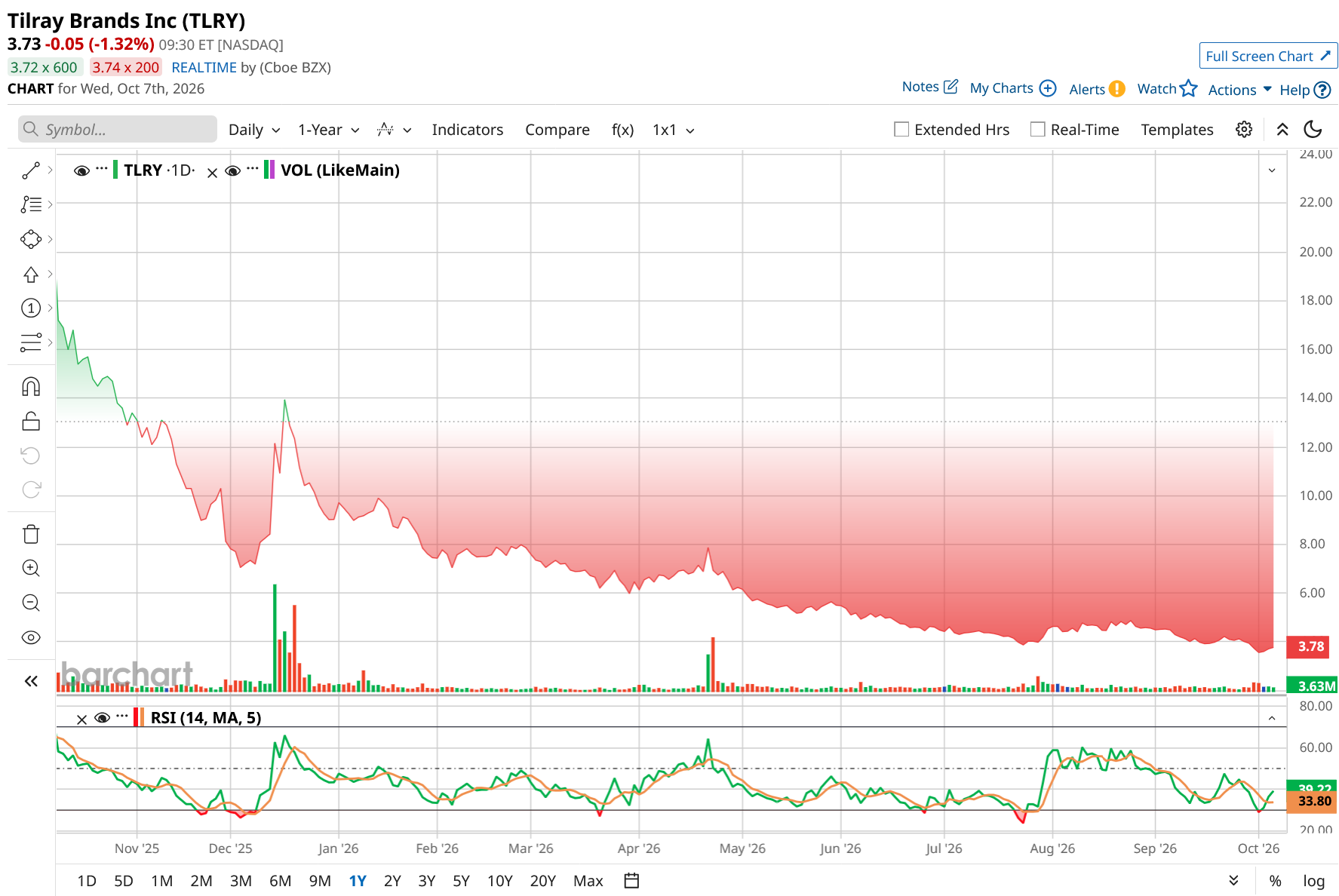
TLRY stock has been a rough ride, and 2026 has done little to change that story. The shares have plunged 58% on a year-to-date (YTD) basis, extending a longer slide that has wiped out 78% over the past 52 weeks and 42% over the past six months. The selling has remained intense more recently, with TLRY down 13% over the past three months and 16% in the past month alone.
The weakness reflects a cannabis industry still struggling with regulatory uncertainty, uneven demand, and difficult economics, leaving Tilray’s financial performance with little to cheer. The company’s diversified business has provided some cushion, but its cannabis operations remain tied to a market where regulatory restrictions continue to weigh on growth and profitability. The stock’s longer-term record is even harsher, with TLRY down 96% over five years.
On Oct. 1, shares touched a 52-week low of $3.54, while falling 7.5% over the past five trading days. That was because the DEA temporarily paused its cannabis-rescheduling hearing recently, adding another regulatory setback to the stock’s already bruising slide.
Then came a burst of buying. Tilray's shares recently moved higher as renewed U.S. cannabis-reform chatter revived interest across the sector. Comments surrounding cannabidiol’s potential benefits for older adults, along with renewed discussion about moving marijuana to a lower federal schedule, triggered heavier trading and lifted cannabis stocks broadly. Tilray, one of the more actively traded cannabis names on U.S. exchanges, caught the wave.
Still, the rally was driven by reform headlines rather than a sudden change in Tilray’s underlying business, making the recent move a sharp reaction to renewed regulatory attention.
TLRY’s valuation sends a mixed signal. The stock trades at just 0.46 times forward sales, below both sector peers and its historical median, making the revenue multiple look relatively modest. However, at 61.88 times forward adjusted earnings, TLRY trades well above both the sector and its own historical average, suggesting investors are paying a much richer price for its expected earnings.
Q4 Earnings Snapshot
Tilray Brands wrapped up fiscal 2026 with a stronger finish, as its fourth-quarter results indicated that the company’s increasingly diversified business is starting to contribute across several fronts. In July, Tilray reported fourth-quarter revenue of $281.7 million, up 25% year-over-year (YoY) and ahead of Wall Street’s expectations. The growth was broad-based, with cannabis revenue rising 5% to $71.5 million, while beverage revenue reached $105.6 million. Distribution revenue climbed 15% to $85 million, and wellness revenue increased 16% to $19.7 million.
The improvement also showed up in profitability. Gross profit jumped 34% to $90.5 million, pushing gross margin to 32% from 30% a year earlier. Adjusted EBITDA increased to $31.9 million from $27.6 million. Excluding approximately $2.3 million in fuel surcharges, adjusted EBITDA would have been $34.2 million. Tilray posted adjusted net income of $5.3 million, or $0.05 per adjusted share. On a reported basis, however, the company remained in the red, with a -$37.9 million net loss, or -$0.43 per-share loss, driven predominantly by non-cash charges.
Meanwhile, Tilray continued to lean harder into beverages. Its acquisition of BrewDog created a pro forma global beverage platform of roughly $500 million and brought one of the world’s best-known craft beer and hospitality brands into the fold. Since taking ownership, Tilray says it has stabilized BrewDog, improved its performance, and positioned the business for profitability while using its pub network and consumer platform for initiatives such as the £1 million Bar Tab campaign. Its expanded U.K. and European presence, combined with an exclusive U.S. partnership with Carlsberg, has further broadened the beverage operation.
The balance sheet also ended the year on firmer footing. Tilray finished fiscal year 2026 with about $235 million in cash, restricted cash, and marketable securities, while net debt fell to just $0.7 million. Operating cash flow, excluding working capital, improved 157% to approximately $18.2 million.
Looking ahead, management expects more than $1 billion in annual revenue in fiscal 2027 and projects adjusted EBITDA of $68 million to $75 million, representing double-digit growth from fiscal 2026.
Tilray’s road ahead still looks bumpy, with analysts expecting a -$0.18-per-share loss in fiscal Q1 2027 and revenue of about $267.1 million. For the full fiscal year, losses are projected to narrow to -$0.42 per share, representing a 61.5% YoY improvement. The earnings picture is expected to keep improving, with fiscal 2028 losses forecast to shrink another 57.1% annually to -$0.18 per share. So, while Tilray is not exactly sprinting toward profitability, the estimates point to a gradual narrowing of losses rather than continued deterioration.
What Do Analysts Expect for TLRY Stock?
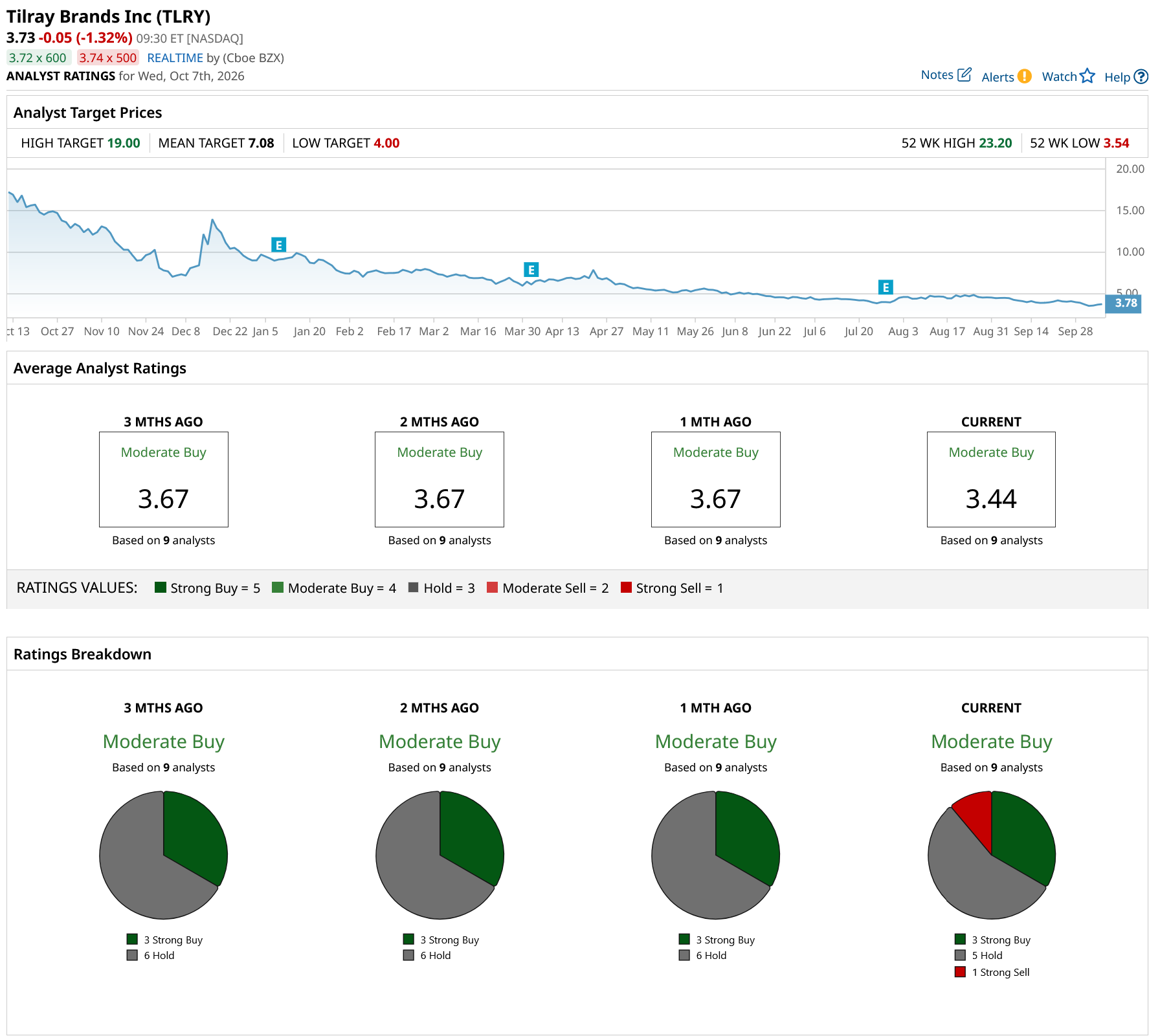
The consensus rating on the cannabis stock remains at “Moderate Buy,” from the nine analysts covering TLRY. Among them, three recommend a “Strong Buy,” five analysts are playing it safe, advising a “Hold” rating, and the remaining one analyst is outright skeptical, suggesting a “Strong Sell.”
Wall Street is not promising fireworks just yet. Tilray’s dips have bruised sentiment. With a mean price target of $7.08, TLRY stock has a rebound potential of 90% from the current price levels, while the Street-high target of $19 indicates the stock could surge as much as 409%.
On the date of publication, Sristi Suman Jayaswal did not have (either directly or indirectly) positions in any of the securities mentioned in this article. All information and data in this article is solely for informational purposes. For more information please view the Barchart Disclosure Policy here.