


Nippon Electric Glass (TSE:5214) Unveils BDX 3 As Investors Weigh Whether The Stock Looks Fully Valued
Nippon Electric Glass (TSE:5214) has put space technology in focus after unveiling BDX-3, an ultra-thin Starveil cover glass designed to cut radiation discoloration and improve UV shielding for satellite equipment across multiple orbital zones.
The recent BDX-3 announcement comes after a busy few months for Nippon Electric Glass. The company also completed a share buyback of 2,782,600 shares, or 3.74% of outstanding equity, for ¥15,883.68m by the end of September 2026.
The 1-day share price return of 2.11% and 7-day gain of 7.80% to ¥5,267 suggest short-term momentum is building, even though the 90-day share price return declined 11.81% and the year-to-date share price return is down 15.32%.
Looking further out, total shareholder return of 9.40% over one year and more than doubling over three and five years indicates that investors who stayed invested in Nippon Electric Glass have seen stronger long-run outcomes than suggested by this year’s weaker price trend.
Compare Nippon Electric Glass with other space and advanced materials plays by scanning our hand picked 33 best rare earth metal stocks that could benefit from similar demand for high performance components.
Nippon Electric Glass now trades only around 2% below the average analyst target after a sharp bounce. Is that a sign the market is too cautious on the space glass story, or already paying up for it?
Price-To-Earnings of 15x for Nippon Electric Glass: Is it justified?
On simple valuation terms, Nippon Electric Glass trades on a P/E of 15x, which sits below both the Japanese Electronic industry average of 16.6x and the peer group on 28.9x. That places the current ¥5,267 share price at a discount compared with similar businesses that are also tied to electronics and advanced materials demand.
The P/E ratio compares the market value of the equity to its earnings, so it reflects what investors are willing to pay today for each yen of profit. For a specialist glass producer with exposure to displays, semiconductors, automotive and aerospace uses, earnings power and its stability matter at least as much as raw top line growth when thinking about this metric.
Analysts expect earnings to expand by about 5.6% per year and revenue by roughly 2.5% a year, both slower than the broader Japanese market projections of 9.5% earnings growth and 6.9% sales growth. That softer forecast helps explain why investors are not assigning a richer multiple, even though the P/E of 15x is also below an estimated fair P/E of 17.2x that some models suggest the share price could gravitate towards over time.
Against that backdrop, the valuation picture tilts toward relative value. Nippon Electric Glass is viewed as trading at good value versus its industry, its peer set and that fair ratio estimate, despite a low current and forecast return on equity near 5% and a past five year period in which earnings declined 14.1% per year before recently turning profitable again.
Explore the SWS fair ratio for Nippon Electric Glass.
Result: Price-to-earnings of 15x (UNDERVALUED)
Still, reliance on cyclical electronics demand and relatively low recent return on equity near 5% leave Nippon Electric Glass exposed if end markets soften or capital needs rise.
Find out about the key risks to this Nippon Electric Glass narrative.
Another View on Nippon Electric Glass Valuation
There is a very different message coming from the SWS DCF model. On that framework, Nippon Electric Glass at ¥5,267 is trading well above an estimated future cash flow value of ¥1,824.65, which points to an overvalued stock rather than a bargain on earnings.
For investors, that gap raises a practical question: Is the current price reflecting durable cash generation, or are you paying up for a story that the cash flows do not yet support?
Look into how the SWS DCF model arrives at its fair value.
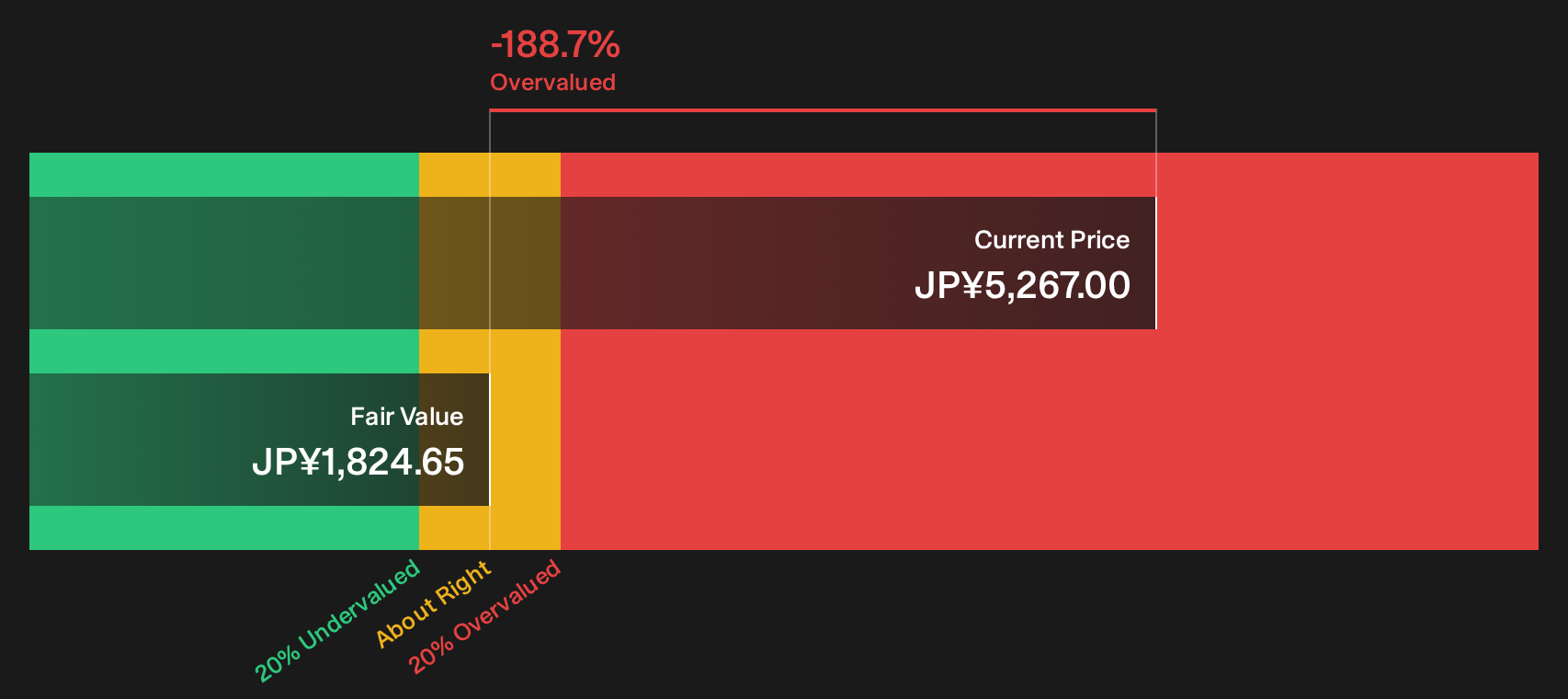
Simply Wall St performs a discounted cash flow (DCF) on every stock in the world every day (check out Nippon Electric Glass for example). We show the entire calculation in full. You can track the result in your watchlist or portfolio and be alerted when this changes, or use our stock screener to discover 14 high quality undervalued stocks. If you save a screener we even alert you when new companies match - so you never miss a potential opportunity.
Next Steps
If this mix of upside and risk around Nippon Electric Glass feels finely balanced, move quickly, review the numbers yourself, and weigh both sides of the story. For a structured view of the key issues investors are flagging on both fronts, start with the 4 key rewards and 2 important warning signs
Looking for more Nippon Electric Glass investment ideas?
If Nippon Electric Glass has your attention, do not stop here. Fresh opportunities often show up where pricing, balance sheets, and income potential quietly line up.
- Target resilience by reviewing companies that screen as 22 resilient stocks with low risk scores so you are not relying on just one story to protect your capital.
- Hunt for pricing gaps by scanning our 14 high quality undervalued stocks that pair solid fundamentals with share prices that have not fully reflected them yet.
- Strengthen your foundation by studying the list of solid balance sheet and fundamentals (23 results) and build a watchlist anchored in financial staying power.
This article by Simply Wall St is general in nature. We provide commentary based on historical data and analyst forecasts only using an unbiased methodology and our articles are not intended to be financial advice. It does not constitute a recommendation to buy or sell any stock, and does not take account of your objectives, or your financial situation. We aim to bring you long-term focused analysis driven by fundamental data. Note that our analysis may not factor in the latest price-sensitive company announcements or qualitative material. Simply Wall St has no position in any stocks mentioned.
Have feedback on this article? Concerned about the content? Get in touch with us directly. Alternatively, email editorial-team@simplywallst.com