


What Should We Read Into Monday Morning's Markets?
The commodity complex was a typical mix of illogical moves coming out of the weekend.
However, a buried headline out of Russia, this one having to do with the plague, got my attention.
The Grains sector was higher across the board on renewed algorithm buying following last week's sharp selloff.
Morning Summary: Welcome to another week everyone, the first full week of October. A look at the quote screen and we see the commodity complex is – well – it’s just another Monday morning. Why is gold up to start the week? Because it isn’t down. What makes this more fun is the US dollar index ($DXY) is also in the green pre-dawn. Does that make sense? Does it have to? US Treasury yields are flat to slightly higher meaning Treasury futures are quietly mixed as of this writing. US stock index futures were showing small losses after Asian markets closed higher and European markets were mostly lower as the trading week gets rolling. Speaking of Europe, the most alarming headline was buried deep on the financial news page, “Russia hospitalizes almost 200 people after researcher’s death from plague”, according to Reuters. Does this given anyone else flashbacks to when a few folks weren’t feeling well in Wuhan nearly 7 years ago[i]? Keep in mind the same crack team, they of the injecting bleach to kill the virus, is at the helm again so we are all fine. Yep. The Energies sector was mixed with an interesting combination of higher Brent crude and lower WTI.
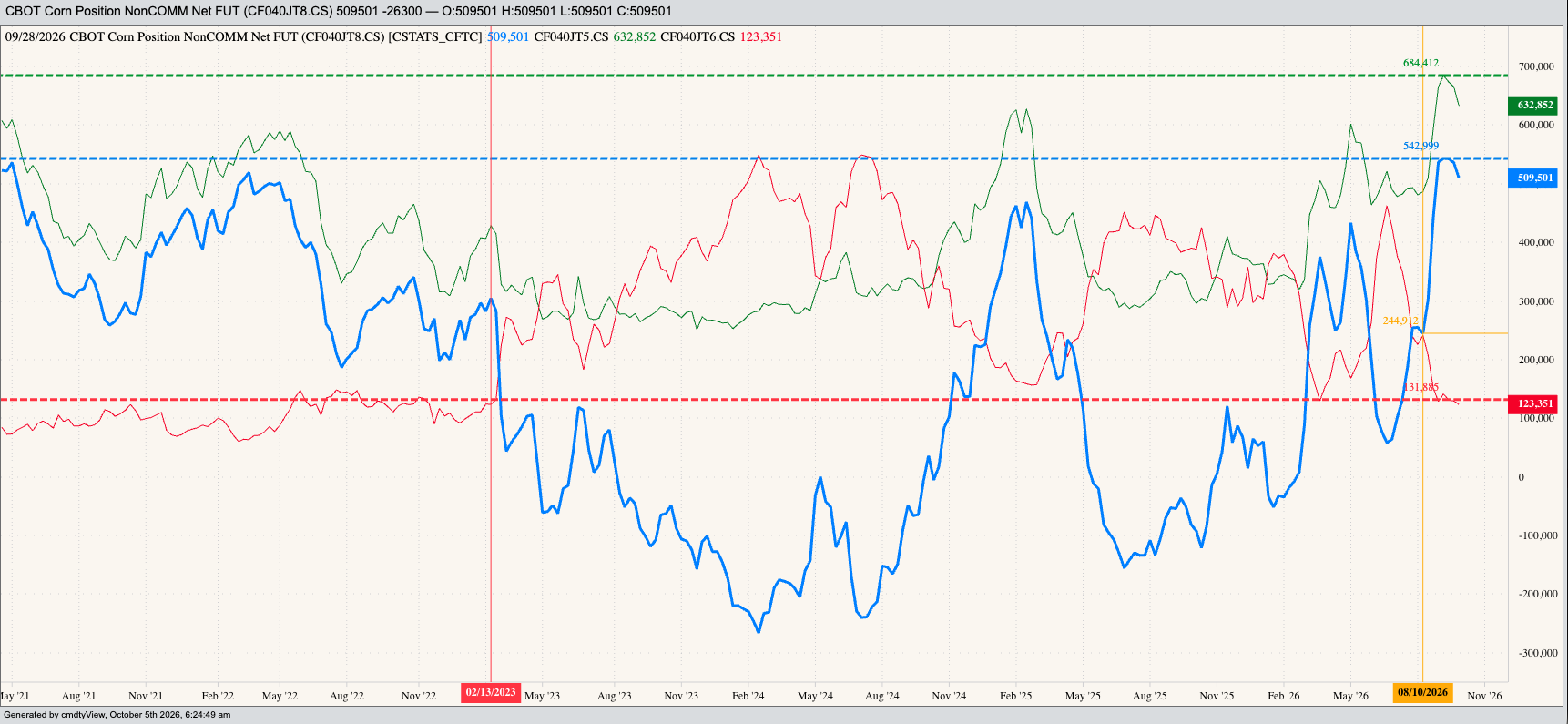
Corn: The corn market rallied on solid overnight trade volume. A look back at last Friday’s session and we see the December issue (ZCZ26) closed 4.5 cents lower, leaving it sharply oversold on it short-term daily chart, from a technical point of view. I mentioned the mix of trends in Weekly Analysis with the long-term trend turning down at the end of September, the intermediate-term trend still down from the week ending Friday, September 4, but the short-term trend in position to turn up. Given this, it isn’t overly surprising to see corn contracts higher to start the week on what looks to be noncommercial buying interest. Speaking of which, last Friday’s Commitments of Traders report showed a decrease in the net-long futures position by 26,300 contracts as of Tuesday, September 29. From that day’s close through last Friday’s settlement Dec26 was down 24.25 cents indicating more long contracts were liquidated. Fundamentally, weather forecasts for much of the US Plains and Midwest look more favorable for harvest progress this week, with no inland hurricanes in the picture. Futures spreads didn’t do much last week while rain-delayed harvest helped national average basis firm from Friday-to-Friday, though the market remains weak. Now we’ll see how the rest of the week plays out.
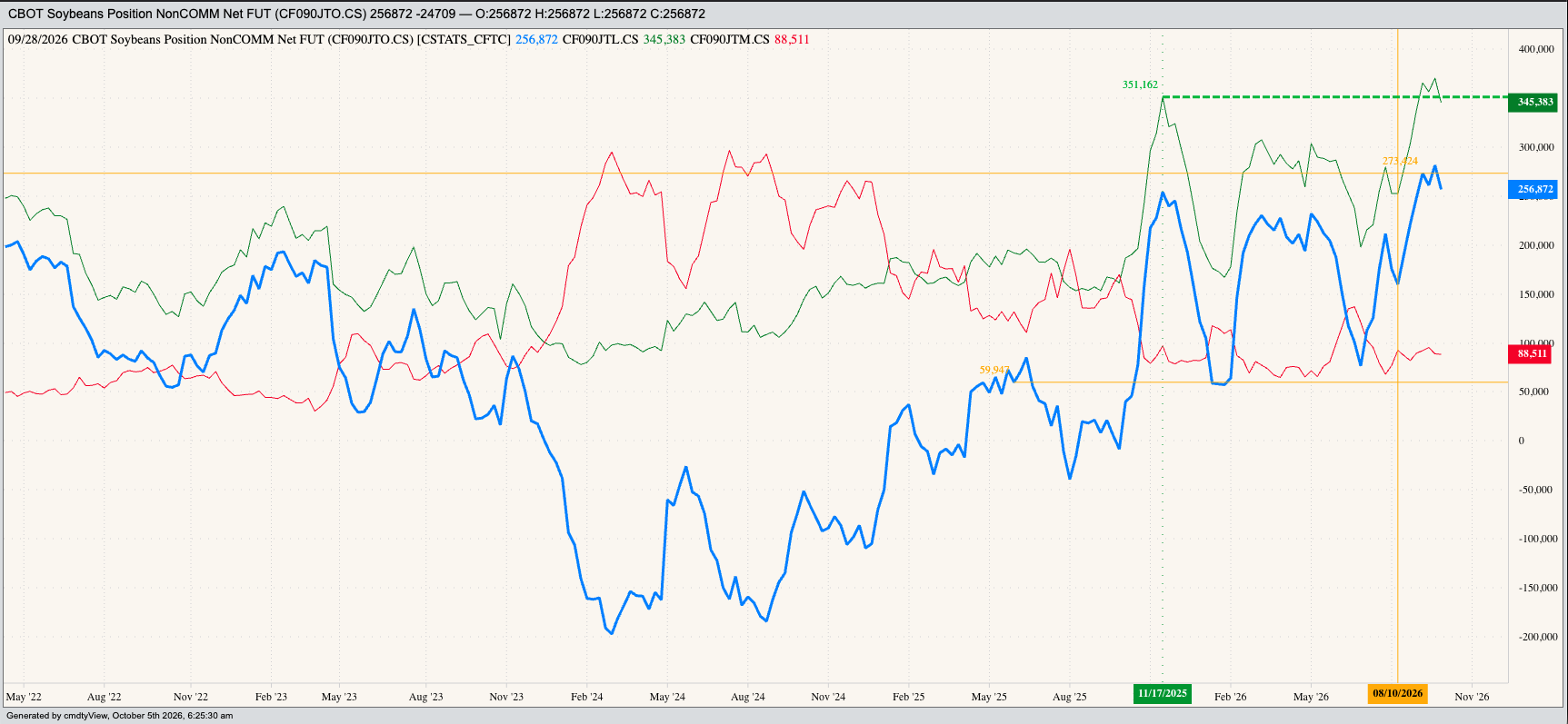
Soybeans: The oilseed sub-sector was higher across the board early Monday morning. As I mentioned in the opening Summary, the Energies sector was mixed with diesel fuel (HOX26) up 7.0 cents after rallying as much as 15.75 cents. The market showed a lot of volatility last week, but when all the shouting was done, the inverse (backwardation for you New Yorkers) in diesel’s forward curve had strengthened. This tells us all we need to know: Supply and demand continued to tighten. This renewed buying had funds interested in oilseeds overnight with the only market hinting at commercial buying being soybean oil. Here we see the December issue up 1.25 cents and just off its overnight high. As for soybeans, the November issue (ZSX26), as well as the January through July, was up 10.75 cents on moderate-at-best trade volume. The latest Commitments of Traders report showed funds decreased their net-long futures position by 24,710 contracts as of Tuesday, September 29. Nov26 then proceeded to lose another 19.5 cents through last Friday’s close. It’s the fundamental side that stood out this past weekend, though. The Nov-January futures spread closed last Friday covering 56% calculated full commercial carry as compared to the previous week’s settlement covering 46%.
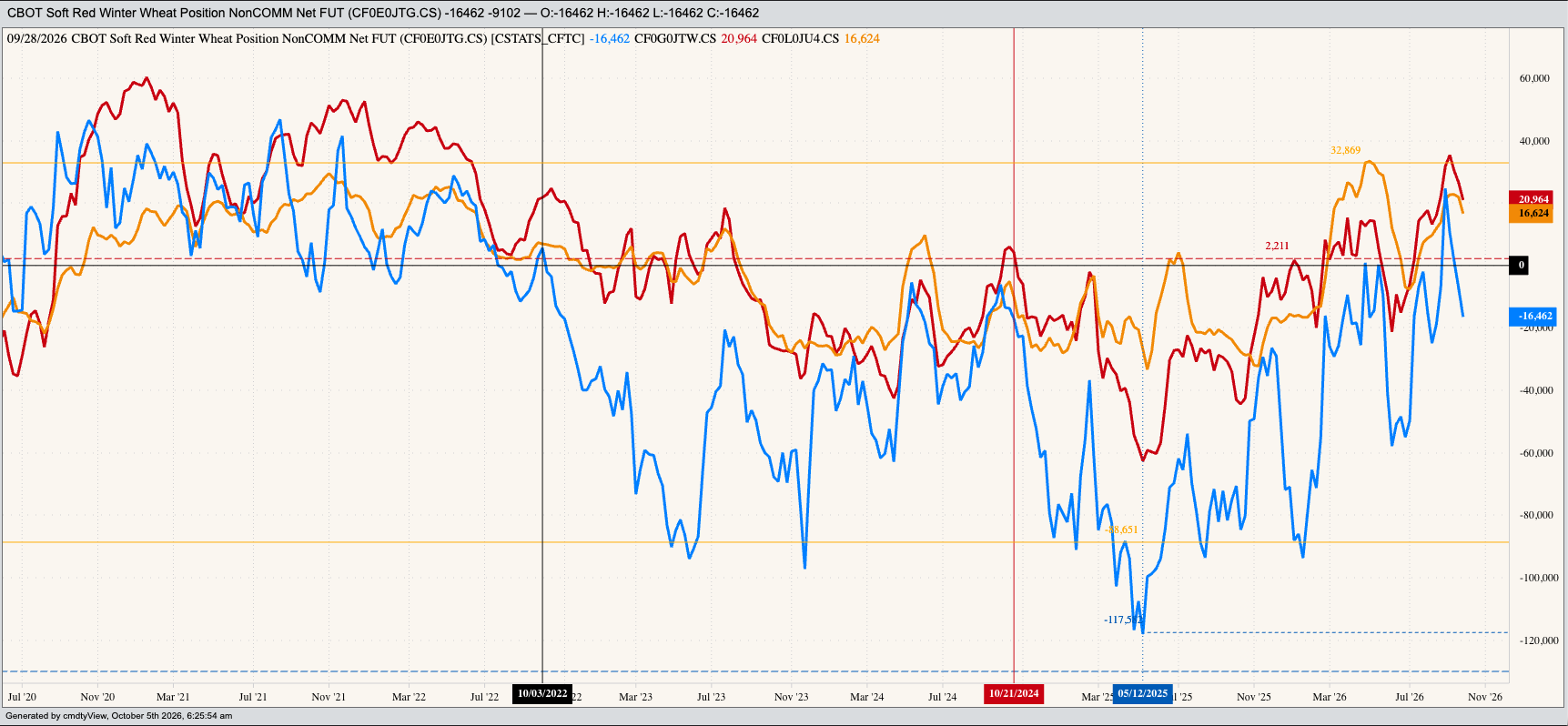
Wheat: The wheat sub-sector was showing double-digit gains across the board. Even though I’m not listening, I can hear commodity market talking heads, most who wouldn’t know a kernel of wheat from a coffee bean, squawking about how the world is running out of wheat – again. Okay. It’s an easy narrative and fills time and space. What’s the reality, as if it mattered? The Dec SRW issue (ZWZ26) closed 20.25 cents lower last week after losing as much as 32.5 cents. Technically, Dec tested potential statistical support near $6.6850 with its low of $6.7075, something Watson may have been watching. The latest Commitments of Traders report showed the recently established noncommercial net-short futures position increasing by 9,100 contracts as of Tuesday, September 29, putting the net-short at 16,460 contracts, the largest net-short since Tuesday, August 18. This also left Dec SRW oversold on its daily chart, another statistic algorithms could be watching, leading to what looks to be a round of short covering as the week gets rolling. Overnight trade volume was not heavy with Dec registering 14,000 contracts changing hands. With weather clearing across the US Plains and Midwest, attention will be turning toward new-crop winter wheat markets. The July issue 20.75 cents lower last week.
[i] Wow…It is hard to believe it has been 7 years.
On the date of publication, Darin Newsom did not have (either directly or indirectly) positions in any of the securities mentioned in this article. All information and data in this article is solely for informational purposes. For more information please view the Barchart Disclosure Policy here.