


Does Frontier AI Defense Change The Bull Case For Palo Alto Networks Stock?
- Recent announcements from Cyderes, Semtech and Palo Alto Networks detail new partnerships and AI-driven offerings that connect Cortex XDR, Cortex XSIAM and NGFWs with managed services and edge hardware to modernize security operations and automate protection across cloud, endpoint, identity and remote assets.
- The launch of Unit 42 Continuous Frontier AI Defense, using multiple frontier AI models for ongoing exposure management, underlines Palo Alto Networks’ push to embed advanced AI across its portfolio and deepen ties with large enterprises that want continuous visibility into cyber risk.
- We will now look at how Palo Alto Networks' investment narrative is shaped by deeper AI driven Unit 42 capabilities and partnerships.
Palo Alto Networks Investment Narrative Recap
To own Palo Alto Networks, you need to believe its bet on AI led security, platformization and subscription heavy ARR can offset rising costs and share based compensation. The Cyderes, Semtech and Unit 42 announcements reinforce the operating focus on AI driven security and outsourced operations, but do not change the central thesis.
The near term swing factor still looks like execution on platform integration of Idira and Chronosphere while defending gross margins that sit at 75.8% in FY26 amid higher cloud and hardware costs. The biggest risk remains that integration complexity and elevated stock based compensation limit operating leverage and hold back earnings per share progress.
The Unit 42 Continuous Frontier AI Defense launch is the clearest link to current catalysts because it directly speaks to AI security spend and exposure management. It turns earlier frontier AI efforts into an always on service that fits neatly beside Prisma AIRS, Cortex XSIAM and broader SecOps offerings across Palo Alto Networks.
For you as a shareholder, the practical question is whether Unit 42 can become a multi year subscription pillar alongside identity security from Idira and observability from Chronosphere. Persistent integration risk, softer margins and dilution from stock based compensation sit on the other side of the ledger and could matter more than any single AI service launch.
How Palo Alto Networks' AI Story Shows Up In The Numbers
On the forecasts analysts are using, Palo Alto Networks is tied to some fairly punchy expectations. The revenue line is modeled to climb at 17.3% a year over the next three years, while profit margins move from 2.7% today to 13.8% in the same window. Consensus points to earnings of US$2.6b by about 2029, compared with US$307.0m today, which implies an earnings increase of roughly US$2.3b on current levels.
Palo Alto Networks' narrative projects US$18.5b revenue and US$2.6b earnings by 2029. This assumes 17.3% yearly revenue growth and an earnings increase of roughly US$2.3b from US$307.0m today.
Those profit forecasts then plug directly into how the stock is framed. To line up with the analyst case, you would need to accept that by 2029 the business is generating US$18.5b of revenue and US$2.6b of earnings, and that the market is comfortable paying a P/E of 198.3x on those profits. That multiple would still sit far above the current US software sector P/E of 29.8x. This indicates that a significant amount of confidence is being placed in Palo Alto Networks' ability to turn AI-focused platforms and Unit 42 style services into much larger and more profitable operations over time.
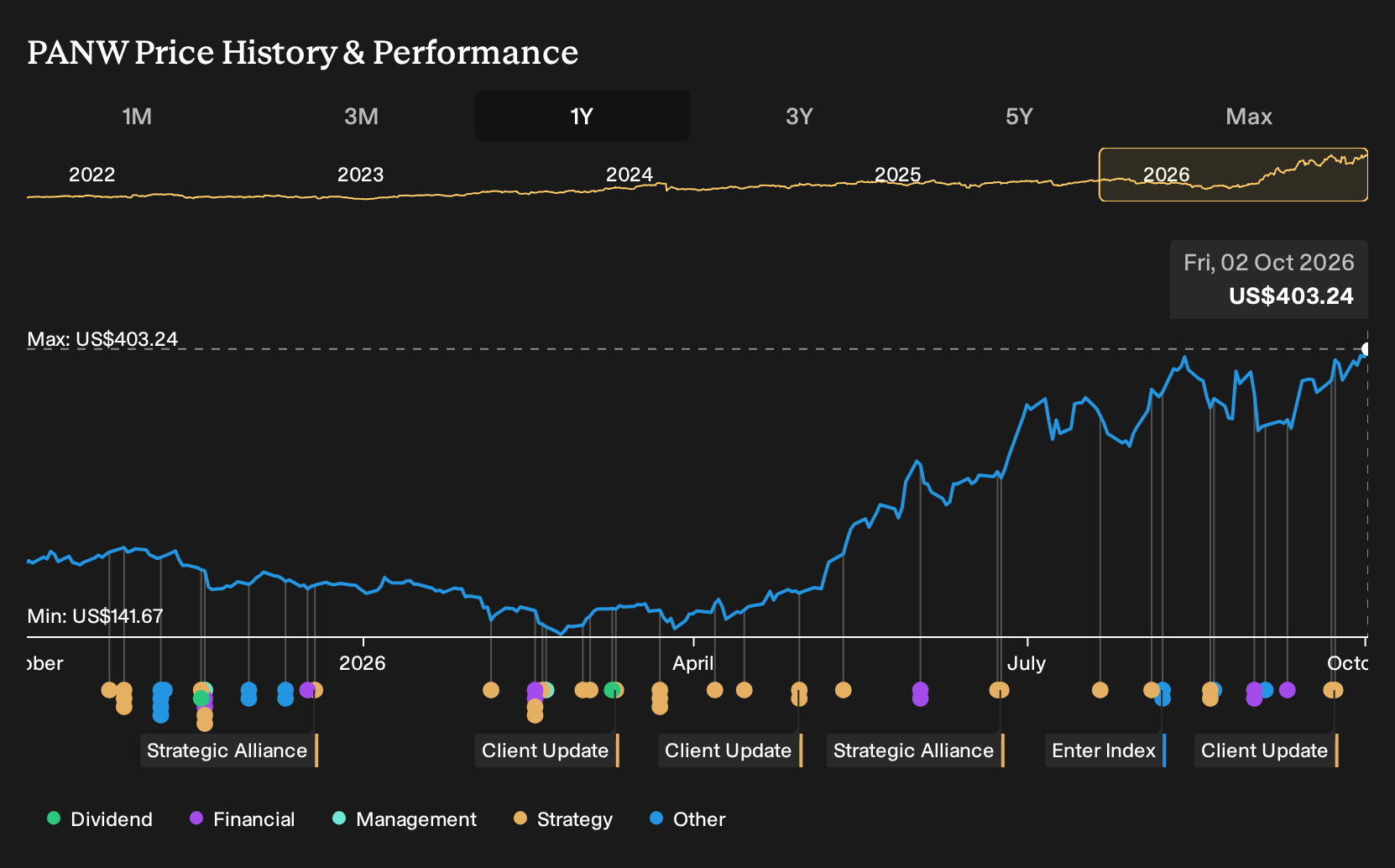
Uncover why Palo Alto Networks' fair value indicates a value that is roughly in line with its current price.
Exploring Other Perspectives
One alternate narrative focuses on AI adoption risk for Palo Alto Networks. Bullish analysts were already assuming revenue could climb about 23.2% a year and earnings might reach roughly US$3.6b by 2029. If the new Cyderes, Semtech and Unit 42 announcements reset expectations on enterprise AI usage, those forecasts could shift meaningfully in either direction, so you may want to compare several viewpoints before deciding what feels reasonable.
Explore 6 other Palo Alto Networks fair value estimates, including one that suggests it could be worth as much as $396.92.
Reach Your Own Conclusion
Disagree with existing narratives? Extraordinary investment returns rarely come from following the herd, so consider forming your own view.
- A great starting point for your Palo Alto Networks research is our analysis highlighting 1 key reward and 3 important warning signs that could impact your investment decision.
- See our latest analysis for Palo Alto Networks. The report includes a comprehensive fundamental analysis summarized in a single visual, the Snowflake, making it easy to evaluate Palo Alto Networks' overall financial health at a glance.
Looking For More Investment Ideas Beyond Palo Alto Networks?
If the Palo Alto Networks story has you thinking more broadly about where to allocate capital, it can help to line up a few contrasting opportunities and pressure test your assumptions. The Simply Wall St Screener is a straightforward way to surface stocks that match different risk, quality and income preferences, then compare them against what you see in PANW.
- For investors who want income front and center, review a curated set of 7 dividend fortresses that combine higher yields with a focus on sustainability.
- If capital preservation and resilience matter more to you than chasing every AI theme, filter for 31 resilient stocks with low risk scores that aim to keep business and balance sheet risks in check.
- When you are hunting for fresh ideas away from the usual large caps, use the screener to surface 19 high quality undiscovered gems that pair solid fundamentals with lower market attention.
This article by Simply Wall St is general in nature. We provide commentary based on historical data and analyst forecasts only using an unbiased methodology and our articles are not intended to be financial advice. It does not constitute a recommendation to buy or sell any stock, and does not take account of your objectives, or your financial situation. We aim to bring you long-term focused analysis driven by fundamental data. Note that our analysis may not factor in the latest price-sensitive company announcements or qualitative material. Simply Wall St has no position in any stocks mentioned.
Have feedback on this article? Concerned about the content? Get in touch with us directly. Alternatively, email editorial-team@simplywallst.com