


Building Better Commodity Portfolios – Part 6 Putting It All Together (From Qualified Trade to Portfolio Decision)
Dual Edge Research publishes two powerful newsletters that work great individually — and even better together. The Bull Strangle Newsletter focuses on stocks and options, combining stock ownership with premium-selling strategies to generate consistent income and market-beating returns. The Smart Spreads Newsletter specializes in seasonal commodity futures spreads, offering a diversified approach with low correlation to equities. Together, they deliver a complete investment perspective — one focused on income, the other on diversification — all under one simple subscription.
Introduction
Throughout this series, we have moved from identifying attractive commodity spreads to deciding how to structure those trades to coexist. A successful research process can produce several qualified opportunities simultaneously. Still, it cannot determine on its own which to pursue, how large they should be, or whether they improve the existing portfolio.
Portfolio construction adds a second question to trade selection:
- Does this attractive trade belong in this portfolio, at this size, at this time?
Answering it requires bringing together trade quality, position size, diversification, capital capacity, and ongoing monitoring.
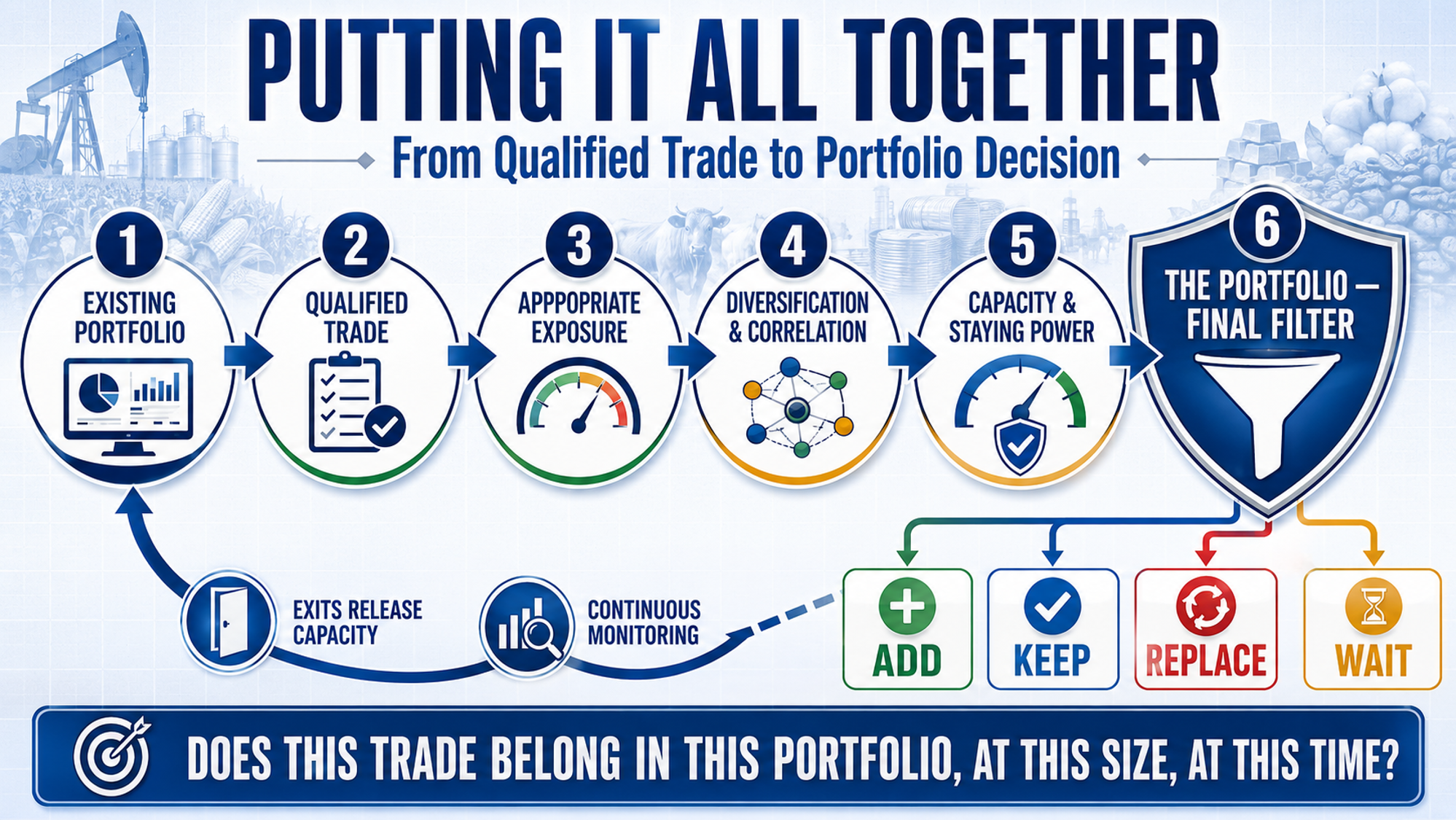
Step 1: Begin With the Existing Portfolio
The process should begin with what the portfolio already owns—not with the highest-ranked trade on the watch list. Existing positions establish the starting point for every new decision. Before considering another trade, I want to understand the portfolio’s exposure by commodity and market class, the balance between long and short spreads, the structures being used, correlated clusters, upcoming exits, and the amount of capacity already consumed.
A portfolio containing several petroleum markets may still depend heavily upon the same underlying forces. Conversely, positions in a single commodity can sometimes reflect different relationships through direction, structure, contract months, and entry timing. The important question is:
- Where is the portfolio’s risk actually coming from?
Step 2: Confirm That the Trade Is Qualified
Portfolio fit should never justify a weak trade. Every prospective position must first qualify through the Smart Spreads research process, including its historical profitability, winning percentage, downside risk, seasonal consistency, liquidity, timing, structure, and current market behavior.
This creates a clear order:
- Determine whether the trade is qualified.
- Determine whether the qualified trade improves the portfolio.
The first decision protects trade quality. The second protects portfolio quality. Among qualified candidates, the highest-ranked opportunity and the best portfolio addition will often be the same trade—but they do not have to be.
Step 3: Determine the Appropriate Exposure
Once a trade qualifies and fits the portfolio, the next question is how much exposure to establish. Contracts are units of execution, not standardized units of risk. One contract of a gradual calendar spread can behave very differently from one contract of a volatile structure approaching front-month expiration. Position size should reflect historical movement, downside characteristics, structural volatility, contract spacing, and the speed at which adverse movement can develop. Existing exposure also matters. If I already hold an HGU26–H27 copper spread and later consider HGZ26–H27, I do not treat them as completely independent positions. Together, they represent the portfolio’s overall copper allocation. The better question is:
- How much exposure do I want to this market, and how should I construct it?
That exposure can sometimes be distributed across different contract relationships, structures, and entry weeks rather than concentrated in one position.
Step 4: Evaluate Diversification
A new position can affect market-class concentration, direction, structure, entry timing, seasonal timing, and correlation. Several trades may respond to the same weather event, economic force, or supply disruption, even when their symbols differ. Correlation analysis helps reveal these relationships, but outright commodity correlations are only part of the picture. Smart Spreads trades relationships between contract months. Two highly correlated commodities can produce different spread behavior, while multiple structures within one commodity can respond differently to changes in the forward curve.
The goal is not to eliminate every relationship among positions. It is to recognize those relationships before they become unintended concentrations. A useful question is:
- If one common market force appears, how many positions could require capital and attention simultaneously?
Step 5: Test Available Capacity
A qualified, appropriately sized, and diversifying trade can still be the wrong addition if the portfolio lacks sufficient capacity. Available margin is not the same as available risk capacity. Margin tells us whether another position can be established. It does not tell us whether the portfolio can absorb normal variation, temporary drawdowns, changing volatility, or higher margin requirements.
Capacity should be judged by staying power. Seasonal spreads require time, and their expected tendencies rarely develop in a straight line. Maintaining excess capital gives positions room to progress without forcing decisions based on short-term financial pressure. Unused capacity also preserves optionality. Committing nearly all available capital today may prevent the portfolio from capitalizing on a stronger opportunity next week. The relevant question is:
- Can the portfolio support this trade alongside everything else already being held?
Step 6: Add, Keep, Replace, or Wait
After evaluating the trade and portfolio together, the decision generally falls into one of four categories.
Add: The trade is qualified, appropriately sized, fits the portfolio, and can be supported comfortably.
Keep: The existing portfolio remains the better combination of opportunities.
Replace: A new position offers a better use of capital than an existing trade.
Wait: The trade may qualify, but current concentration, capacity, timing, or structure argues against acting.
Replacement recognizes that existing positions and new opportunities should compete for limited portfolio capacity. Suppose a Lean Hogs V26–G27 spread has generated a good profit while an LHG27–M27 spread farther out appears exceptionally attractive. Adding both may unnecessarily increase livestock exposure. Closing the existing position, realizing the gain, and establishing the farther-out spread can redirect capital without stacking another related trade on top of the portfolio. Replacement is not intended to create constant turnover. Sometimes the correct decision is to keep the existing trade or leave capacity unused.
The Framework Is a Continuous Loop
Portfolio decisions do not remain fixed. Positions move through their seasonal windows, structural risk changes, margin requirements adjust, planned exits return capital, and new opportunities appear. The process becomes a continuous feedback loop:
- Existing positions establish the portfolio context. Qualified opportunities are evaluated against that context. The decision is to add, keep, replace, or wait. Exits release capacity, and the process begins again.
Monitoring does not mean reacting to every short-term movement. In many cases, a disciplined review results in no action. Its purpose is to keep decisions deliberate and ensure that the portfolio continues to reflect the intended combination of risks and opportunities.
The Portfolio Is the Final Filter
The Smart Spreads research process identifies attractive opportunities. Portfolio construction determines how those opportunities should be used. Position sizing prevents one trade from becoming disproportionately important. Diversification and correlation reveal where risks overlap. Capital capacity provides staying power. Monitoring keeps the portfolio aligned as conditions change.
No single measurement can make every decision. Historical results cannot determine position size on their own. Correlation cannot define diversification by itself. Margin cannot define capacity. Profit and loss cannot describe the portfolio’s complete condition. The objective is not to own the greatest possible number of attractive spreads. We maintain a deliberate mix of qualified positions that can coexist amid normal market fluctuations while preserving flexibility for future opportunities. That brings the series back to its central idea:
- Trade selection asks whether a spread is attractive. Portfolio construction asks whether that attractive spread belongs in this portfolio, at this size, at this time. Putting it all together means treating the portfolio—not the individual trade—as the final filter.
Additional Details
The Bull Strangle Newsletter focuses on stocks and options, combining stock ownership with disciplined option-selling techniques designed to generate consistent income while managing risk.
The Smart Spreads Newsletter focuses on seasonal commodity spreads, a historically proven approach that seeks opportunities across agricultural, energy, metal, and financial futures markets.
Each strategy is designed to stand on its own, but together they provide a diversified approach that can perform across a wide range of market environments. For traders looking to deepen their education, The Bull Strangle Strategy and Trading Commodity Spreads are both available on Amazon.
Visit BullStrangle.com to subscribe for just $1 for the first month.
For a video overview of the Bull Strangle Newsletter
For a video overview of the Smart Spreads Newsletter
Darren Carlat
Dual Edge Research
(214) 636-3133
DualEdgeResearch@gmail.com
Disclaimer
This information is for informational purposes only and should not be considered investment advice. Past performance is not indicative of future results, and all investments carry inherent risk. Consult with a financial advisor before making any investment decisions.