


3 Dividend Stocks For Higher Rates With McCormick, UnitedHealth, And Medtronic
Interest rates look stuck in a holding pattern, long-term yields are pressing higher, and dividend payers are quietly back in the spotlight as investors hunt for income that does not swing as wildly as high-growth stories. That mix creates an opening for patient buyers who care about cash returns and balance-sheet strength before the next Fed move lands. This article walks through three large-cap U.S. dividend value stocks from our screener that appear meaningfully exposed, in different ways, to this new rate backdrop.
The three stocks that follow are a small sample of this idea. The full screen surfaced 18 more large cap dividend payers with equally grounded stories that do not fit into a single article. To see the broader opportunity set, head straight into the Large-Cap U.S. Dividend Value Stocks screener and use it to identify, compare, and analyze the highest conviction candidates for your watchlist.
McCormick (MKC)
McCormick is the classic Large-Cap U.S. Dividend Value Stocks screener story, a global spice and seasoning supplier whose everyday pantry role and long dividend history give it particular appeal when investors care more about stability and cash payouts than headline growth.
McCormick & Company supplies branded and private label herbs, spices, seasonings, sauces, and condiments to households, retailers, food manufacturers, and foodservice customers worldwide. As a roughly US$11.9b consumer staples business, it fits the screener’s focus on large, dividend paying U.S. companies with steady cash generation.
"Sustained volume-led growth, especially in the Consumer segment, is still tied to ongoing investments in brand marketing, product innovation focused on health, wellness, and convenience, and broader distribution. Continued softness and unpredictability in key customer segments, particularly in Consumer Americas where organic sales were flat in Q2 2026 and pricing was fully offset by volume declines amid heightened private label and branded competition, could extend share losses and limit McCormick’s ability to grow revenue and earnings in its largest region."
What happens to McCormick’s appeal as a dividend anchor depends heavily on how that single pressure point ultimately feeds through to profit resilience.
That profit question is exactly what sits at the center of the full narrative for McCormick, which outlines how McCormick could move from pressured volumes to a renewed focus on income.

UnitedHealth Group (UNH)
UnitedHealth Group is one of the purest Large-Cap U.S. Dividend Value Stocks screener plays in healthcare, pairing a long-running dividend profile with a large, diversified benefits and services platform that generates cash even when growth elsewhere cools.
UnitedHealth Group runs a broad health benefits and services ecosystem. UnitedHealthcare generates US$346.5b of revenue and the Optum Rx, Optum Health and Optum Insight units add about US$274.8b combined. This is supported by a roughly US$327.8b market cap that places it firmly in the large-cap value camp.
"The current AI program targets billions of dollars of G&A savings through automation of claims, call handling, clinical documentation and back-office functions, aimed at lifting net margins and operating earnings over time."
What matters most for UnitedHealth Group now is how one unresolved cost pressure interacts with those efficiency efforts and any future attempts at margin repair.
That cost question is just the starting point, and the full narrative for UnitedHealth Group shows how efficiency gains, regulation, and growth bets could be quietly reshaping the next chapter for UnitedHealth Group.

Medtronic (MDT)
Medtronic brings a large US$110.6b medical devices platform to this dividend and value screen, pairing a long-running payout with healthcare exposure that tends to be steadier when rate expectations and bond yields move around.
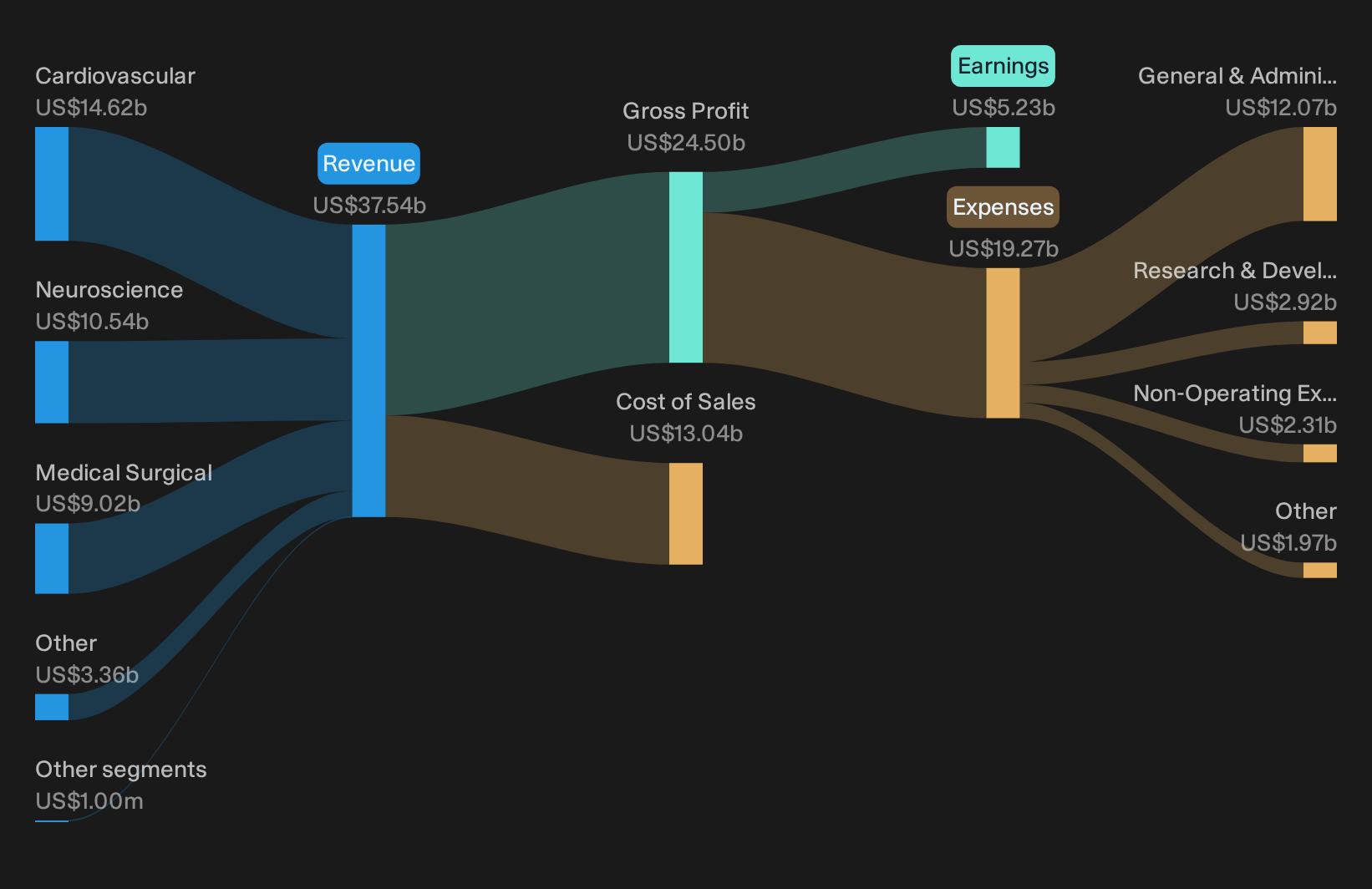
Medtronic develops therapies across cardiovascular, neuroscience and medical surgical portfolios, with US$14.6b from Cardiovascular, US$10.5b from Neuroscience, US$9b from Medical Surgical and US$3.4b from Other activities, which together support its large cap US$110.6b valuation.
"The separation of the MiniMed diabetes business, which carries structurally lower margins and higher R&D intensity, together with SKU rationalization and design to cost programs, is expected to move Medtronic toward higher gross and operating margins and support faster EPS growth once the spin off is fully reflected in reported results."
What matters most for Medtronic now is how one quiet shift in where profits come from ultimately shapes the staying power of its dividend story.
That profit mix is only the starting point, and the full narrative for Medtronic shows how Medtronic’s portfolio reshaping could accelerate earnings power and reframe its dividend profile.
Seeking Fresh Alternatives Before They Fly
Fresh ideas move first. By the time momentum hits headlines, the best entry points can be gone. Scan focused stock shortlists while it matters and get in early.
- Spot income payers with staying power before yields get crowded by running through the 7 dividend fortresses curated from companies built around substantial cash distributions.
- Track where capital spending on reactors, turbines and grid build outs is quietly building momentum using the 19 nuclear energy infrastructure stocks packed with infrastructure focused plays.
- Catch automation leaders before orders start flying through earnings reports by working through the 90 robotics and automation stocks built around robotics and factory digitization specialists.
This article by Simply Wall St is general in nature. We provide commentary based on historical data and analyst forecasts only using an unbiased methodology and our articles are not intended to be financial advice. It does not constitute a recommendation to buy or sell any stock, and does not take account of your objectives, or your financial situation. We aim to bring you long-term focused analysis driven by fundamental data. Note that our analysis may not factor in the latest price-sensitive company announcements or qualitative material. Simply Wall St has no position in any stocks mentioned.
Have feedback on this article? Concerned about the content? Get in touch with us directly. Alternatively, email editorial-team@simplywallst.com