


2 Massive Turnaround Stocks: Which Is a Brilliant Buy and Which to Avoid?
Key Points
Lucid's management is focused on improving cash, customer experience, and company culture.
Lucid has identified $1.4 billion in cash savings in 2026.
Stellantis has a $70 billion turnaround plan focused on highly scalable and profitable brands, as well as tackling affordability in the U.S. market.
"The best thing that happens to us is when a great company gets into temporary trouble... We want to buy them when they're on the operating table." Warren Buffett said in a 1999 interview with Businessweek.
Buffett, of course, turned out to be pretty good at the whole investing thing, but he brings up a great point. There are few better developments than investors finding an oversold, beaten-down stock with clear upside as it fixes flaws in its business. However, there's also a fallacy in believing that all companies will bounce back, which is assuredly untrue, and investors take on that exact risk. Here are two of the biggest potential turnaround stories in the automotive industry that could reward investors over the next five years. Increasingly, Stellantis (NYSE: STLA) looks like a brilliant play, while Lucid (NASDAQ: LCID) has failed to produce a plan that inspires confidence.
Missed AI’s "Act 1"? Act 2 Could Be 15x Bigger. Most investors think they missed the AI boat because they didn't buy Nvidia in 2005. But according to our analysts, we’re only at the end of "Act 1"—the R&D phase. "Act 2" is the global rollout. Continue »
Three critical C's
"Lucid has leading technology, compelling products, and deeply committed people, but potential is not performance," said Silvio Napoli, CEO of Lucid, in a statement. "We are going back to basics, with a clear focus on cash, customers, and culture. We are focused on delivering on our four must-win priorities, including our $1.4 billion cash flow improvement plan and the advancement of our Robotaxi, AMP-2, and Midsize programs, which will establish a strong foundation for Lucid's next chapter."
With the backing of the board, and after meeting with restructuring consultant AlixPartners, Lucid is embarking on efforts to improve its executive structure and customer experience, and to turn its advanced electric vehicle (EV) technology and software into meaningful value for shareholders.
Digging deeper, Lucid is already trying to improve its ownership experience to match the advanced performance of its vehicles and is targeting a one-third reduction in wait times this year. The EV maker is also applying greater focus on spending decisions and capital allocation. It has identified $1.4 billion in cash reductions this year, but is being cautious about hindering important programs that drive its long-term competitiveness.
While Lucid has the beginnings of a turnaround, the company is still rapidly burning through cash, and because of its continuous need to raise capital, early shareholders have been significantly diluted compared to rival Rivian (NASDAQ: RIVN). Note that Lucid's shares outstanding dropped considerably only due to a 1-for-10 reverse stock split.

LCID Shares Outstanding (Quarterly) data by YCharts
Lucid has also delayed its upcoming midsize platform, which was supposed to launch the Cosmos vehicle later this year, and now it won't hit the road until late 2027 at the earliest. Lucid could prove a lucrative turnaround story, but for investors, the current risks outweigh the upside.
Put your money where your mouth is
Stellantis certainly put its money where its mouth was when it announced to the world a turnaround strategy, creatively spelled "FaSTLAne 2030", that would cost the company a staggering $70 billion commitment and investment. One of the biggest takeaways from all the moving parts is that Stellantis is finally focusing the majority of its investment on four global brands that can more effectively scale and deliver higher-margin sales. Two of those brands are none other than Jeep and Ram, which are its two most important brands in its core profit engine, North America.
More specifically, Stellantis plans to expand beyond its historical focus on full-size trucks by introducing a midsize Ram pickup, a compact pickup, a new large SUV named the Ramcharger, and even high-performance SRT variants. Jeep's Belvidere Assembly Plant in Illinois is receiving a $600 million capital injection to reopen and ramp production of the next-generation Jeep Compass and restart manufacturing of the Jeep Cherokee.
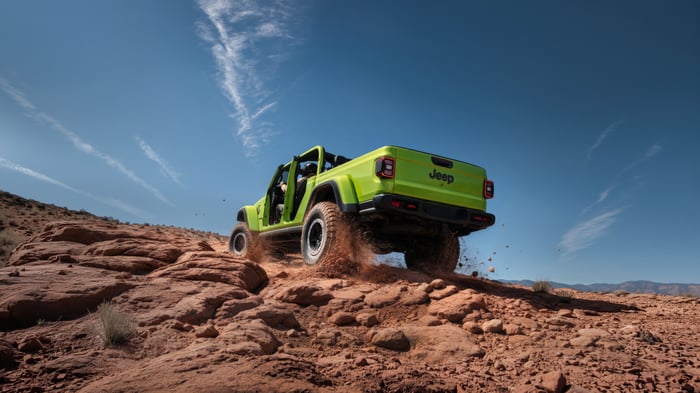
Image source: Stellantis.
Jeep and Ram will drive high interest as well as higher margins, but just as important to Stellantis' success in its key market is found at the other side of the spectrum: affordability. With average prices of new cars hovering around $50,000, many consumers feel priced out of the market. That pent-up demand for affordable options is something Stellantis strategically targeted by planning to introduce nine affordable new vehicle models priced under $40,000, with two starting below $30,000.
Brilliant or bust?
Ultimately, while both Lucid and Stellantis have been heavily sold off and certainly have upside potential if their respective turnarounds gain traction, both have plenty of problems to address. That said, Stellantis has more of an identity than it has in years, is investing tens of billions in capital in the most important brands in its most profitable markets, and is tackling the affordability problem in the U.S. market with a long list of affordable options. The strategy will help support margins through Jeep and Ram, and improve delivery numbers while helping fill unused production capacity in its factories.
On the flip side, Lucid is burning through cash with no slowdown in sight; it continues to experience bumpy launches, costly delays, and recalls, all while failing to protect shareholders from significant dilution. Right now, Stellantis seems more like a brilliant rebound option than Lucid, and the latter should be considered with caution.
Daniel Miller has no position in any of the stocks mentioned. The Motley Fool recommends Stellantis. The Motley Fool has a disclosure policy.