


Long-Term Agreements Don’t Protect the Memory Makers the Way You Think
Memory stocks have rarely looked this secure. Samsung, SK hynix (SKHY), and Micron (MU) have already secured major customer commitments for HBM and DRAM, with supply agreements stretching into 2027. Several cloud giants have also signed long-term agreements (LTAs) to lock in supply. To many investors, that looks like protection against the next downturn. I’m not so sure.
Long-Term Agreements Don’t Solve the Demand Problem
A long-term agreement may sound like a safe deal, but even this doesn’t guarantee that a buyer takes the chips. It also can't guarantee those chips actually get used. Supply chain experts call this the bullwhip effect. Each company in the chain orders a little extra to be safe. By the time those orders reach the chipmaker, a small rise in real demand looks like a gigantic one. When demand slows, that extra sits unused, and buyers stop ordering until it clears. And that's when the chipmaker takes the hit, regardless of what was signed. Memory is especially exposed, since new factories take around two years to build. Capacity added today is a bet on demand two to three years out. The industry has been here before. Memory makers expanded through the 2021 and 2022 shortage, but then demand cooled. Micron posted a loss in fiscal 2023.
The Warning Signs Are Starting to Show
TrendForce said in July that server CPU shortages slowed assembly at U.S. cloud providers, leaving DRAM inventory piling up. Buyers with enough supply are still stocking up ahead of an expected 2027 shortage. Some cloud providers, like Alphabet (GOOG) (GOOGL), now have negative free cash flow from record spending. TrendForce also expects NAND supply to overtake demand in the second half of 2027, which is why I'd watch SanDisk (SNDK) most closely. Micron still carries some of that risk. As I covered earlier, though, SanDisk sells only NAND, while Micron’s DRAM and HBM mix gives it more cushion.
Micron’s earnings result on Sept. 30 also gives some useful context to what’s happening to the memory trade. Despite comfortably beating expectations, the stock showed no excitement in post-market trading. The market is wary of the warning signs.
About DRAM ETF
Roundhill Memory ETF (DRAM) is an exchange-traded fund launched and managed by Roundhill Financial Inc. It invests in public equity markets, stocks of companies operating across Information Technology sectors, and invests in growth and value stocks of companies of diversified market capitalization. It is the world’s first pure-play exchange-traded fund dedicated exclusively to computer memory and data storage chips. Roundhill Memory ETF was formed in March 2026 and is domiciled in the United States.
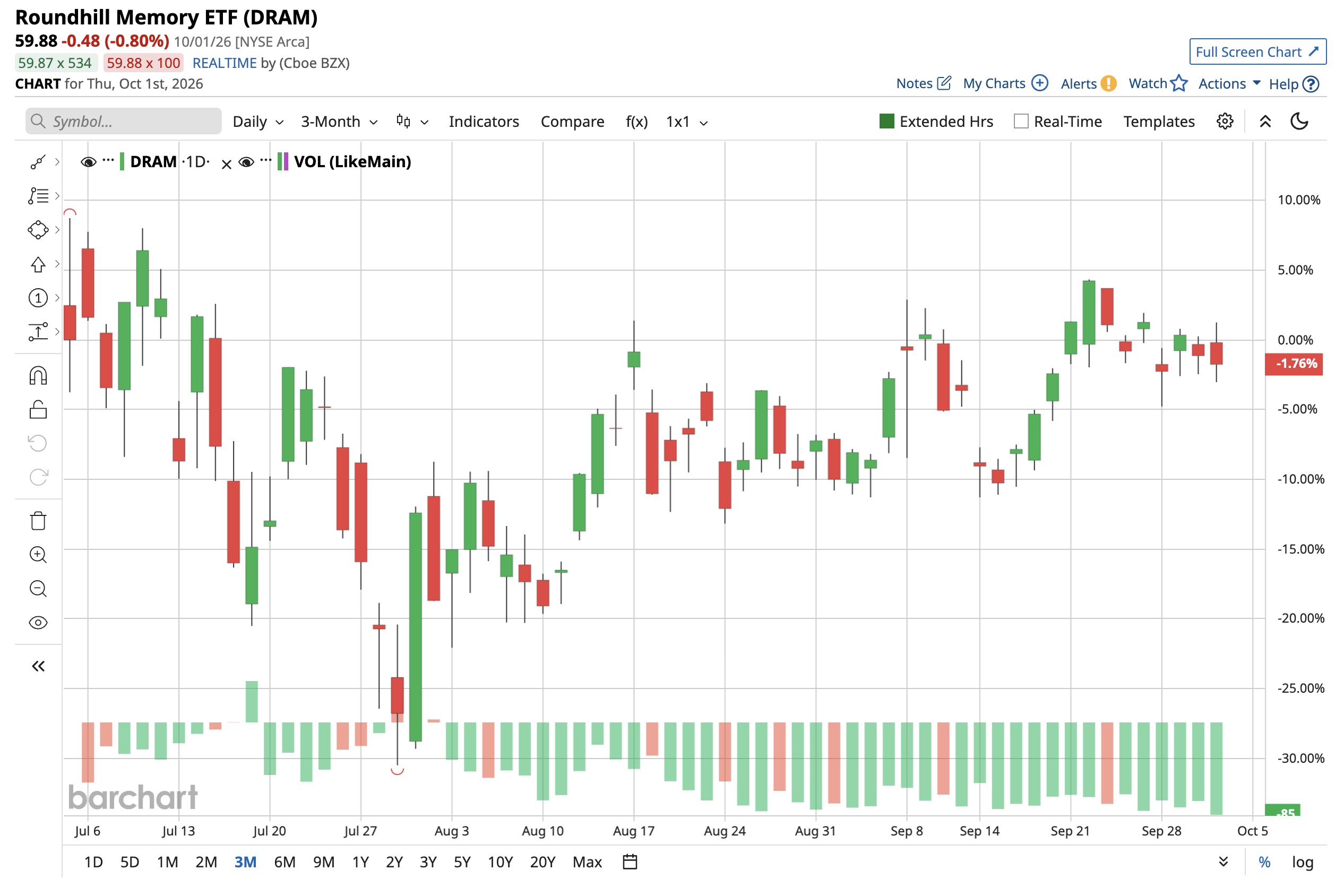
The DRAM ETF is trading at the same level it was trading at in late May this year. After a blockbuster debut in April, the ETF tripled, but sideways trading since then goes to show how the memory trade was already over by the time it became mainstream. Since the end of May, the S&P 500’s ($SPX) 1% return has comfortably outperformed the ETF. From its June highs, the fund is down 24%.
What Are Analysts Saying About Memory Stocks?
Based on 40 Wall Street analysts covering MU stock, it holds a consensus “Strong Buy” rating. The mean price target of $1,486.33 reflects 36% upside from the current levels. The high price target of $2000 implies an impressive 83% upside from the current share price. SNDK stock is being covered by 25 Wall Street analysts and also holds a consensus “Strong Buy” rating. The stock has a mean price target of $2,154.21, which reflects 23% upside from current levels.
Despite Wall Street’s optimism, investors remain concerned about the sustainability of the current memory upcycle. Both MU and SNDK have benefited from surging AI-related demand. However, their strong rallies have raised expectations, leaving the stocks vulnerable if pricing momentum slows. At current valuations, the market is pricing in sustained earnings at historically high levels for the next five to six years. This may not be possible, as the memory bottleneck will resolve itself either through increased manufacturing capacity or technological breakthroughs. This explains the extremely low earnings multiple these stocks trade at.
On the date of publication, Jabran Kundi did not have (either directly or indirectly) positions in any of the securities mentioned in this article. All information and data in this article is solely for informational purposes. For more information please view the Barchart Disclosure Policy here.