


US stock outlook | Futures of the three major stock indexes soared, and non-agricultural data hit the storage sector hard. Toshiba's HDD expansion plan hit the storage sector hard
Pre-market market trends
1. Before the US stock market on October 2 (Friday), futures on the three major US stock indexes rose sharply. As of press release, Dow futures were up 0.46%, S&P 500 futures were up 0.46%, and NASDAQ futures were up 0.58%.

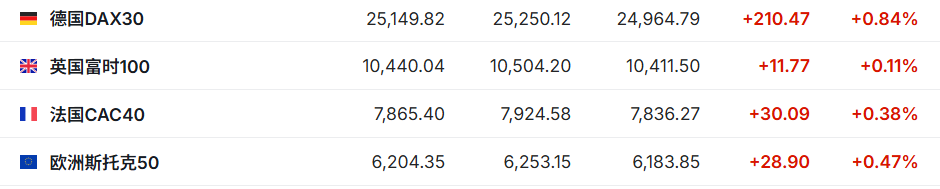
2. As of press release, the German DAX index rose 0.84%, the UK FTSE 100 index rose 0.11%, the French CAC40 index rose 0.38%, and the European Stoxx 50 index rose 0.47%.
3. As of press release, WTI crude oil fell 3.09% to $90.00/barrel. Brent crude oil fell 2.28% to $99.98 per barrel.

Market news
Non-agricultural agriculture hits the ball! The number of new non-farm payrolls dropped to 90,000 in September: Tonight's real “flashpoint” for non-farm workers, or whether the August data will be drastically revised. The market expects 90,000 new jobs, down from 162,000 at the beginning of August. The unemployment rate remains 4.1%, and the average hourly wage increase is 0.3% month-on-month; among them, the abnormal performance and potential downgrade of seasonal adjustments in August are important variables in interpreting this report: the previous month's revisions and strong new jobs in September may occur at the same time. Therefore, the two-month cumulative increase and revised trend reflect employment momentum better than the single headline figure. The number of people applying for and continuing to claim unemployment benefits, ADP, and the overall support for the labor market remains resilient, but consumers' perception of employment opportunities continues to weaken, leaving room for surprises in both directions. Meanwhile, moderate inflation data and the cautious statements of Federal Reserve officials have reduced the probability of an interest rate hike in October from about 70% at the beginning of the week to about 25% on Thursday, and Goldman Sachs has also postponed expectations for the next rate hike until December.
After several weeks of continuous sell-off, the US Treasury bond market finally showed a clear rebound, but traders did not change their basic judgment on subsequent interest rate hikes as a result. As 10-year US bond yields fall from a 24-year high, market attention turned to the September US non-farm payrolls report released on Friday evening Beijing time: if employment only moderately cools down, it may be difficult for the bond market to continue to rebound; only employment and wage data that are significantly weaker than expected may force investors to withdraw their interest rate hike bets on a large scale. Bond traders don't need to see employment continue to slow, but rather to see weak data that could shake the Federal Reserve's path of austerity. The Goldman Sachs model estimates that CTA holds about US$390 billion in global bond shorts. The size of US 10-year and 30-year treasury bonds is close to 99% and 100% of their historical maximums, respectively, while the implied fluctuation of the S&P 500 dropped to about 0.67% to 0.70% on the same day. If employment cools down moderately and wage pressure is controlled, falling interest rates are expected to ease the pressure on stock valuations; if the data is clearly weak or the previous month is drastically lowered, it may push expectations of interest rate hikes to decline further and trigger shortfalls in trend strategies and amplify the rise in bonds; if employment and wages exceed expectations, interest rate hikes may be raised again, causing risk assets to once again face the impact of “good economic news and bad valuation news.” Another major potential “flashpoint” of this report can be described as the revaluation of employment trends resonating with overcrowded positions in the bond market.
Macron plans to call the G7 to stabilize oil prices and release reserve expectations to push crude oil back down. French President Emmanuel Macron spoke with US and Canadian leaders on October 2, local time, and plans to convene a G7 leaders' meeting as soon as possible to help curb the continued rise in fuel prices and focus on easing the global supply of refined oil products. According to a statement from the French presidential office, France, which holds the rotating presidency of the G7 this year, is actively cooperating with the International Energy Agency (IEA) to coordinate measures aimed at easing price pressure and guaranteeing the supply of crude oil and refined oil products. Macron stressed that G7 countries “act together without enforcing restrictions on energy exports, which is in the common interest.” Overall coordination efforts at the European level are also progressing. European countries have been holding urgent discussions to discuss how to deal with Washington's pressure to release strategic fuel reserves and avoid a possible US ban on energy exports. Faced with global market turmoil caused by geopolitical wars, Europe is using emergency oil reserves much slower than the US, so the region still has considerable reserves to release.
Iran has been revealed to be planning the “worst”: if the US resumes its attacks, it will never just do a symbolic counterattack. According to media reports, several senior Iranian officials and people familiar with the matter said that Tehran believes that if the US launches another large-scale attack, Iran cannot respond only with symbolic actions, but the relevant military plan is still under review, and no final decision has yet been made. Since Iranian President Pezzahizyan returned to Tehran from New York last week, senior Iranian officials and military commanders have been discussing the scope and timing of America's response when it launches another attack. Three senior Iranian officials and a person familiar with related discussions said that potential targets may no longer be limited to military assets directly related to the US, but may also extend to countries supporting US military operations, and even to locations outside the Middle East.
The Federal Reserve's “No. 2 and No. 3 figures” released pigeons one after another to suppress hawks' voices, and the Federal Reserve calmed the market's aggressive interest rate hike expectations in October. Federal Reserve Vice Chairman Philip Jefferson (Philip Jefferson) delivered a speech on Thursday. The wording is highly consistent with the statement made by New York Federal Reserve Chairman John Williams (John Williams) earlier this week. Both emphasized that more time is needed to evaluate the data before deciding on the next policy action. Since “Person No. 2” Jefferson and “Person No. 3” Williams are part of the “troika” of the unofficial core leadership group supporting Chairman Walsh, the coordinated voices of the two were interpreted by the market as an expression of the collective will of senior Federal Reserve officials, rather than the words of a family of individual officials. Affected by this, the federal funds futures market's pricing probability of an interest rate hike at the October FOMC meeting plummeted from about 70% to about 25% at the beginning of this week, and the focus of market expectations has clearly shifted to December. Although hawkish officials such as Dallas Federal Reserve Chairman Lorie Logan (Lorie Logan) and Minneapolis Federal Reserve Chairman Neel Kashkari (Neel Kashkari) also delivered speeches on Thursday, insisting that inflation is still too high and needs to be further tightened, their voices clearly faded in the face of Jefferson's dovish statement.
Individual stock news
Toshiba spent 60 billion yen to expand HDD production and plans to double production capacity. Storage themes generally weakened before the market, and Seagate fell more than 13% before the market. As of press release, the stock price of US HDD storage giant Seagate plummeted by more than 13% before the US stock market, and the market began to re-evaluate the supply and demand pattern of the HDD hard drive storage industry in the context of AI data center expansion. On October 2, according to Japanese media reports, Toshiba plans to invest about 60 billion yen to expand the HDD factory in the Philippines, aiming to double the hard drive production capacity for AI data centers by the 2027 fiscal year. For US HDD giants Seagate and Western Digital, the sharp expansion of production by competitors means that although AI data center demand for high-capacity HDDs is still growing exponentially, industry supply will also increase at the same time. The current tight supply and demand relationship may gradually ease around the end of this year. As a result, the market is worried that Seagate's future market share and bargaining power will be pressured. In recent years, AI data center expansion has continued to drive demand for high-capacity HDDs. Compared to SSDs that cost about 20 times that of HDDs, HDDs are still an important choice for large-scale data storage due to their cost advantages. Seagate said in January of this year that all of its near-line HDD production capacity was sold out in 2026, indicating that supply in the industry is still tight. Toshiba's current production expansion also sends a clear signal: demand for HDDs continues to grow due to AI, but manufacturers have begun to compete for the incremental market by expanding production capacity and increasing single-drive capacity. As Toshiba and Western Digital increase one after another, the market focus is shifting from the increase in demand itself to whether additional supply will change the current tight balance in the HDD industry.
A well-known Apple whistleblower revealed Apple's next “big killer”: the first Siri AI home hub and touchscreen MacBook Pro will be launched as soon as October. Apple product whistleblower Mark Gurman (Mark Gurman), who has revealed the details of iPhone updates in advance several times, broke several blockbuster exclusives: the touchscreen MacBook Pro was unveiled as soon as October, the “global warehouse is ready” in Apple's smart home hub, doubts about the value of the iPhone 18 Pro upgrade, and Apple is replacing traditional media reports with influencer marketing. Gulman revealed that Apple's internal AI smart home hub (Smart Home Hub), codenamed “J490,” will be the key to breaking the game. “This is Apple's next 'Big Thing' (Big Thing), and it's only been a few weeks until release.” Gurman emphasized. He pointed out that Apple's past experiments in the smart home field (such as iPod Hi-Fi and early HomePods) were “semi-finished products,” but the J490 will completely change this status quo. The device is described as an “Amazon Echo Show made by Apple in the Apple Universe” and is equipped with a square touch screen of about 6 inches. Its biggest selling point is the brand new operating system. “What would Siri AI look like if it had an operating system rather than just an app or interface on a phone? That's the answer.” Gurman quoted the original saying that the system combines the features of Watch OS and standby mode, and that “voice will be the main interface interaction element.”
The AVGO.US (AVGO.US) syndicate has begun to raise 60 billion US dollars to deliver chip “ammunition” to Anthropic. According to people familiar with the matter, Broadcom's (AVGO.US) Wall Street syndicate is starting to raise 60 billion US dollars in new financing to purchase artificial intelligence (AI) chips. The beneficiaries will include Anthropic PBC and others. People familiar with the matter said that banks participating in this huge debt scheme are preparing to issue a syndicated distribution letter for a Class A senior guarantee loan of 42 billion US dollars. As the deal has yet to be announced, these individuals requested anonymity. According to people familiar with the matter, Blackstone Group (BX.US) is leading a $18 billion Class B subprime debt, promising to invest 9 billion US dollars from many of its funds, and plans to distribute the remaining portion in syndicated distribution. According to reports, this financing has been in preparation for weeks and is receiving close attention from Wall Street and Silicon Valley professionals to determine whether investors are still keen to support AI infrastructure construction while data center construction is facing public opposition. Broadcom wants to sell more chips and other data center equipment to challenge Nvidia (NVDA.US); while AI companies such as Anthropic need to continue to expand their computing power. People familiar with the matter said in August that the potential deal would help companies like Anthropic acquire chips and other critical AI infrastructure.
The Google (GOOGL.US) advertising technology monopoly compensation case was approved to proceed: publishers can claim more than US$3.2 billion in total. A federal judge in New York ruled, “USA Today Co.” , “Daily Mail General and Trust Plc” (Daily Mail General and Trust Plc), and a collective of large publishers can claim more than $3.2 billion for damage caused by Alphabet (GOOGL.US)'s monopoly on the advertising technology market. In an opinion on Wednesday evening local time, Manhattan-based US District Judge P. Kevin Castel (P. Kevin Castel) said he would allow Google to go to the jury trial on how actions related to its advertising trading platform AdX harmed major publishers. He ruled that a collective of about 5,000 publishers could claim approximately $1.7 billion from Google, and dismissed the company's request to challenge the damages calculation. He determined that “USA Today” and “Daily Mail”, which are suing separately, will be allowed to claim approximately $900 million and $600 million, respectively. Google said in a statement that the ruling also rejected claims made by some publishers using different advertising purchasing tools, and that the company would “defend the rest in court.”
Rumor has it that Anthropic has scheduled pre-listing Investor Day on October 14, aiming for November listing. According to people familiar with the matter, Anthropic PBC is scheduled to meet with potential investors on October 14, local time, to prepare for its initial public offering (IPO). Even in the face of scrutiny surrounding artificial intelligence security, the company is still advancing a potentially heavyweight listing plan. People familiar with the matter said that invitations for this event have just been sent out recently. At that time, a select group of institutional investors will have the opportunity to ask questions to company executives. One of the sources said the event will take place at the company's headquarters in San Francisco. This schedule will allow the Claude developer to hopefully launch in November. According to previous reports, Anthropic is likely to begin an official promotion for the IPO as early as the week of November 9, so trading is expected to begin before Thanksgiving. People familiar with the matter warned that the details of the IPO may still change, and they requested anonymity because the relevant information has not yet been disclosed. An Anthropic spokesperson declined to comment. People familiar with the matter said earlier that investors think Anthropic's reasonable valuation is between $1.8 trillion and $2 trillion. The company anticipates that the size of its IPO will match or surpass that of SpaceX.
Key economic data and event forecasts
20:30 Beijing time: US unemployment rate in September, US non-farm payrolls after September seasonal adjustment (10,000 people)
22:00 Beijing time: Monthly rate of US factory orders in August, 2026 FOMC voting committee, Dallas Federal Reserve Chairman Logan delivered a welcome speech at the 5th “Macroeconomic Impact of Immigration Seminar.
The next day at 01:00 Beijing time: Total number of oil drills in the US for the week from October 2 (port)