


Is Connected Hospital Report Altering The Investment Case For Baxter International (BAX)?
- Baxter International released its 2026 Connected Hospital Report, outlining how U.S. hospitals use a four stage technology maturity framework to pursue workflow automation, operational efficiency, and data integration.
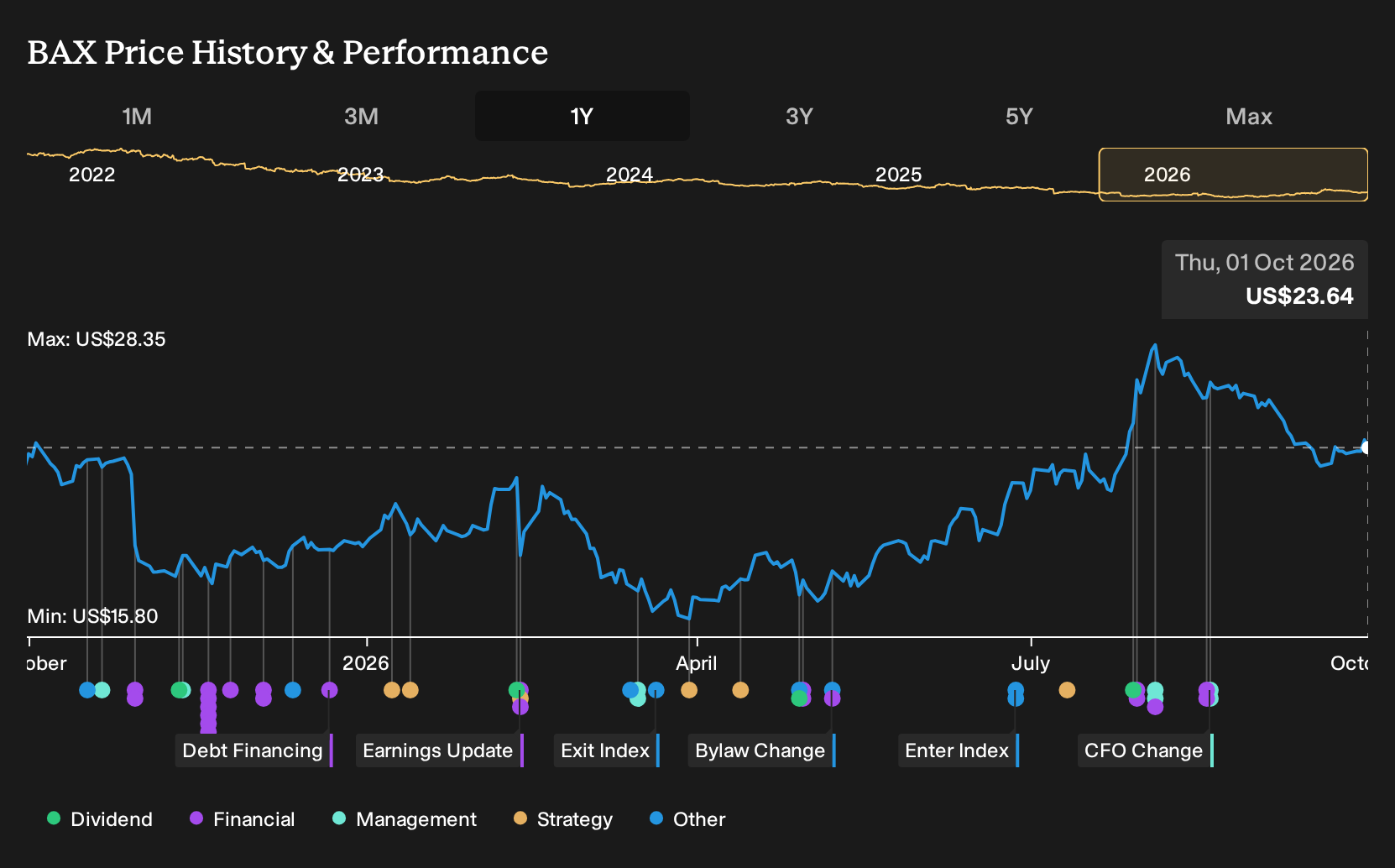
- The report highlights Baxter International’s push into connected care technology at a time when the business faces declining earnings, negative returns on capital, and pressure to justify further product investment.
- We will now look at how Baxter International's Connected Hospital Report focus on workflow automation could influence the broader investment narrative.
Scan beyond Baxter International and compare it with a curated group of hospital and medtech peers pushing hard into workflow automation and connected care via the 35 healthcare AI stocks.
Baxter International Investment Narrative Recap
To stay invested in Baxter International, you need to believe the turnaround in a complex, low margin hospital hardware and pharma mix can eventually translate into cleaner earnings. The big swing factor is whether automation and connected care efforts actually tighten execution while the core consumables and infusion platforms return to steadier, low single digit type demand patterns.
Right now the key near term catalyst is operational follow through. You want to see improving product economics and better use of capital after a stretch of declining earnings and negative returns. The main risk remains operational drag from quality actions, supply constraints and tariff headwinds that keep margins under pressure even if revenue holds up.
The 2026 Connected Hospital Report is the clearest recent signal of where Baxter International is trying to lean. Workflow automation and data integration sit in the same bucket as its Connex 360, Dynamo, IQX and PeerVue platforms, which management already frames as higher value areas within Healthcare Systems & Technologies.
If hospitals genuinely prioritize the four stage maturity framework Baxter just published, that can support demand for connected care offerings and smart devices over time. Execution still matters most. The firm needs to balance any fresh investment in these platforms with disciplined cost control, resolution of infusion system field actions and progress on deleveraging so that reported losses do not deepen further.
Baxter International's current reports show revenue is assumed to grow by 2.8% each year, with earnings today at a loss of $968.0 million and consensus earnings forecasts of $788.3 million by 2029. This implies an earnings swing of about $1.76 billion into profit and points to total revenues of $12.4 billion in that same year.
Discover why Baxter International's fair value indicates a 22% potential upside to its current price that may not last much longer.
Exploring Other Perspectives
Some of the most optimistic analysts frame Baxter International very differently. They lean on a connected care catalyst and argue that if execution improves, earnings could reach about US$1.5b on roughly US$12.5b of revenue by 2029. That compares with bearish views closer to US$680m, which is a wide gap. These opinions were all formed before the Connected Hospital Report, so the release could easily shift how both camps think about Baxter’s runway.
Explore 4 other Baxter International fair value estimates, including one that suggests as much as 56% upside from the current price.
The Verdict Is Yours
Disagree with existing narratives? Extraordinary investment returns rarely come from following the herd, so consider doing your own analysis.
- A great starting point for your Baxter International research is our analysis highlighting 4 key rewards and 1 important warning sign that could impact your investment decision.
- See our latest analysis for Baxter International. The report includes a comprehensive fundamental analysis summarized in a single visual, the Snowflake, making it easy to evaluate Baxter International's overall financial health at a glance.
Looking For More Investment Ideas Beyond Baxter International?
If the Baxter International story has you thinking about where connected care and hospital technology might go next, it can help to widen the lens and compare it with other companies that fit different risk and income profiles.
- For investors who want potential upside but still care about balance sheet strength, you can use a list of solid balance sheet and fundamentals (25 results) to see which businesses pair financial resilience with reasonable fundamentals.
- If steadier cash returns matter more to you than rapid expansion, you can scan a curated set of income ideas through the 7 dividend fortresses and focus on companies with higher yields and more mature payout profiles.
- When you are hunting for less crowded opportunities with quality metrics that still look attractive, you can broaden your watchlist with a 19 high quality undiscovered gems that surfaces underfollowed stocks with solid underlying numbers.
This article by Simply Wall St is general in nature. We provide commentary based on historical data and analyst forecasts only using an unbiased methodology and our articles are not intended to be financial advice. It does not constitute a recommendation to buy or sell any stock, and does not take account of your objectives, or your financial situation. We aim to bring you long-term focused analysis driven by fundamental data. Note that our analysis may not factor in the latest price-sensitive company announcements or qualitative material. Simply Wall St has no position in any stocks mentioned.
Have feedback on this article? Concerned about the content? Get in touch with us directly. Alternatively, email editorial-team@simplywallst.com