


Has the AI frenzy ushered in a “financing death line” test? Well-known Wall Street strategists warn: US dollar and US bond yields have not peaked, and risk appetite is difficult to reverse
The Zhitong Finance App learned that a team led by Bank of America senior strategist Michael Hartnett (Michael Hartnett), who has the title of “Wall Street's Most Accurate Strategist,” released a research report saying that until the dollar rally showed clear signs of peaking, and the continuous surge driven by energy inflation, yields on US Treasury bonds of 10 years or more fell from historically high ranges, and it was still difficult for risk assets to escape the pressure of deleveraging and selling. According to reports, the Bloomberg US dollar index rebounded about 3% from its September low, reflecting investors reducing their holdings of risky assets such as stocks, cryptocurrencies, etc.; at the same time, the yield on 10-year US Treasury bonds, the “anchor of global asset pricing,” once hit a 24-year high (a record high since 2002) on October 1, and only then declined somewhat.
Therefore, Bank of America strategist Hartnett, while remaining cautious, advised investors to start buying bonds that have been snubbed by the market, and put forward a policy-level support expectation: if yields continue to rise and threaten the AI investment boom before the November midterm elections, the US government may step up treasury bond repurchases. He is particularly concerned about whether the decline in bank stocks will fully spread to small and medium capitalization stocks in the stock market, because this will mean that economists' and investors' growth optimism about a “soft landing” in the US economy will be seriously shaken, and huge selling pressure may eventually be transmitted to technology stocks.
According to the strategist team led by Hartnett, the investment boom in the AI computing power industry chain still needs to be tested by the double pressure of the US dollar and the long-term yield curve. Whether the strong demand for AI computing power resources from the blowout expansion can be transformed into an increase in asset prices also depends on whether financing conditions and valuation discount pressure can be mitigated simultaneously.
The energy inflation situation in the Middle East, which has led to a recent surge in US bond yields of 10 years or more, shows a pattern of “diplomatic and military pressure goes hand in hand, oil prices have pulled back, but the geopolitical war premium is still there.” Qatar continues to mediate the “seven-day mutual trust plan” between the US and Iran. The two sides disagree on the order of actions; the US is mobilizing more military forces to the Middle East, and Iran is also preparing to deal with large-scale attacks that the US may resume.
As of 16:40 Beijing time on October 2, the international crude oil pricing benchmark — the latest Brent crude oil futures price was 99.48 US dollars/barrel, down 2.77% on the same day, and the WTI crude oil futures price was 89.52 US dollars/barrel, down 3.61%; based on the settlement prices of 72.48 US dollars and 67.02 US dollars on February 27, the last trading day before the war broke out on February 28, the two benchmarks still rose by about 37.3% and 33.6%, respectively. This comparison uses recent monthly futures price benchmarks at various points, which is enough to show that after the short-term decline in oil prices, energy prices are still significantly higher than before the war.
Bank of America Senior Strategist Michael Hartnett: Risk aversion may continue until the US dollar index peaks
The strategy team, led by Bank of America's senior strategist Michael Hartnett, said investors will continue to avoid riskier trades until the recent sharp rise in the dollar shows signs of peaking.
In addition to waiting for key signs that the dollar is peaking, the strategist-led team also said in a recent report that market unease and anxious sell-off may continue until rising bond yields fall back from their highest level in more than 20 years. He recommended “buying assets that have been rejected by the market — that is, assets that have recently experienced major sell-offs,” and began to tend to add to the investment portfolio some long-term insurance US debt asset allocations that have continued to be sold recently.
As investors in financial markets exit riskier asset positions and begin to re-accumulate cash buffers, the Bloomberg Dollar Index has risen 3% from its September low. At the same time, bond yields have also risen, driven by inflationary pressure brought about by the Iran war, market expectations for further tightening monetary policy in the future, and strong growth in corporate profits.
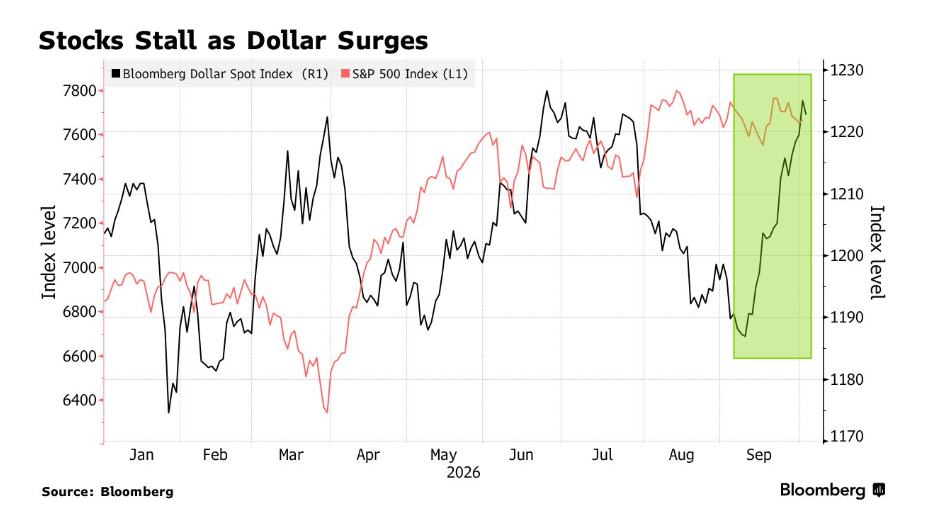
As shown in the chart above, the US dollar index and US bond yields have risen sharply recently, and the stock market's gains have stagnated.
Hartnett said that although recent price trends indicate that the market is reducing leverage and exposure to risky assets such as stocks and cryptocurrencies, the US government's more aggressive treasury bond repurchases may provide downward support to the market — especially when rising yields may threaten the AI investment boom before the US midterm elections in November.
Hartnett said that if small and medium capitalization stocks also join the sharp decline in bank stocks, downside risks will become even more worrying. He stressed that this trend will clearly indicate that market optimism about strong economic growth has peaked and ultimately dragged down technology stocks.
From energy transportation bottlenecks to the “financing killing line” of the AI frenzy
Bank of America's senior strategist Michael Hartnett recently made a series of cautious opinions that have always revolved around capital, positions, and bond markets. On September 11, his team pointed out that the net outflow of US equity funds in the previous three weeks was 14.2 billion US dollars, and the average weekly inflow of global equity funds also fell from 52 billion US dollars in July to 7 billion US dollars.
According to a subsequent September fund manager survey prepared by Bank of America, although cash allocation rose to 3.9%, it was still at a low level where he determined would trigger a reverse sale signal for risky assets, and the disorderly rise in bond yields became the last risk that respondents were most concerned about; on September 25, he was also wary that the US bond volatility index MOVE rose 33% in two days. This latest line of opinion on Hartnett means that even if strong profits and economic growth driven by AI computing power themes remain resilient, cash buffers are weak, bond volatility rises, US bond yields repeatedly hit phased highs, and the US dollar strengthens, it may reduce investors' ability to continue taking risks.
Energy transportation is being repaired, but there is still a long way to go back to normal transportation costs. Saudi Arabia's east-west pipeline has been restarted, and the port of Yanbu has resumed shipping, increasing export channels around the Strait of Hormuz; its 7 million b/d is the design transportation capacity, and the actual transportation valuation quoted by Reuters on September 29 is still around 2 million to 2.65 million b/d.
Although statistics show that traffic volume in Hormuz has rebounded, reaching 19-21 batches of LNG shipments in September, three tankers were still attacked by unknown bullets on September 29; the Strait of Mandé is also in need of escort. The French military said on October 1 that it had escorted about 10 merchant ships through the past week. The differences in energy routes among the major oil producers in the Persian Gulf are particularly critical: Yanbu can go north to Europe via the Suez Canal, and south to Asia usually still have to go through the Mander Strait. Insurance, escort, and detour costs continue to limit transportation efficiency. The amount of supply restored, and how low the energy can be delivered, are two variables that the market needs to price at the same time.
The “financing cutoff line” of the AI frenzy. Against the backdrop of the sharp rise in 10-year US bond yields due to energy inflation to new highs in more than 20 years, safe-haven demand and risk appetite continues to be sluggish due to the surge in the US dollar index. As a result, the “financing cutoff line” of the AI investment frenzy seems to be getting closer — that is, as the “anchor of global asset pricing” 10-year US bond yields hit a new high since 2002, and the market is increasingly questioning the financing progress of AI capital expenses and AI infrastructure project returns. Whether the expected return on the project can continue to cover the rising cost of capital.
When the expected cash return for additional computing power projects after deducting expenses such as electricity, operation and maintenance, and equipment upgrades cannot cover cost indicators including financing costs, it is difficult to create economic value if it continues to expand. A single large-scale AI infrastructure project may start to collapse; it first restricts marginal projects with weak cash flow and unlocked financing.
The 10-year US Treasury is known as the “anchor of global asset pricing,” stemming from its benchmark position in the US dollar financing system and medium- to long-term cash flow valuation. The US Treasury bond market is large and active in trading, and the US dollar is widely used in international financing and reserves, so changes in yield have cross-market effects — US dollar corporate bonds usually refer to the yield of US bonds with similar maturity and compounded by credit spreads. Housing mortgage interest rates are affected by the pricing of treasury bonds and mortgage-backed securities, and stock and real estate valuations are highly sensitive to future cash flow discount rates. When this benchmark rises and profit and rent expectations do not improve at the same time, asset prices face downward pressure. The impact will also be transmitted overseas through US dollar financing costs, exchange rate hedging, and cross-border capital flows; different currencies, terms, and credit risks determine the extent to which specific assets are impacted.
Looking at data center projects, GPU servers, power access, and cooling facilities require upfront investment, while revenue from computing power services is recovered gradually; rising long-term risk-free interest rates and credit spreads will simultaneously raise financing costs and lower forward cash flow valuations. A stronger dollar will also increase debt repayment and equipment procurement burdens for some non-US borrowers. Therefore, strong demand for computing power can occur at the same time as tightening project financing conditions. The first thing tested is usually an expansion plan that relies on external financing and is far from being repaid. The policy support Hartnett is looking forward to is to ease this capital cost constraint: the Ministry of Finance has expanded the liquidity of long-term treasury bonds to support repurchases, but its official goal is to improve market liquidity, and further protecting AI investment is still his policy judgment. As far as investors' comprehensive strategies are concerned, the trend of the US dollar, the yield on US Treasury bonds of 10 years or more, and the market performance of banks and small to medium capitalization stocks are becoming important signals to test whether the AI computing power super bull market can continue to spread to the wider stock market sector.